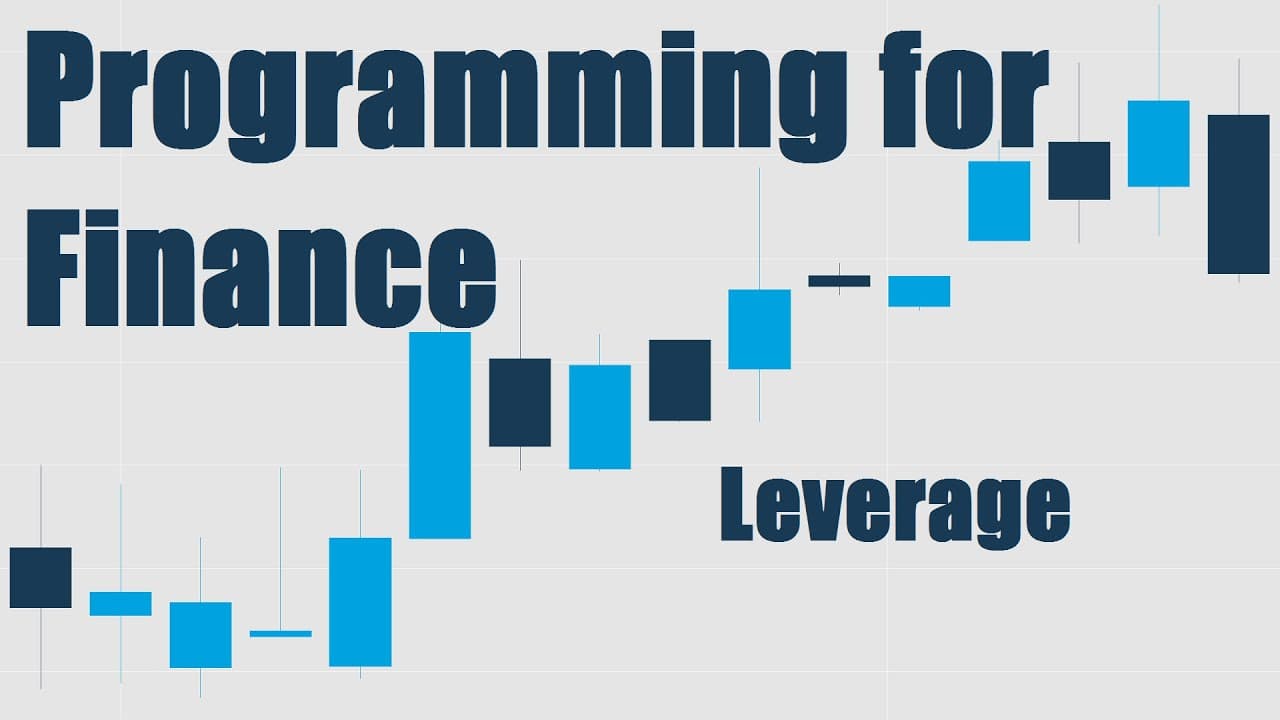
[See Description] Leverage - Python for Finance with Quantopian and Zipline 18
TL;DR
Leverage, or borrowing money to increase investment returns, can backfire and lead to significant losses if not used carefully.
Transcript
what is going on everyone welcome to another Python with finance tutorial video in this video what we're gonna be talking about is cocaine so people in the finance industry love to engage in it but it can end your career in a heartbeat if you're not careful buy cocaine I mean leverage so coming over here we've got this eighty six point four percent... Read More
Key Insights
- 🌸 Leveraging can initially boost investment returns, but it also significantly amplifies losses.
- ⌛ Different levels of leverage, such as one times, two times, or three times, have different impacts on investment performance.
- ✋ Leveraged ETFs can provide higher returns but also come with higher risks.
- 🥺 Applying leverage to a trading strategy does not necessarily lead to increased profits.
- ✳️ It is crucial to manage risk carefully when using leverage in investments.
- 🥺 Leverage can be addictive and lead to poor decision-making when things go wrong.
- 🍉 Leverage should not be used as a long-term investment strategy.
Install to Summarize YouTube Videos and Get Transcripts
Explore YouTube Video Summarizer or Get YouTube Transcript Extractor
Questions & Answers
Q: What is leverage in finance?
Leverage in finance refers to borrowing money to invest with the aim of increasing potential returns.
Q: Why do people use leverage in the finance industry?
People use leverage in the finance industry to amplify their potential profits and maximize their investment returns.
Q: How does leverage work?
Leverage involves signing up with a brokerage or institution that provides leverage, which is like a loan. They will loan you a certain multiple of the amount of funds you have, such as one times, two times, or three times.
Q: What are the risks of using leverage?
The main risk of using leverage is that it amplifies losses. If the investment performs poorly, the losses will be multiplied, potentially leading to a complete loss or even owing more money than the initial investment.
Q: Can leverage be used to consistently increase returns?
No, applying leverage does not guarantee higher returns. In fact, it can sometimes lead to lower returns or even losses, as demonstrated by the examples in the video.
Q: Are leveraged ETFs a good investment option?
Leveraged ETFs can be risky investments because they use leverage to amplify returns, but they also amplify losses. They should be approached with caution and not held for long periods.
Q: Can leverage be used successfully in certain scenarios?
Leverage can be used successfully in certain scenarios, but it requires careful risk management and understanding of the potential downsides.
Q: Is using leverage common in the finance industry?
Leverage is common in the finance industry, particularly among traders and investors seeking higher returns. However, it is important to note that it can be risky and should be used wisely.
Summary & Key Takeaways
-
Leverage in finance involves borrowing money to invest, with the goal of increasing potential returns.
-
Applying leverage can lead to higher returns initially, but it also amplifies losses and increases the risk of losing more than the initial investment.
-
Leverage should be used cautiously, as it can quickly lead to financial ruin if not managed properly.
Read in Other Languages (beta)
Share This Summary 📚
Summarize YouTube Videos and Get Video Transcripts with 1-Click
Try YouTube Summary with ChatGPT & Claude or YouTube Transcript Generator
Explore More Summaries from sentdex 📚




Summarize YouTube Videos and Get Video Transcripts with 1-Click
Try YouTube Summary with ChatGPT & Claude or YouTube Transcript Generator