These Frogs Hide Thanks to Transparent Skin
TL;DR
Glass frogs have translucent bellies that provide a unique form of camouflage, blending in with their leafy background and making it challenging for predators to spot them.
Transcript
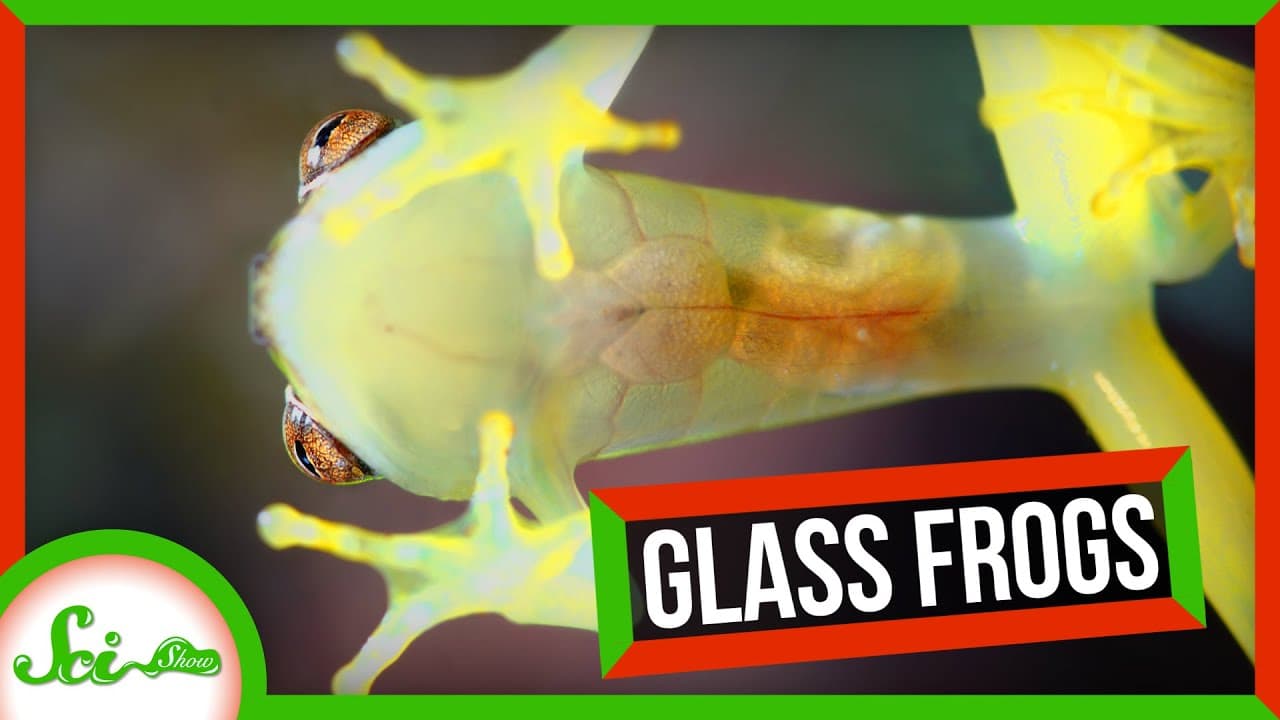
[♩INTRO] Hanging out in the trees of Central and South America are some frogs with pretty unusual coloration. Which is to say, parts of them have no color at all. Their bellies are completely see-through thanks to a combination of thin skin and a total lack of pigment-bearing cells. You can see everything! From their guts, to their beati... Read More
Key Insights
- 🤔 Glass frogs have transparent bellies due to thin skin and a lack of pigmentation, allowing their internal organs to be seen.
- 🥬 The green color on their backs helps glass frogs blend into their leafy environment, making them less visible to predators.
- 🦔 The transparent bellies of glass frogs serve as a unique form of camouflage called edge diffusion, where the leaf color shines through and blends their edges into the background.
- 😎 Researchers conducted experiments to show that the transparency of glass frogs aids in their camouflage, fooling both humans and wild animals.
- 🐸 Gelatin replicas of glass frogs were used to confirm that transparent frogs were less likely to be targeted by predators compared to opaque frogs.
- 😎 This study provides the first evidence of how the transparent bellies of glass frogs actually work for camouflage.
- 🙂 Glass frogs' transparency-based camouflage is distinct from other forms of camouflage, highlighting the diverse ways in which living organisms utilize color and light for survival.
Install to Summarize YouTube Videos and Get Transcripts
Explore YouTube Video Summarizer or Get YouTube Transcript Extractor
Questions & Answers
Q: How do glass frogs achieve transparency in their bellies?
Glass frogs have thin skin and a lack of pigment-bearing cells in their bellies, which results in transparency. This allows their internal organs to be visible.
Q: Why do glass frogs have green backs?
The green hue on the backs of glass frogs helps them blend into their leafy background, making it harder for hungry birds or other predators to spot them.
Q: How does the translucent underside of glass frogs help with camouflage?
The translucent underside allows the color of the leaf the frog is sitting on to shine through, helping the frog blend in with its surroundings. It also blurs the frog's edges, making it challenging for predators to see a clear outline.
Q: Did the experiments confirm that transparency helps glass frogs avoid predators?
Yes, the researchers conducted experiments with real frogs and gelatin replicas. The transparent frogs were less frequently and more slowly detected by predators compared to opaque frogs.
Summary & Key Takeaways
-
Glass frogs in Central and South America have transparent bellies, allowing their guts and beating hearts to be seen.
-
The transparent bellies act as a form of camouflage, blending with their leafy background and making it difficult for predators to identify them.
-
Researchers conducted experiments with real frogs and gelatin counterparts, confirming that transparency helps glass frogs avoid being detected by predators.
Read in Other Languages (beta)
Share This Summary 📚
Summarize YouTube Videos and Get Video Transcripts with 1-Click
Try YouTube Summary with ChatGPT & Claude or YouTube Transcript Generator
Explore More Summaries from SciShow 📚


Summarize YouTube Videos and Get Video Transcripts with 1-Click
Try YouTube Summary with ChatGPT & Claude or YouTube Transcript Generator