22. Provably Intractable Problems, Oracles
TL;DR
Oracles are a powerful tool in complexity theory that provide free information to a Turing machine, affecting the difficulty of solving problems. They can be used to solve specific problems efficiently, but do not solve the P versus NP problem.
Transcript
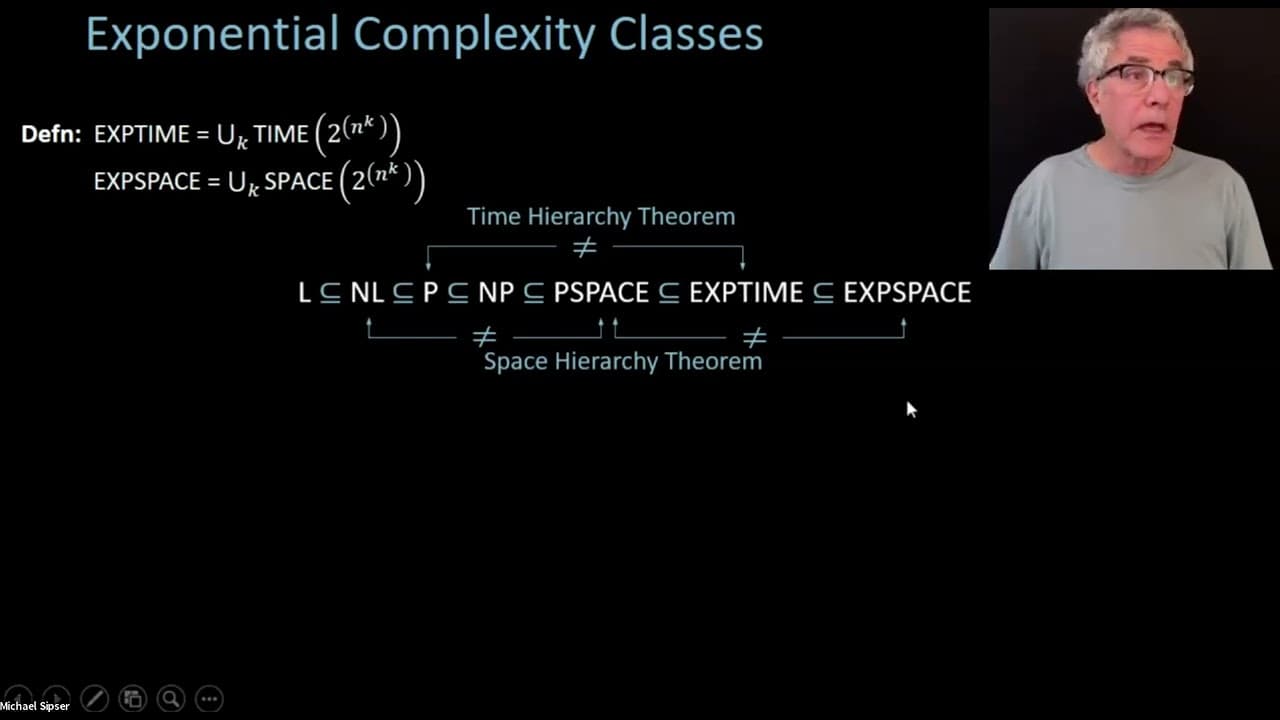
[SQUEAKING] [RUSTLING] [CLICKING] MICHAEL SIPSER: Welcome, everyone. Welcome back to theory of computation. And just to recap where we are, we have been looking at time complexity and space complexity. And we just finished proving what are called the hierarchy theorems, which, in a nutshell, basically say that, if you allow the computational model ... Read More
Key Insights
- 🥶 Oracles provide free information to a Turing machine, affecting the complexity of problems.
- 🅰️ Different types of oracles can be used to solve specific problems efficiently.
Install to Summarize YouTube Videos and Get Transcripts
Explore YouTube Video Summarizer or Get YouTube Transcript Extractor
Questions & Answers
Q: What is an oracle in the context of complexity theory?
An oracle is a free source of information that a Turing machine can use to answer questions about membership in a specified language, typically without the computational cost.
Q: Can you give an example of a problem that can be solved efficiently with an oracle?
One example is the SAT problem, which can be solved efficiently with a SAT oracle. The oracle can quickly determine if a given formula is satisfiable, allowing for an efficient solution to SAT.
Q: Can an oracle solve undecidable problems?
Yes, an oracle can be used to solve undecidable problems by providing free information that helps determine the answer. However, the oracle itself cannot solve the undecidable problem, it only provides additional information to aid in the solution.
Summary & Key Takeaways
-
Oracles provide free information to a Turing machine, allowing it to test membership in a specified language without the cost of computation.
-
P with a SAT oracle contains all problems in NP, as SAT is a complete problem for NP.
-
The MIN-FORMULA language can be solved in polynomial time with a SAT oracle, as a shorter equivalent formula can be found by guessing and testing equivalence with the oracle.
-
It is not known if P with a SAT oracle is equal to NP with a SAT oracle.
Read in Other Languages (beta)
Share This Summary 📚
Summarize YouTube Videos and Get Video Transcripts with 1-Click
Try YouTube Summary with ChatGPT & Claude or YouTube Transcript Generator
Explore More Summaries from MIT OpenCourseWare 📚



Summarize YouTube Videos and Get Video Transcripts with 1-Click
Try YouTube Summary with ChatGPT & Claude or YouTube Transcript Generator