Can LLMs reason? | Yann LeCun and Lex Fridman
TL;DR
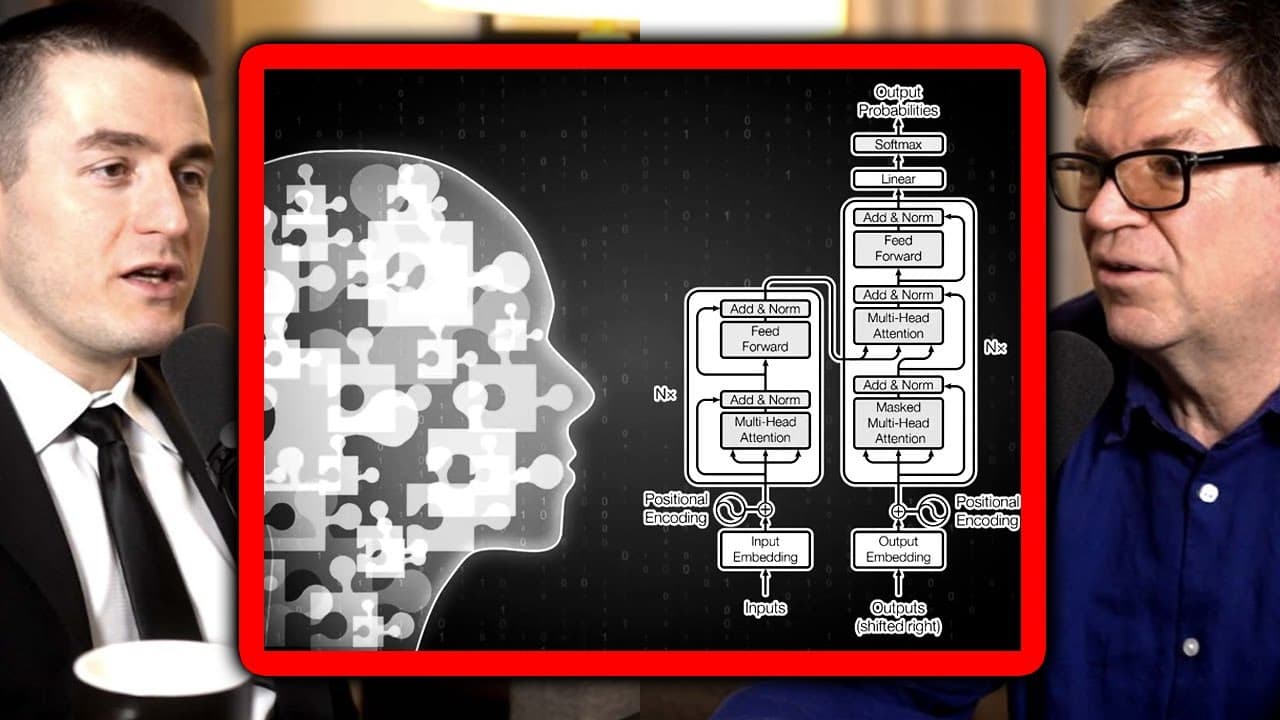
Language models (LLMs) use a primitive type of reasoning that does not prioritize complex problem-solving and lacks the ability to plan answers or engage in deep reasoning.
Transcript
the type of reasoning that takes place in llm is very very primitive and the reason you can tell is primitive is because the amount of computation that is spent per token produced is constant so if you ask a question and that question has an answer in a given number of token the amount of competition devoted to Computing that answer can be exactly ... Read More
Key Insights
- ❓ The reasoning process in LLMs is primitive due to its fixed amount of computation per token, hindering their ability to tackle complex problems.
- ⚾ Future dialogue systems should incorporate optimization-based planning and reasoning on abstract representations, rather than generating token sequences.
- 🚂 LLMs can be trained using contrastive or non-contrastive methods to measure compatibility between prompts and answers effectively.
Install to Summarize YouTube Videos and Get Transcripts
Explore YouTube Video Summarizer or Get YouTube Transcript Extractor
Questions & Answers
Q: Why is the type of reasoning in LLMs considered primitive?
LLMs use a fixed amount of computation per token, which restricts their ability to allocate more resources to complex questions or problems, unlike human reasoning, which adapts to difficulty levels.
Q: Can LLMs be improved to handle planning and reasoning effectively?
Yes, by using energy-based models that optimize answers in abstract thought representation spaces, LLMs can plan and reason better before translating those answers into text.
Q: How can LLMs be trained to measure the compatibility between prompts and answers?
Energy-based models can be trained by contrasting pairs of compatible and incompatible prompts and answers, or by minimizing the volume of space with low energy, ensuring high energy for untrained scenarios.
Q: How does this reasoning approach differ in visual data processing?
In visual data, compatibility between images or videos is measured by predicting the representation of uncorrupted inputs and computing prediction errors, enabling a compressed and reliable representation of visual reality.
Summary & Key Takeaways
-
LLMs rely on a constant amount of computation per token produced, which limits their ability to tackle complex questions or problems efficiently.
-
LLMs lack the capacity to devote more resources to complex problems compared to simpler ones, as human reasoning does.
-
Future dialogue systems need to incorporate optimization-based planning and reasoning, which operate on abstract representations rather than the generation of token sequences.
Read in Other Languages (beta)
Share This Summary 📚
Summarize YouTube Videos and Get Video Transcripts with 1-Click
Try YouTube Summary with ChatGPT & Claude or YouTube Transcript Generator
Explore More Summaries from Lex Clips 📚




Summarize YouTube Videos and Get Video Transcripts with 1-Click
Try YouTube Summary with ChatGPT & Claude or YouTube Transcript Generator