What Is the Cubic Formula and Why Isn't It Taught?
TL;DR
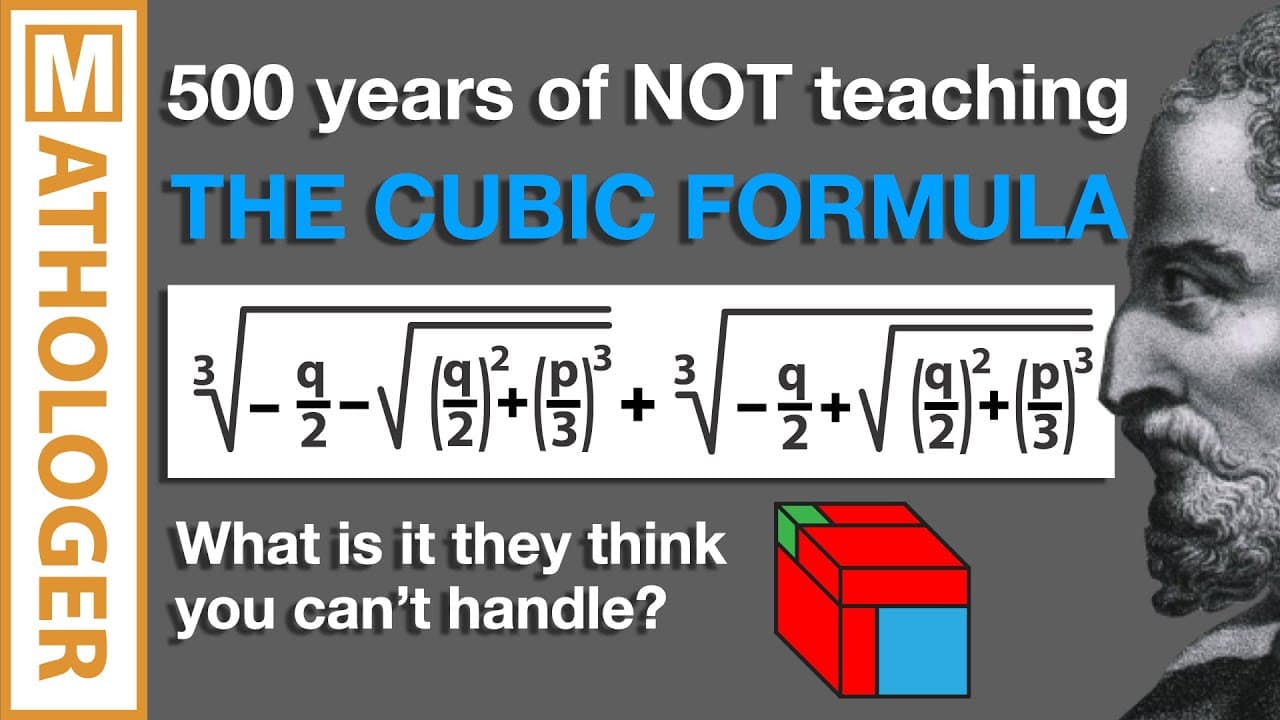
The cubic formula provides solutions to cubic equations, but it's rarely taught in schools due to its complexity. By using pre-processing methods, cubic equations can be simplified, making them more manageable. Understanding the cubic formula is crucial as it not only enlightens the nature of cubic equations but also led to the development of complex numbers in mathematics.
Transcript
Welcome to another an Mathologer video. If I were to wake you up in the middle of the night, I'm sure that most of you would be able to rattle off the quadratic formula: minus B plus or minus the square root of B squared, and so on. But along with all that quadratic fun you had in school, most of you would have tortured a few carefully cooked up cu... Read More
Key Insights
- 🎓 The cubic formula offers a method for solving cubic equations but is often overlooked in mathematics education due to its complexity.
- 😑 Pre-processing techniques simplify the cubic equation, allowing for a more manageable form of the cubic formula.
- 🥺 The discriminant determines the number of real roots in a cubic equation, while negative discriminants lead to complex solutions.
- #️⃣ Complex solutions are represented using trigonometric functions, and the study of cubic equations contributed to the development of complex numbers.
- 🥹 The cubic formula holds historical significance in the advancement of mathematics and its role in solving higher degree polynomial equations.
Install to Summarize YouTube Videos and Get Transcripts
Explore YouTube Video Summarizer or Get YouTube Transcript Extractor
Questions & Answers
Q: Why is the cubic formula not commonly taught in math education?
The cubic formula is often omitted in math education due to its complex nature and the challenges it poses in generalizing the solution process for all cubic equations. Instead, emphasis is placed on more practical methods like factoring and graphing.
Q: How does pre-processing simplify the cubic equation?
Pre-processing involves dividing the equation by the leading coefficient and removing the linear term. This simplifies the equation and transforms it into a more manageable form, reducing the complexity of the cubic formula.
Q: What is the significance of the discriminant in cubic equations?
The discriminant, (q/2)^2+(p/3)^3, determines the number of real roots a cubic equation has. If it is positive, there is one real root, while a negative discriminant indicates three real roots. However, the formula may produce complex solutions in the latter case.
Q: Why do the solutions of cubic equations involve complex numbers?
Cubic equations with negative discriminants yield complex solutions. These are expressed in terms of trigonometric functions, adding complexity to the formula. Complex numbers arose during the exploration of cubic equations and understanding their roots.
Summary & Key Takeaways
-
The cubic formula, much like the quadratic formula, provides a solution to cubic equations, but it is often overlooked in math education.
-
By simplifying the cubic equation through pre-processing techniques, the complicated cubic formula can be transformed into a simpler cubic formula.
-
The number of solutions to a cubic equation can be determined through the discriminant, and the complex roots can be further understood using trigonometric representations.
-
The cubic formula has historical significance, as its discovery led to the development of complex numbers and it plays a crucial role in the understanding of higher degree polynomial equations.
Read in Other Languages (beta)
Share This Summary 📚
Summarize YouTube Videos and Get Video Transcripts with 1-Click
Try YouTube Summary with ChatGPT & Claude or YouTube Transcript Generator
Explore More Summaries from Mathologer 📚

Summarize YouTube Videos and Get Video Transcripts with 1-Click
Try YouTube Summary with ChatGPT & Claude or YouTube Transcript Generator