17: Principal Components Analysis_ - Intro to Neural Computation
TL;DR
Principal Component Analysis (PCA) is a powerful technique used to analyze high-dimensional data by finding the most important components that explain the variance in the data.
Transcript
MICHALE FEE: OK, let's go ahead and get started. So today we're turning to a new topic called that basically focused on principal components analysis, which is a very cool way of analyzing high-dimensional data. Along the way, we're going to learn a little bit more linear algebra. So today, I'm going to talk to you about eigenvectors and eigenvalue... Read More
Key Insights
- ✋ Principal Component Analysis (PCA) is a powerful technique for analyzing high-dimensional data.
- ❓ PCA involves finding the eigenvectors and eigenvalues of the covariance matrix to determine the most important components in the data.
- 🏑 PCA is widely applicable in various fields, such as genetics, neuroscience, and image recognition.
Install to Summarize YouTube Videos and Get Transcripts
Explore YouTube Video Summarizer or Get YouTube Transcript Extractor
Questions & Answers
Q: What is the purpose of Principal Component Analysis (PCA)?
PCA is used to analyze high-dimensional data by reducing its dimensionality and identifying the most important components that explain the variance in the data.
Q: How is PCA implemented in practice?
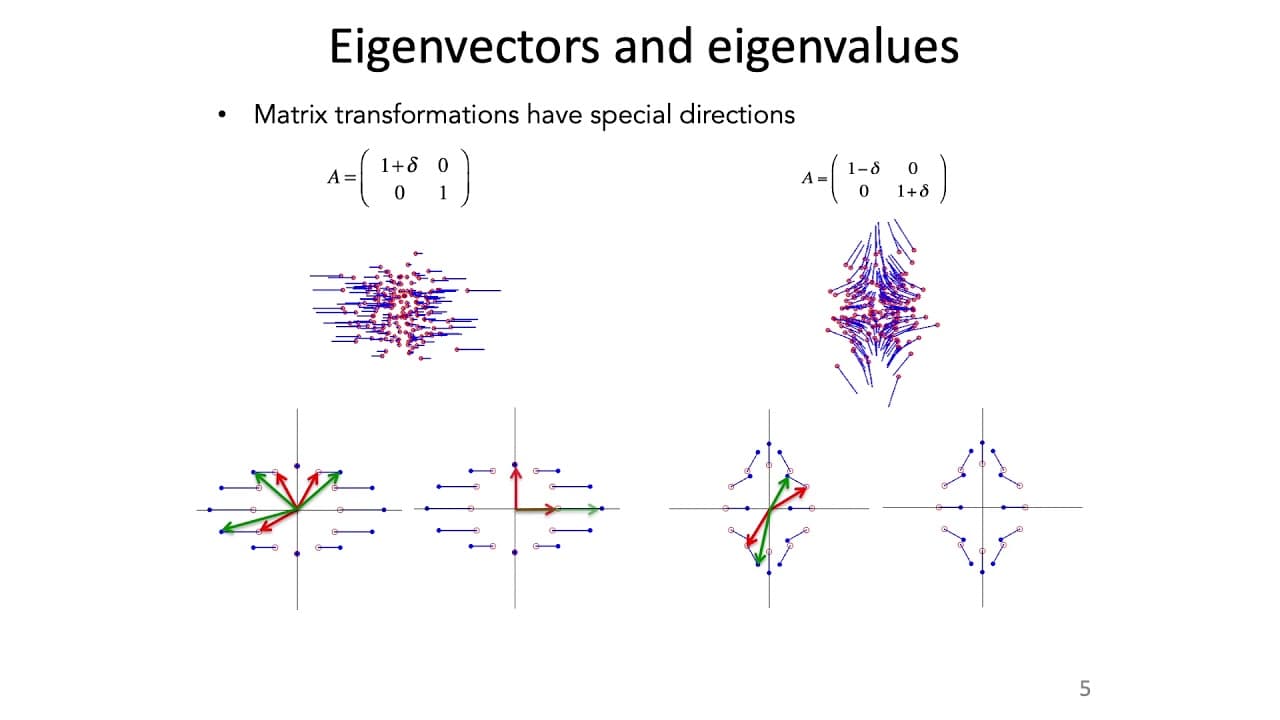
In practice, PCA involves finding the eigenvectors and eigenvalues of the covariance matrix of the data. The eigenvectors represent the principal components, and the eigenvalues represent the amount of variance explained by each component.
Q: What are the applications of PCA?
PCA can be applied in various fields, including genetics, neuroscience, image recognition, and data analysis. It helps in understanding patterns, reducing noise, and identifying important components in high-dimensional data.
Q: How does PCA help in dimensionality reduction?
PCA reduces the dimensionality of the data by identifying the most important components that explain the variance. By selecting a subset of these components, the data can be represented in a lower-dimensional space while preserving most of its information.
Summary & Key Takeaways
-
Principal Component Analysis (PCA) is a method used to analyze high-dimensional data by reducing its dimensionality and finding the most important components.
-
PCA involves finding the eigenvectors and eigenvalues of the covariance matrix of the data to determine the directions and amount of variance in the data.
-
The eigenvectors represent the principal components, and the eigenvalues represent the amount of variance each principal component explains.
-
PCA is widely applicable in various fields, such as understanding genetics, analyzing neural activity, and image recognition.
Read in Other Languages (beta)
Share This Summary 📚
Summarize YouTube Videos and Get Video Transcripts with 1-Click
Try YouTube Summary with ChatGPT & Claude or YouTube Transcript Generator
Explore More Summaries from MIT OpenCourseWare 📚



Summarize YouTube Videos and Get Video Transcripts with 1-Click
Try YouTube Summary with ChatGPT & Claude or YouTube Transcript Generator