L20.7 Confidence Intervals for the Mean, When the Variance is Unknown
TL;DR
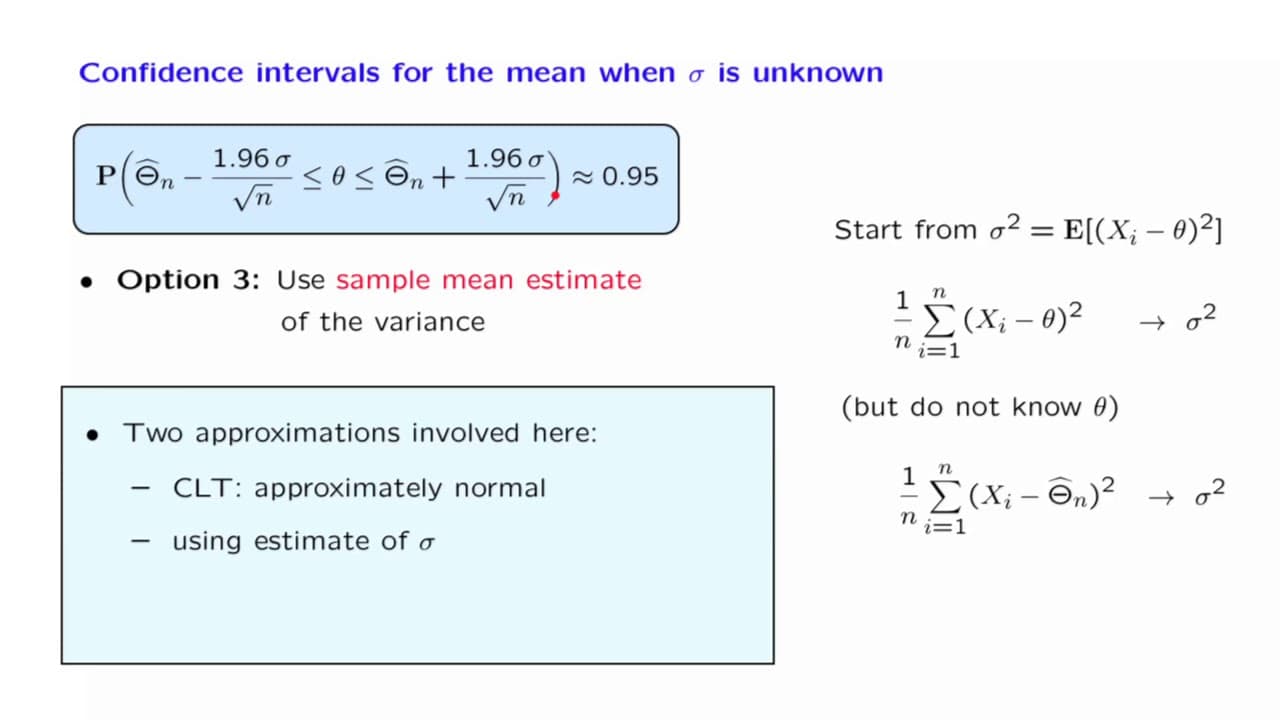
Confidence intervals can be constructed when the standard deviation is unknown by using upper bounds, estimating sigma, or using a generic method to estimate variance.
Transcript
By this time, we know how to construct confidence intervals when we try to estimate an unknown mean of a certain distribution using the sample mean as our estimator. Or actually, these are approximate confidence intervals, because we are using the approximation suggested by the central limit theorem. But what if we do not know the value of sigma, t... Read More
Key Insights
- ❓ Confidence intervals for estimating unknown means require knowledge of the standard deviation.
- ⚾ Options for estimating the standard deviation include using an upper bound or estimating sigma based on specific situations.
- 🥡 A more general approach involves estimating variance by taking multiple samples and calculating the average.
- 🙂 The introduction of randomness when estimating sigma can slightly increase the size of confidence intervals.
- 🛩️ Correction using t-distribution tables is necessary for smaller sample sizes.
- 💁 Using an alternative form to estimate variance may result in an unbiased estimator.
- ➖ The choice between using n or n minus 1 in the variance estimator depends on the sample size.
Install to Summarize YouTube Videos and Get Transcripts
Explore YouTube Video Summarizer or Get YouTube Transcript Extractor
Questions & Answers
Q: How can confidence intervals be constructed when the standard deviation is unknown?
Confidence intervals can be constructed by using an upper bound on sigma or by estimating sigma based on the specific situation.
Q: What is the advantage of estimating sigma when constructing confidence intervals?
Estimating sigma allows for a more accurate representation of the true standard deviation, especially when the sample size is large.
Q: How can variance be estimated without knowing the true value of sigma?
By taking multiple samples and calculating the average of a specific expression, one can obtain an estimate of the variance.
Q: Are confidence intervals affected by the introduction of randomness when estimating sigma?
Yes, the introduction of randomness due to estimating sigma can cause confidence intervals to be slightly larger, but this can be corrected using t-distribution tables.
Summary & Key Takeaways
-
Confidence intervals for estimating an unknown mean can be constructed using the sample mean as an estimator, but this assumes knowledge of the standard deviation.
-
If the standard deviation is unknown, options include using an upper bound or estimating sigma based on specific situations.
-
A more general approach involves estimating variance by taking multiple samples and calculating the average, but this requires an estimate of the mean.
Read in Other Languages (beta)
Share This Summary 📚
Summarize YouTube Videos and Get Video Transcripts with 1-Click
Try YouTube Summary with ChatGPT & Claude or YouTube Transcript Generator
Explore More Summaries from MIT OpenCourseWare 📚



Summarize YouTube Videos and Get Video Transcripts with 1-Click
Try YouTube Summary with ChatGPT & Claude or YouTube Transcript Generator