We Were Completely Wrong About Why Bugs Are Attracted To Lights
TL;DR
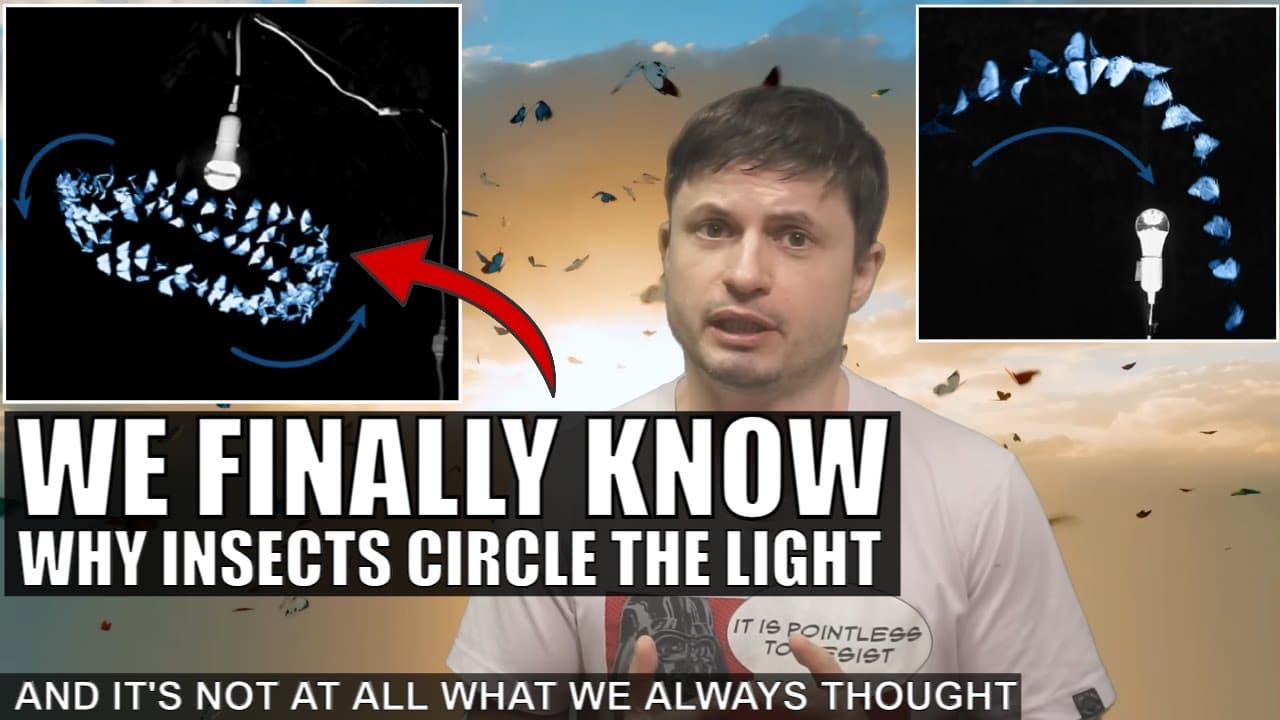
Insects are not actually attracted to light; it is their instinctual behavior to change direction when close to a light source, causing them to appear disoriented and trapped.
Transcript
okay this is one of those videos I guess I have to start with a video in this case this bugs flying around the light something that I'm sure most of us are quite familiar with as a matter of fact as mentioned in the study we're going to be discussing today apparently insects being attracted to artificial light was even mentioned in some of the earl... Read More
Key Insights
- 🙂 Insects are not actually attracted to artificial lights but rather change direction unconsciously when close to them due to their dorsal light response.
- 🙂 Artificial lights confuse insects' orientation instincts and cause them to fly in disrupted patterns.
- 🙂 Light pollution from upward-facing lights has a significant impact on insect behavior and can trap them for extended periods.
- 🙂 Insects play a crucial role in pollination and protecting crops, and reducing light pollution could help preserve their natural behaviors.
Install to Summarize YouTube Videos and Get Transcripts
Explore YouTube Video Summarizer or Get YouTube Transcript Extractor
Questions & Answers
Q: Why are insects attracted to artificial lights?
Insects are not actually attracted to lights but rather instinctually change direction when very close to the light source. This behavior is a result of their dorsal light response, which helps them determine their flight attitude based on the Sun and Moon.
Q: How do artificial lights interfere with insects' orientation instincts?
Artificial lights confuse insects' dorsal light response, causing them to fly in unusual patterns and appear disoriented. The lights send mixed messages and trap insects in loops around the light source.
Q: Can reducing upward-facing lights help insects?
Yes, reducing upward-facing lights can help insects. While downward lights are not as bad, upward-facing lights confuse insects the most and trap them in spiraling behaviors. The best solution is to reduce overall light pollution.
Q: Why do some insects not get affected by upward-facing lights?
Certain flies and moths, such as vinegar flies and Oleander Hawk moths, were not affected by upward-facing lights but were still trapped by other types of lights. There is variation in the effects of lights on different insect species.
Summary & Key Takeaways
-
For years, scientists have tried to explain why insects are drawn to artificial lights, with theories including escape mechanisms, confusion with the moon, and attraction to heat. However, all of these explanations have been disproven.
-
Recent research used slow-motion cameras and different light orientations to observe insects' behavior around lights. It was discovered that insects do not aim for the light, but rather unconsciously change direction when extremely close to it.
-
This behavior, known as dorsal light response, is an instinctual response that evolved to help insects determine their flight attitude based on the Sun and Moon. However, artificial lights confuse this instinct, causing insects to fly in erratic patterns and traps them.
Read in Other Languages (beta)
Share This Summary 📚
Summarize YouTube Videos and Get Video Transcripts with 1-Click
Try YouTube Summary with ChatGPT & Claude or YouTube Transcript Generator
Explore More Summaries from Anton Petrov 📚





Summarize YouTube Videos and Get Video Transcripts with 1-Click
Try YouTube Summary with ChatGPT & Claude or YouTube Transcript Generator