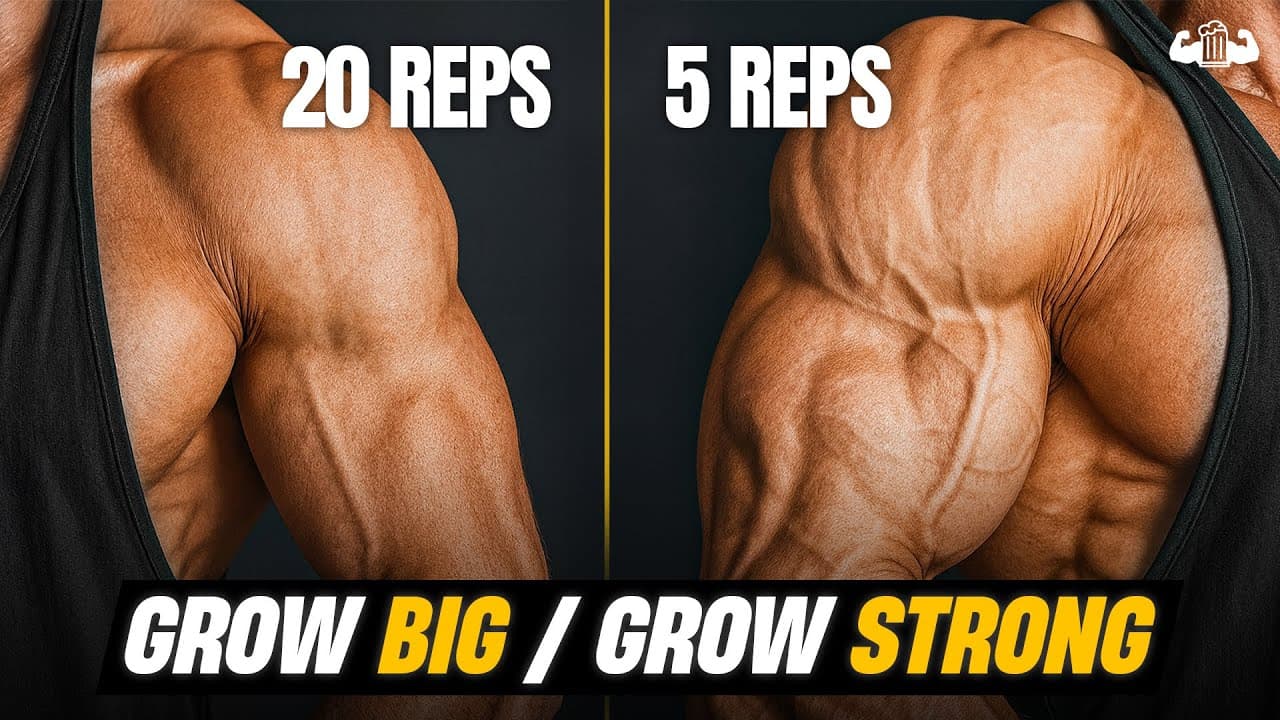
How Many Reps Should You Do To Build Muscle? | The TRUTH And SCIENCE | BeerBiceps Gym Tips
TL;DR
Rep ranges impact muscle size and strength; choose wisely.
Transcript
hey guys R here again bringing you beer biceps YouTube's first India specific fitness channel and today we're going to be talking about the science of rep ranges so your rep range refers to the number of repetitions you do in any weight training exercise and by having a better understanding of the science of rep ranges you can make your body look l... Read More
Key Insights
- 🇨🇫 Rep ranges are central to effective muscle training, determining the balance between size and strength.
- 🔇 Sarcoplasmic hypertrophy emphasizes volume and is preferable for bodybuilders aiming for size rather than strength.
- 💪 Myofibril hypertrophy is ideal for athletes focused on powerlifting, enhancing strength without major muscle expansion.
- 🧡 Training with a mix of rep ranges can maximize overall muscle development and prevent plateaus.
- 🥺 There is a widespread misconception that heavy lifting leads to unwanted bulkiness, when it actually promotes strength.
- 🧡 Understanding individual fitness goals can help in selecting the appropriate rep range for training.
- 🅰️ Both hypertrophy types involve distinct physiological processes that can be tailored to an individual’s desired outcome.
Install to Summarize YouTube Videos and Get Transcripts
Explore YouTube Video Summarizer or Get YouTube Transcript Extractor
Questions & Answers
Q: What is the significance of rep ranges in muscle development?
Rep ranges influence the type of muscle growth experienced during training. Higher rep ranges (typically 12+ reps) lead to sarcoplasmic hypertrophy, enhancing muscle size. In contrast, lower rep ranges (1-6 reps) foster myofibril hypertrophy, which increases muscle strength. Understanding how to manipulate these ranges can help individuals achieve their specific fitness goals, whether for aesthetics or performance.
Q: How does sarcoplasmic hypertrophy differ from myofibril hypertrophy?
Sarcoplasmic hypertrophy is focused on increasing the size of muscles through high-rep workouts with lighter weights. This method is effective for building muscle volume but does not significantly improve strength. Myofibril hypertrophy, however, builds muscle density and strength by using heavier weights for fewer reps, which adds more filaments to each muscle fiber without enlarging them considerably.
Q: Can you achieve both types of hypertrophy in the same training program?
Yes, it's possible to train for both sarcoplasmic and myofibril hypertrophy concurrently. Since neither type of hypertrophy is mutually exclusive, incorporating both high-rep, lower-weight sets and low-rep, heavy-weight sets into a balanced workout routine allows for optimized muscle growth in both size and strength, providing a well-rounded fitness regimen.
Q: What common misconceptions do people have about lifting heavier weights?
Many individuals believe that lifting heavier weights will automatically make them bulkier. In reality, heavier weights typically lead to strength gains through myofibril hypertrophy, which does not significantly increase muscle size. Instead, achieving a bulkier physique requires lighter weights with higher repetitions that promote sarcoplasmic hypertrophy, filling muscles with more fluid rather than adding dense fibers.
Summary & Key Takeaways
-
The concept of rep ranges is crucial for determining how one’s muscles grow, either in size or strength. Understanding hypertrophy types helps in designing effective training programs.
-
Sarcoplasmic hypertrophy focuses on higher rep ranges with lighter weights, promoting muscle size but not strength, commonly used by bodybuilders.
-
Myofibril hypertrophy emphasizes lower rep ranges with heavyweight, leading to increased strength and density without significant changes in muscle size, typically adopted by powerlifters.
Read in Other Languages (beta)
Share This Summary 📚
Summarize YouTube Videos and Get Video Transcripts with 1-Click
Try YouTube Summary with ChatGPT & Claude or YouTube Transcript Generator
Explore More Summaries from BeerBiceps 📚

Summarize YouTube Videos and Get Video Transcripts with 1-Click
Try YouTube Summary with ChatGPT & Claude or YouTube Transcript Generator