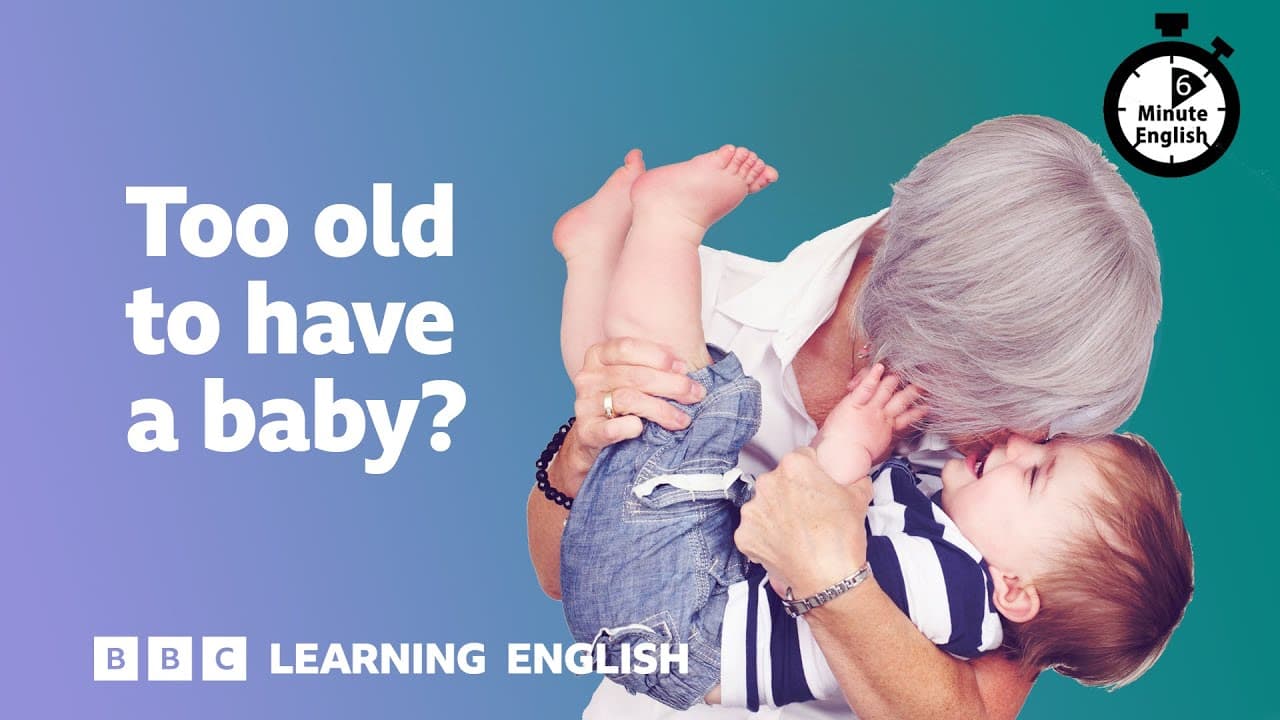
Too old to have a baby? ⏲️ 6 Minute English
TL;DR
Discussion on older motherhood and societal attitudes.
Transcript
Hello. This is 6 Minute English from BBC Learning English. I'm Neil. And I'm Beth. Women today are having fewer babies. More women are delaying having children until their forties - the period of ten years in life between 40 and 49, and some women are giving birth in their fifties, their sixties, even their seventies! There are many reasons behind ... Read More
Key Insights
- Women are increasingly having children later in life due to better access to education and careers, but this trend also comes with health risks.
- The term 'geriatric mother' was once used for mothers over 35, but it is now considered offensive and outdated.
- Men's fertility declines more slowly than women's, leading to societal acceptance of older fathers compared to older mothers.
- The oldest recorded woman to give birth was Mangayamma Yaramati at 73, highlighting the extreme end of this trend.
- There is a cultural divide in attitudes towards older mothers, with some societies disapproving while others see motherhood as a blessing.
- The phenomenon of older motherhood is relatively new and reflects changing societal norms and expectations.
- Vocabulary terms such as 'phenomena', 'linger', and 'pat on the back' are used to describe societal attitudes and trends.
- Gen Z women are increasingly choosing not to have children, contrasting with traditional views on motherhood.
Install to Summarize YouTube Videos and Get Transcripts
Explore YouTube Video Summarizer or Get YouTube Transcript Extractor
Questions & Answers
Q: Why are more women having babies later in life?
More women are having babies later in life due to increased access to education and career opportunities. This empowerment allows them to focus on personal and professional development before starting a family. However, this trend also comes with health risks associated with older motherhood.
Q: What is the societal reaction to older mothers compared to older fathers?
Society tends to be more accepting of older fathers than older mothers. Older fathers often receive praise or congratulations, while older mothers may face disapproval or discomfort. This reflects a gender bias where men's fertility is seen as lasting longer and more acceptable.
Q: Who is Mangayamma Yaramati and why is she significant?
Mangayamma Yaramati is significant as she became the oldest recorded woman to give birth at the age of 73. Her case highlights the extremes of the trend of older motherhood and raises questions about the implications and societal perceptions of having children at an advanced age.
Q: What vocabulary terms are introduced in the program?
The program introduces vocabulary terms like 'phenomena', 'linger', 'to father', 'pat on the back', and 'God forbid'. These terms help explain societal attitudes towards older parents and the ongoing trends in family planning and motherhood.
Q: What cultural differences are highlighted regarding motherhood?
Cultural differences regarding motherhood include traditional societies viewing motherhood as a primary role for women, while in Western cultures, younger generations like Gen Z are increasingly choosing not to have children. These differences reflect varying societal expectations and values concerning family and career.
Q: How does the program address the gender bias in parenting?
The program addresses gender bias by highlighting how older fathers are often celebrated, while older mothers face criticism. This bias is rooted in societal perceptions of fertility and gender roles, with men seen as capable of fathering children longer than women can bear them.
Q: What does the term 'geriatric mother' imply and why is it outdated?
The term 'geriatric mother' refers to women who have children at an older age, typically over 35. It implies a negative view of older motherhood, suggesting increased risks and complications. The term is outdated and considered offensive, as societal attitudes have shifted towards acceptance of diverse family planning choices.
Q: What does the phrase 'God forbid' signify in the context of the discussion?
In the discussion, 'God forbid' is used to express disapproval or hope that something undesirable, like a woman having a child in her eighties, does not happen. It reflects societal discomfort with the idea of extremely older motherhood, contrasting with the acceptance of older fatherhood.
Summary & Key Takeaways
-
The discussion explores the trend of women having children later in life, driven by factors like education and career opportunities, but with accompanying health risks.
-
Societal attitudes differ towards older mothers and fathers, with older fathers often receiving more acceptance and praise compared to older mothers.
-
The program introduces vocabulary related to the topic, such as 'phenomena', 'linger', and 'pat on the back', to help understand societal perspectives.
Read in Other Languages (beta)
Share This Summary 📚
Summarize YouTube Videos and Get Video Transcripts with 1-Click
Try YouTube Summary with ChatGPT & Claude or YouTube Transcript Generator
Explore More Summaries from BBC Learning English 📚
Summarize YouTube Videos and Get Video Transcripts with 1-Click
Try YouTube Summary with ChatGPT & Claude or YouTube Transcript Generator