Tracking Hurricane Maria from Space on This Week @NASA – September 22, 2017
TL;DR
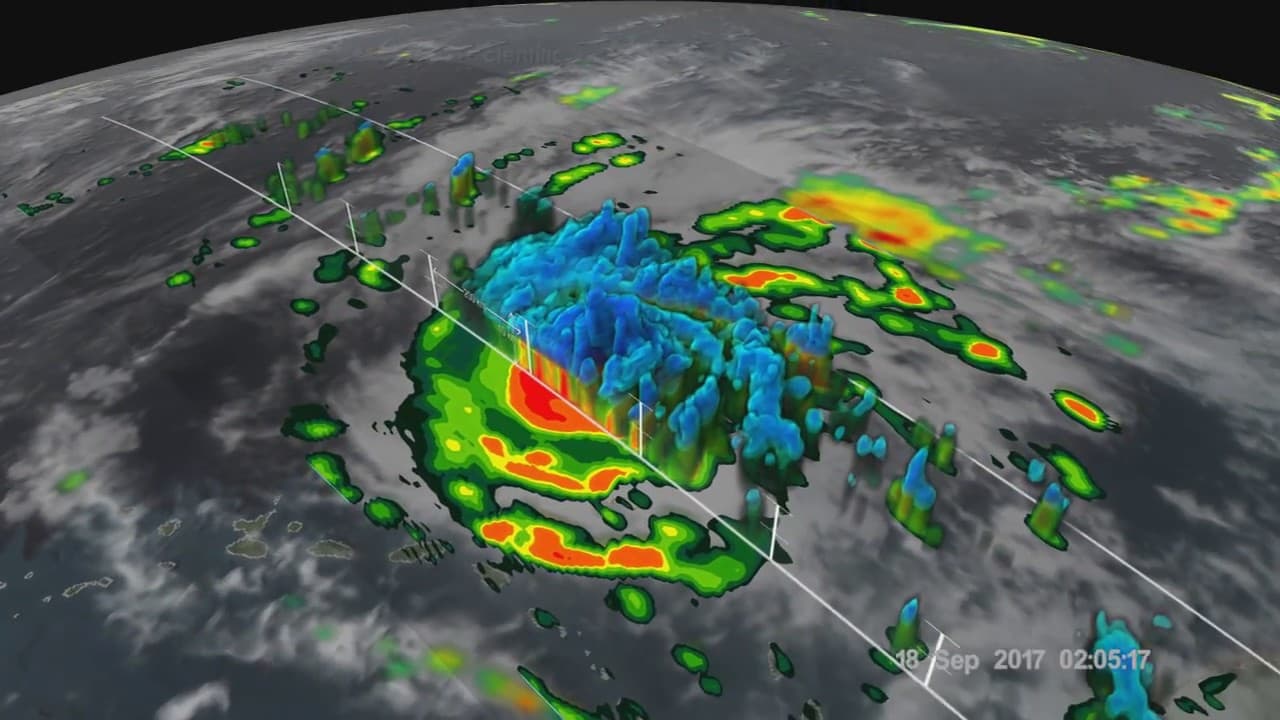
Satellite data shows Hurricane Jose and Hurricane Maria, while the Dragon cargo craft returns to Earth with various studies. Langley Research Center opens a new research facility, and the OSIRIS REx spacecraft uses Earth's gravity to head towards asteroid Bennu.
Transcript
“Here’s some of the stories trending This Week at NASA!” Satellite data continues to enable weather forecasters to look inside and outside of powerful hurricanes. Imagery from NOAA's GOES East satellite, captured Sept. 17 to Sept. 20, shows Hurricane Jose along the U.S. east coast, and Hurricane Maria, as it moved through the Leeward Islands, stren... Read More
Key Insights
- 👣 Satellite data is crucial for weather forecasters to track and predict the movement of hurricanes.
- 😷 The Dragon cargo craft brings back various studies that contribute to advancements in technology and medical research.
- 👾 The opening of the Katherine G. Johnson Computational Research Facility honors a pioneering figure in the history of space exploration.
- 🦖 The OSIRIS REx spacecraft utilizes gravitational assists to reach its target asteroid.
- 🛰️ The Hubble Space Telescope captures images revealing the presence of two asteroids orbiting each other.
- 👨🔬 NASA engages the public through challenges and events to foster interest and advance research.
- 👾 Earth's gravity plays a vital role in space missions, providing necessary momentum and changing orbital planes.
Install to Summarize YouTube Videos and Get Transcripts
Explore YouTube Video Summarizer or Get YouTube Transcript Extractor
Questions & Answers
Q: How did satellite data contribute to weather forecasting during Hurricane Jose and Hurricane Maria?
Satellite data allowed weather forecasters to track the movement and intensity of Hurricane Jose and Hurricane Maria, providing valuable information for predicting their paths and potential impacts.
Q: What studies were brought back to Earth by the Dragon cargo craft?
The Dragon cargo craft returned with various technological and biological studies, including experiments to test strategies for growing new lung tissue and understanding the pathology of Parkinson's disease.
Q: Who is Katherine G. Johnson, and what is the significance of the new research facility named after her?
Katherine G. Johnson is a former "human computer" who calculated trajectories for America's first spaceflights. The new research facility named after her, the Katherine G. Johnson Computational Research Facility, will be used for innovative research and development in support of air mobility and space exploration missions.
Q: How did the OSIRIS REx spacecraft use Earth's gravity to change its orbital plane?
The OSIRIS REx spacecraft used Earth's gravity as a slingshot, utilizing the momentum provided by Earth's gravity to change its orbital plane and propel itself towards the asteroid Bennu.
Summary & Key Takeaways
-
Satellite imagery captured Hurricane Jose and Hurricane Maria, providing valuable data for weather forecasters.
-
The Dragon cargo craft returned to Earth from the International Space Station, bringing back technological and biological studies.
-
The Katherine G. Johnson Computational Research Facility was officially opened at Langley Research Center.
-
The OSIRIS REx spacecraft used Earth's gravity to change its orbital plane and head towards asteroid Bennu.
Read in Other Languages (beta)
Share This Summary 📚
Summarize YouTube Videos and Get Video Transcripts with 1-Click
Try YouTube Summary with ChatGPT & Claude or YouTube Transcript Generator
Explore More Summaries from NASA 📚

Summarize YouTube Videos and Get Video Transcripts with 1-Click
Try YouTube Summary with ChatGPT & Claude or YouTube Transcript Generator