What Is Recursion in Programming?
TL;DR
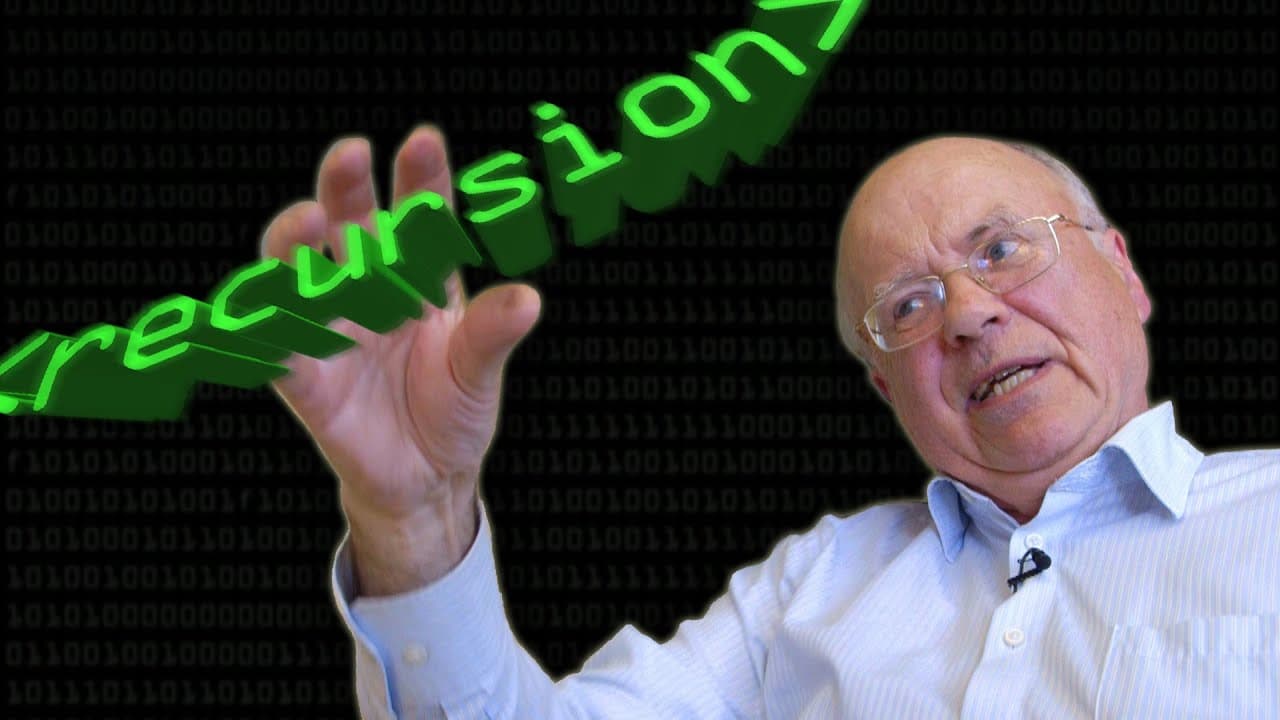
Recursion is a programming technique where a function calls itself to solve a problem by breaking it into smaller subproblems. For instance, calculating the factorial of a number involves defining it in terms of the factorial of the previous number, ultimately relying on a base case to avoid infinite loops. This method showcases the power of recursion but requires careful management of function calls and termination conditions.
Transcript
I think I'm on fairly strong ground when I say that we haven't yet, in Computerphile, done recursion. This can get extremely hard. It is difficult to get your head around recursion, sometimes. In one way you can take a very mathematical view about it and close your eyes, and if you're a pure mathematician who thinks, as we computer scientists would... Read More
Key Insights
- ⚾ Recursion is a challenging concept that requires a deep understanding of base cases, variable management, and termination conditions.
- 🍳 Recursive factorial calculations involve breaking down the problem into smaller steps until reaching the base case.
- ⚾ The base case in recursive factorial calculations is when the factorial of 1 is defined as 1.
- 👶 Recursion can be implemented using a stack, with each function call creating a new frame on the stack until the base case is reached.
- ⛔ Recursion is not limited to mathematical problems and can be used in various algorithms and data structures.
- 🐎 While recursion provides an elegant solution, it can be less efficient in terms of memory usage and speed compared to iterative solutions.
- 💻 Understanding recursion is crucial for mastering computer science and programming concepts.
Install to Summarize YouTube Videos and Get Transcripts
Explore YouTube Video Summarizer or Get YouTube Transcript Extractor
Questions & Answers
Q: What is recursion and why is it challenging in computer science?
Recursion is a programming concept where a function calls itself to solve a problem in smaller steps. It can be challenging because it requires understanding the base case (termination condition) and managing multiple instances of variables.
Q: How does the recursive factorial calculation work?
The factorial of a number is defined as the product of that number and the factorial of the number one less than it. This definition allows for breaking down the problem into smaller steps until reaching the base case (factorial 1), at which point the multiplication results are cascaded back up.
Q: Why is a termination condition necessary in recursion?
Without a termination condition, a recursive function would continue calling itself indefinitely, leading to a stack overflow or infinite loop. To prevent this, a base case is defined that stops the recursion when reached.
Q: Can factorial calculations be done iteratively as well?
Yes, factorial calculations can be implemented iteratively using loops. While recursion provides a more intuitive understanding of factorial calculations, iterative solutions can be more efficient in practice.
Summary & Key Takeaways
-
Recursion is a challenging concept in computer science that can be difficult to grasp initially.
-
Recursive factorial calculations involve defining the factorial of a number as the product of that number and the factorial of the number one less than it.
-
Recursion requires a specific termination condition to avoid an endless loop, which is achieved by defining factorial 1 as equal to 1.
Read in Other Languages (beta)
Share This Summary 📚
Summarize YouTube Videos and Get Video Transcripts with 1-Click
Try YouTube Summary with ChatGPT & Claude or YouTube Transcript Generator
Explore More Summaries from Computerphile 📚

Summarize YouTube Videos and Get Video Transcripts with 1-Click
Try YouTube Summary with ChatGPT & Claude or YouTube Transcript Generator