What Is the Continuous Total Probability Theorem?
TL;DR
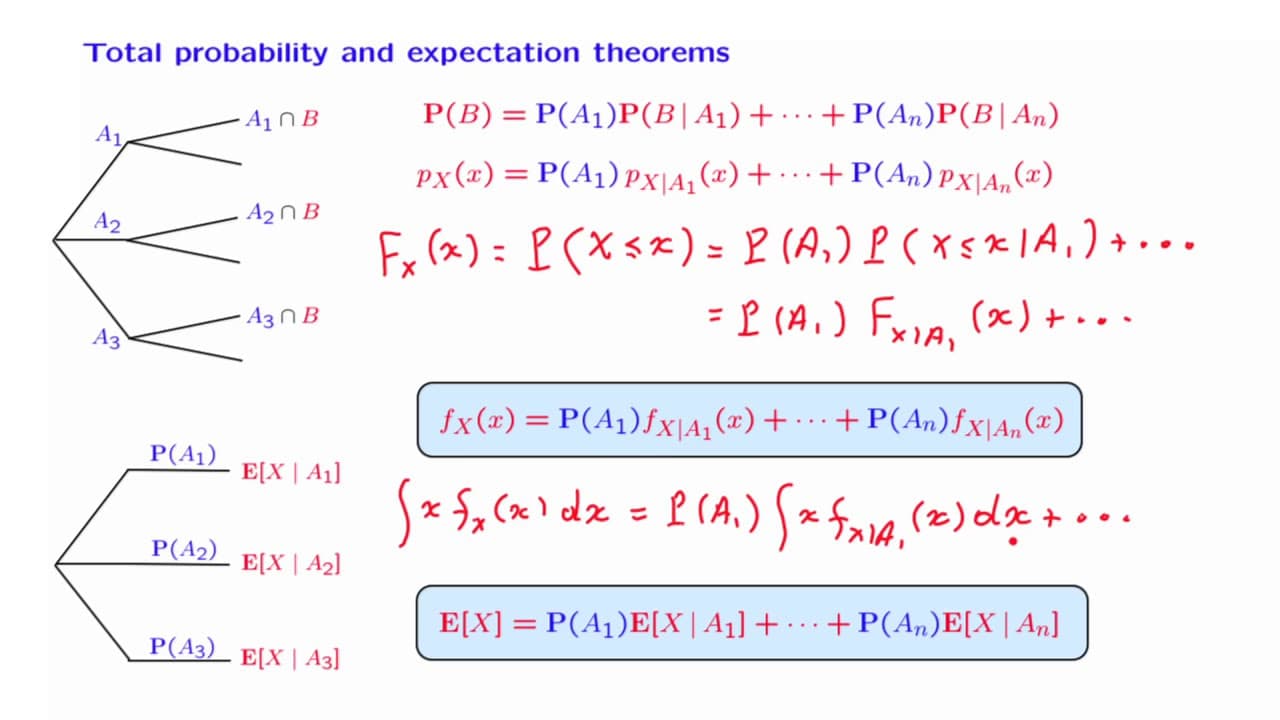
The continuous total probability theorem provides a framework for understanding random variables in continuous settings by relating cumulative distribution functions (CDFs) to probability density functions (PDFs). It allows for the calculation of overall probabilities and expected values across different scenarios, ensuring that both unconditional and conditional models are addressed in analysis.
Transcript
We now continue with the development of continuous analogs of everything we know for the discrete case. We have already seen a few versions of the total probability theorem, one version for events and one version for PMFs. Let us now develop a continuous analog. Suppose, as always, that we have a partition of the sample space into a number of disjo... Read More
Key Insights
- 👻 Continuous analogs of total probability theorem and expectation theorem allow for the analysis of continuous random variables and events.
- ❓ Cumulative distribution functions (CDFs) and probability density functions (PDFs) are interconnected in continuous models.
- ❓ Derivatives of CDFs yield PDFs, and this applies to both unconditional and conditional models.
- 🧡 The probability of a continuous random variable falling within a certain range is determined by the probabilities of each scenario in combination with their conditional PDFs.
- ❓ The total expectation theorem can be used to calculate the expected value of a continuous random variable in models with multiple scenarios.
Install to Summarize YouTube Videos and Get Transcripts
Explore YouTube Video Summarizer or Get YouTube Transcript Extractor
Questions & Answers
Q: What is the total probability theorem and how is it applied in the continuous case?
The total probability theorem states that the probability of an event is the sum of the probabilities of that event occurring under different scenarios. In the continuous case, it involves calculating the conditional probability of a continuous random variable falling within a certain range given different scenarios.
Q: How are cumulative distribution functions (CDFs) and probability density functions (PDFs) related in continuous models?
The left-hand side of the equation in CDF notation represents the CDF of the random variable. The right-hand side involves the probability of each scenario multiplied by the conditional CDF of the random variable within that scenario. Taking derivatives, the left-hand side becomes the PDF, and the right-hand side becomes the conditional PDF.
Q: How can the total expectation theorem be applied in a continuous model with multiple scenarios?
The total expectation theorem states that the expected value of a random variable is the sum of the expected values under different scenarios. In a continuous model, the conditional expectation is calculated for each scenario based on their corresponding conditional PDFs, and then weighted by the probability of each scenario.
Q: How can models with different scenarios be used to find overall probability distributions and expected values?
By knowing the probability distribution (PDF) under each scenario and their corresponding probabilities, the overall probability distribution can be obtained by summing the weighted PDFs. Similarly, the overall expected value can be calculated by summing the weighted conditional expectations under each scenario.
Summary & Key Takeaways
-
The content introduces the continuous analog of the total probability theorem for continuous random variables and events.
-
It explains the connection between cumulative distribution functions (CDFs) and probability density functions (PDFs) in continuous models.
-
An example is provided to illustrate how to calculate the probability density function and expected value under different scenarios.
Read in Other Languages (beta)
Share This Summary 📚
Summarize YouTube Videos and Get Video Transcripts with 1-Click
Try YouTube Summary with ChatGPT & Claude or YouTube Transcript Generator
Explore More Summaries from MIT OpenCourseWare 📚


Summarize YouTube Videos and Get Video Transcripts with 1-Click
Try YouTube Summary with ChatGPT & Claude or YouTube Transcript Generator