Probability – Examples 1 (GMAT/GRE/CAT/Bank PO/SSC CGL) | Don't Memorise
TL;DR
This content explains the types of probability problems involving coins and dice, and provides techniques for solving them efficiently.
Transcript
- coins tossed simultaneously and - dice rolled simultaneously are the two important kinds of probability problems you will come across in your exams do not ignore the other types but understand these two types really well now think of the number of possibilities in the first case there are two coins we may get a head on the first coin and a head o... Read More
Key Insights
- 🤣 There are two important types of probability problems: tossing coins simultaneously and rolling dice together.
- 🤕 When two coins are tossed, there are four possibilities: both heads, one head and one tail, one tail and one head, and both tails.
- 🤣 Rolling two dice together can result in 36 possibilities, which are used to solve probability problems.
- #️⃣ Calculating the probability of specific outcomes involves identifying the number of possibilities that meet the given conditions.
Install to Summarize YouTube Videos and Get Transcripts
Explore YouTube Video Summarizer or Get YouTube Transcript Extractor
Questions & Answers
Q: What are the two important types of probability problems discussed in the content?
The two important types of probability problems are tossing coins simultaneously and rolling dice together.
Q: How many possibilities exist when two coins are tossed simultaneously?
There are four possibilities when two coins are tossed simultaneously: both heads, one head and one tail, one tail and one head, and both tails.
Q: How many possibilities are there when two dice are rolled together?
When two dice are rolled together, there are 36 possibilities in total.
Q: How do we find the probability of getting a sum of six when rolling two dice?
To find the probability of getting a sum of six when rolling two dice, we identify the number of possibilities that result in a sum of six (which is five) out of the total 36 possibilities, giving a probability of 5/36.
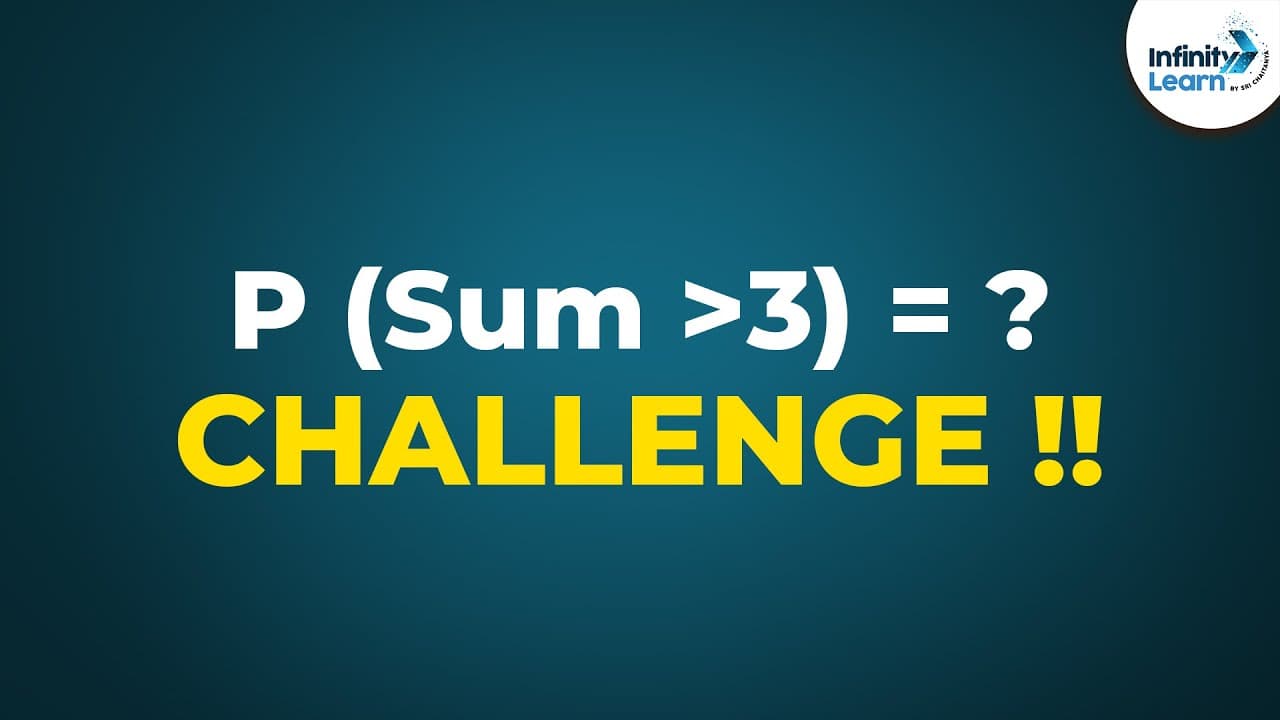
Q: What is the best approach for finding the probability of getting a sum greater than three when rolling two dice?
The best approach is to calculate the probability as 1 minus the probability of getting a sum less than or equal to three. This eliminates the need to list all possibilities and simplifies the calculation.
Summary & Key Takeaways
-
The content discusses two main types of probability problems: tossing coins simultaneously and rolling dice together.
-
In coin-tossing problems, there are four possibilities: both heads, one head and one tail, one tail and one head, and both tails.
-
Rolling two dice together can result in 36 possibilities, and solving probability problems involves finding specific outcomes among these possibilities.
Read in Other Languages (beta)
Share This Summary 📚
Summarize YouTube Videos and Get Video Transcripts with 1-Click
Try YouTube Summary with ChatGPT & Claude or YouTube Transcript Generator
Explore More Summaries from Infinity Learn NEET 📚

Summarize YouTube Videos and Get Video Transcripts with 1-Click
Try YouTube Summary with ChatGPT & Claude or YouTube Transcript Generator