Lecture 11: Minimizing ‖x‖ Subject to Ax = b
TL;DR
The lecture discusses the Gram-Schmidt algorithm and its importance in finding orthogonal basis vectors, as well as the application of Krylov subspaces in solving large matrix equations.
Transcript
The following content is provided under a Creative Commons license. Your support will help MIT OpenCourseWare continue to offer high quality educational resources for free. To make a donation or to view additional materials from hundreds of MIT courses, visit MIT OpenCourseWare at ocw.mit.edu. GILBERT STRANG: Well, so three things to mention. One w... Read More
Key Insights
- ❓ The Gram-Schmidt algorithm is crucial in finding orthogonal basis vectors and reducing dependence among vectors.
- ⬛ The Krylov subspace method is an effective approach to solving large matrix equations by finding the best least squares solution in a lower-dimensional subspace.
- ❓ The Arnoldi and Lanczos algorithms are used to orthogonalize basis vectors in the Krylov subspace method and improve the accuracy of calculations.
Install to Summarize YouTube Videos and Get Transcripts
Explore YouTube Video Summarizer or Get YouTube Transcript Extractor
Questions & Answers
Q: What is the main purpose of the Gram-Schmidt algorithm?
The main purpose of the Gram-Schmidt algorithm is to find an orthogonal basis for a set of vectors. It helps to reduce dependence among the vectors and allows for easier calculations in linear algebra.
Q: How does the Krylov subspace method work?
The Krylov subspace method involves finding the best least squares solution in a subspace spanned by a set of vectors. It helps in solving large matrix equations by projecting the problem onto a lower-dimensional subspace.
Q: What is the role of the Arnoldi and Lanczos algorithms in the Krylov subspace method?
The Arnoldi and Lanczos algorithms are used to orthogonalize the basis vectors in the Krylov subspace method. They ensure that the basis vectors are orthogonal and facilitate more accurate calculations.
Q: Why is it important to find an orthogonal basis when solving matrix equations?
Finding an orthogonal basis allows for easier calculations and reduces the risk of errors. It simplifies the projection process and helps in obtaining more accurate solutions.
Summary & Key Takeaways
-
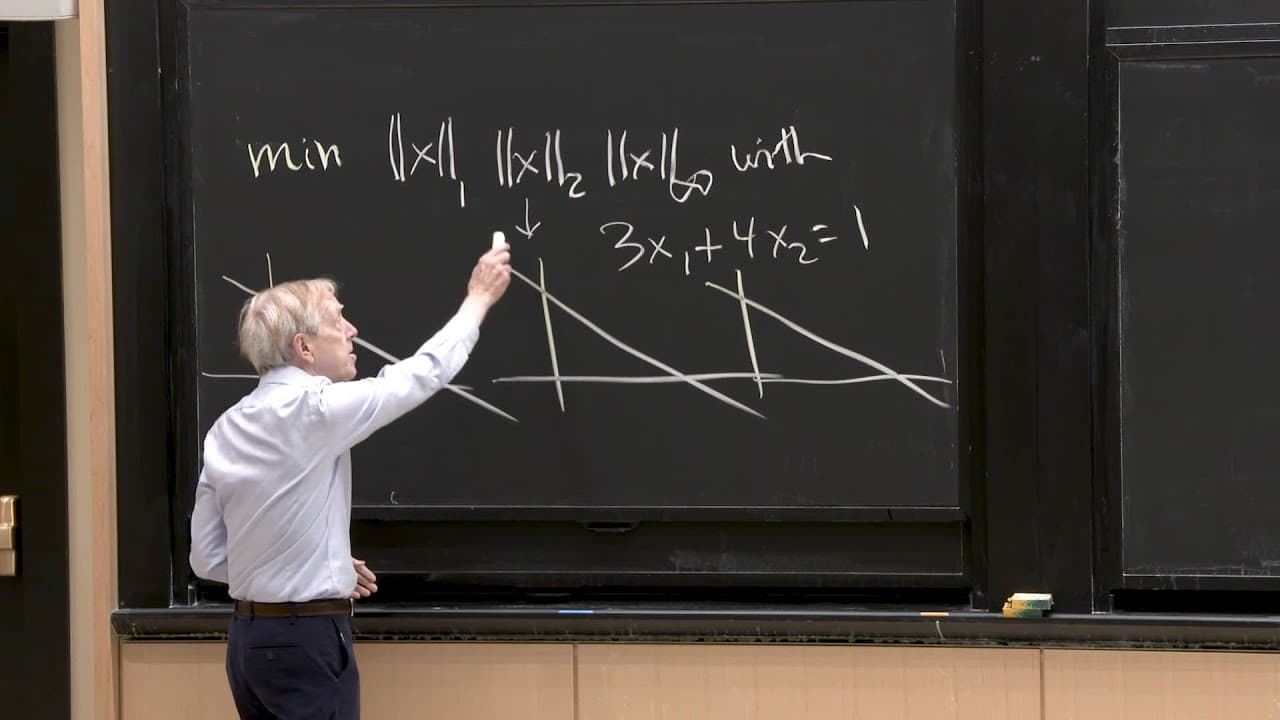
Professor Strang begins by discussing the typos in his book and the time it takes to write a book by hand. He then introduces the concept of minimizing different norms and illustrates it with examples in 2D.
-
He explains the Gram-Schmidt algorithm, which is used to orthogonalize a set of vectors and find a perfect basis. He highlights the importance of an orthogonal matrix and how it relates to a matrix A.
-
Professor Strang also introduces the Krylov subspaces, which involve finding the best least squares solution in a subspace spanned by a set of vectors. He explains how the Arnoldi and Lanczos algorithms are used to orthogonalize the basis vectors.
Read in Other Languages (beta)
Share This Summary 📚
Summarize YouTube Videos and Get Video Transcripts with 1-Click
Try YouTube Summary with ChatGPT & Claude or YouTube Transcript Generator
Explore More Summaries from MIT OpenCourseWare 📚



Summarize YouTube Videos and Get Video Transcripts with 1-Click
Try YouTube Summary with ChatGPT & Claude or YouTube Transcript Generator