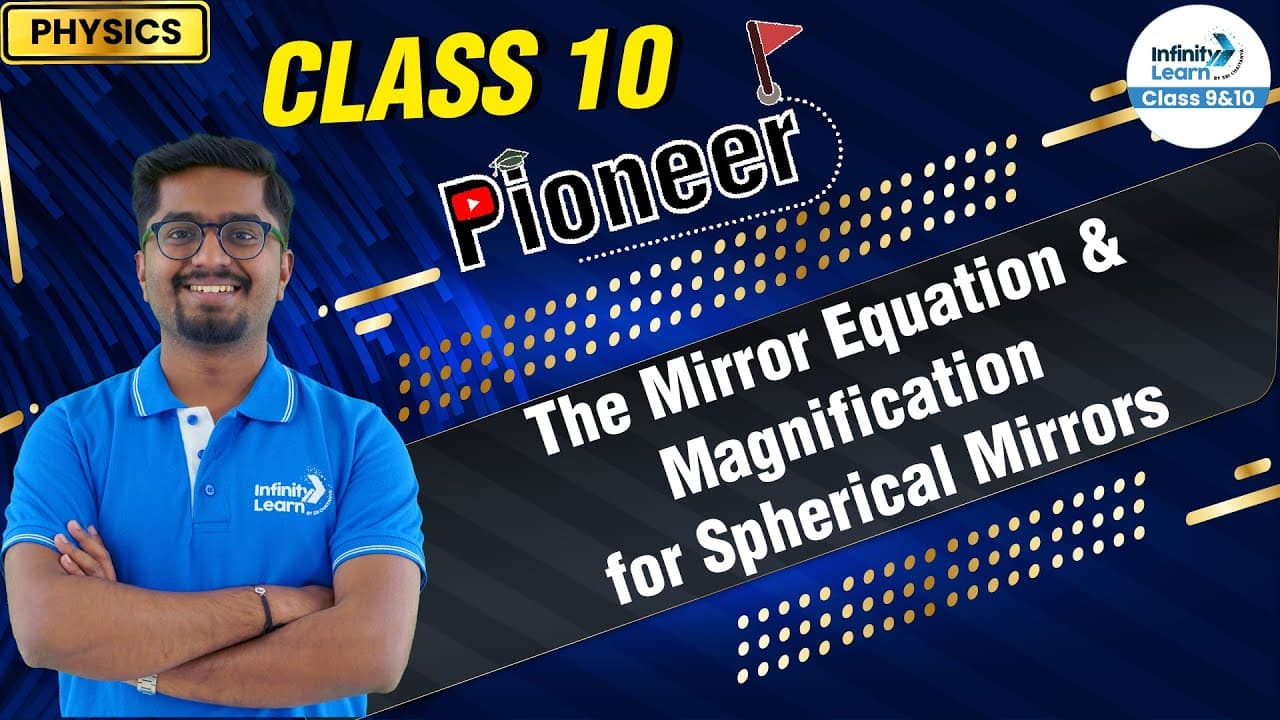
The Mirror Equation & Magnification for Spherical Mirrors - Class 10 || #Pioneer || IL Class 9&10
TL;DR
This content discusses the properties, sign convention, mirror formula, and magnification of concave and convex spherical mirrors.
Transcript
hello hi everyone good afternoon welcome all so we are going to learn the next topic for this Pioneer batch it is magnification due to spherical mirrors so Harmony spherical mirror they have mirror properties there is a concave mirror and a convex mirror the harmony last class image formation there is a magnification so let's begin so just say hi h... Read More
Key Insights
- 🪩 The sign convention for spherical mirrors dictates that distances to the right of the mirror are positive, while distances to the left are negative.
- 🪩 The mirror formula is a useful tool for calculating the image distance using the object distance and focal length of the mirror.
- 🥳 Magnification in spherical mirrors is defined as the ratio of the image height to the object height and can be positive or negative.
- 🪩 Convex mirrors always produce virtual, erect, and diminished images, while concave mirrors can produce real or virtual, inverted or erect, and enlarged or diminished images.
Install to Summarize YouTube Videos and Get Transcripts
Explore YouTube Video Summarizer or Get YouTube Transcript Extractor
Questions & Answers
Q: What is the sign convention for measuring distances in spherical mirrors?
The object should always be on the left of the mirror, and distances on the right side are positive while distances on the left side are negative. Upward distances are positive, while downward distances are negative.
Q: What is the mirror formula, and how is it used?
The mirror formula is used to calculate the image distance in relation to the object distance and focal length. It is given by 1/V + 1/U = 1/f, where V is the image distance, U is the object distance, and f is the focal length of the mirror.
Q: How is magnification defined in the context of spherical mirrors?
Magnification is the ratio of the height of the image to the height of the object. It can be positive or negative based on the nature of the image, with positive values indicating an upright image and negative values indicating an inverted image.
Q: What are the properties of the image formed by a convex mirror?
The image formed by a convex mirror is always virtual, erect, and diminished in size. The magnification of a convex mirror is always less than one.
Q: What is the magnification for a plane mirror?
The magnification for a plane mirror is always equal to one, as the image formed is of the same size as the object and is virtual and erect.
Q: How does the magnification differ for real and virtual images in a concave mirror?
For real images in a concave mirror, the magnification is always negative, indicating an inverted image. For virtual images in a concave mirror, the magnification is always positive, indicating an upright image.
Q: What type of mirror produces an enlarged, real, and inverted image?
A concave mirror, when the object is placed beyond the center of curvature, will produce an enlarged, real, and inverted image.
Q: How is the size of the image calculated in spherical mirrors?
The height of the image can be calculated using the formula: (height of the image) = (minus V/U) x (height of the object), where V is the image distance, U is the object distance, and the magnification is negative.
Summary & Key Takeaways
-
This content introduces the topic of magnification in spherical mirrors, specifically concave and convex mirrors.
-
It explains the sign convention for measuring distances on the x and y axes.
-
The mirror formula and its components, such as object distance, image distance, and focal length, are discussed.
-
The concept of magnification is explained, including its calculation and the effects of object and image properties.
Read in Other Languages (beta)
Share This Summary 📚
Summarize YouTube Videos and Get Video Transcripts with 1-Click
Try YouTube Summary with ChatGPT & Claude or YouTube Transcript Generator
Explore More Summaries from Infinity Learn NEET 📚

Summarize YouTube Videos and Get Video Transcripts with 1-Click
Try YouTube Summary with ChatGPT & Claude or YouTube Transcript Generator