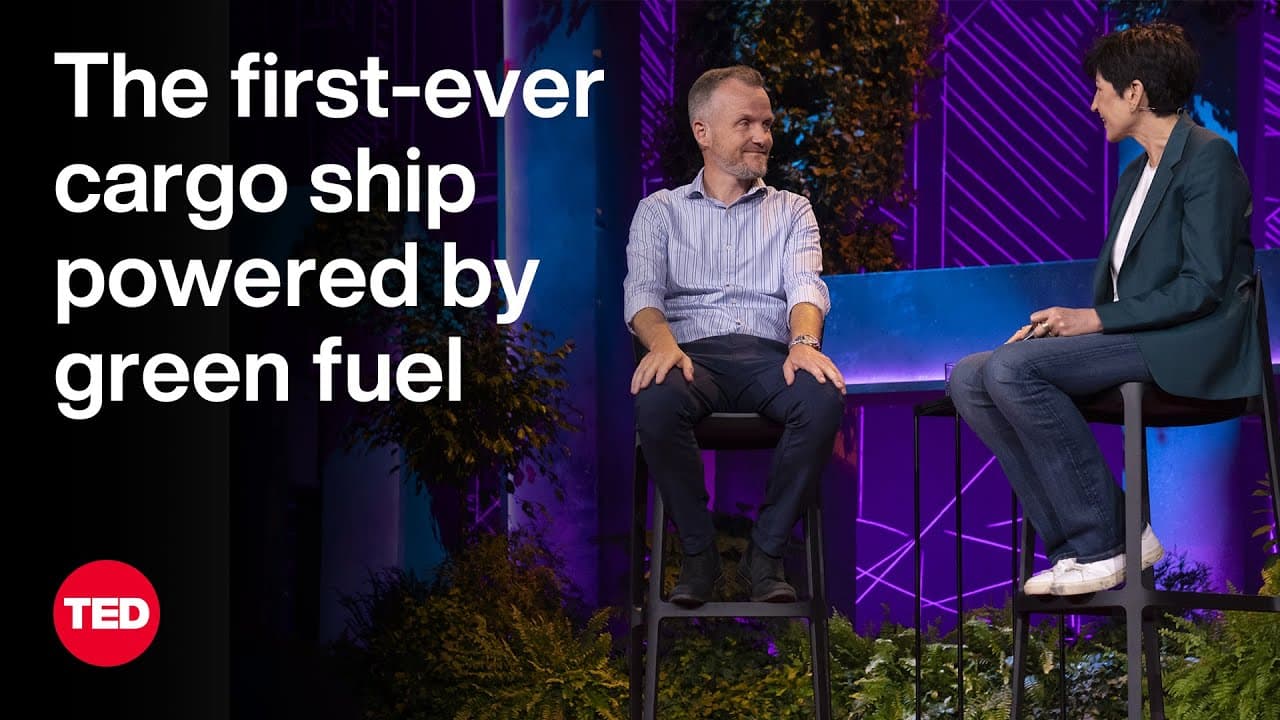
The First-Ever Cargo Ship Powered By Green Fuel | Morten Bo Christiansen | TED
TL;DR
In this interview, Lindsay Levin speaks with Morten Bo Christiansen from Maersk about their ambitious goal to decarbonize their business by 2040 and the progress they have made so far, including ordering container ships that run on green methanol.
Transcript
Lindsay Levin: Welcome, we're excited to have you here, and one of the things we're very keen to do with Countdown is to follow up on stuff and find out how our promises fare. And I know that Maersk, I believe it's correct to say that your greenhouse gas emissions, as a global business, are greater than that of Denmark, where you're based. So you'r... Read More
Key Insights
- 🌍 Maersk has a vision to decarbonize its heavy-emitting business by 2040, and they are already taking steps to implement solutions such as ordering container ships that can sail on green methanol and retrofitting existing vessels to burn green methanol.
- 🚢 Maersk has ordered 25 container ships that can use green methanol as a fuel, with 19 currently being produced and one already delivered. They are also building green warehouses and electrifying their terminals.
- 🚚 Maersk is introducing electric trucks into their US and German markets to reduce emissions from their land operations.
- 🌐 Global logistics, including trucks, ships, planes, warehouses, and ports, account for 11% of all emissions, highlighting the need for action in the industry.
- 📈 The number of container ships ordered that can use green methanol has grown exponentially, with 120 ships currently on order. This shows a shift in the industry towards more sustainable solutions.
- 🐔 Maersk recognizes the challenge of choosing the right technology for decarbonization, as there are multiple options such as green methanol, green ammonia, green methane, electrification, and more. However, they believe it is important to get started and progress towards decarbonization.
- ⚡ Maersk has chosen methanol as their fuel of choice because it is a viable and available option for immediate implementation.
- 💰 Green fuels such as green methanol are currently more expensive than conventional fuels, but Maersk believes that the cost can be absorbed throughout the value chain without a significant impact on consumer prices, while also encouraging customers to pay a green premium to support sustainable practices.
Install to Summarize YouTube Videos and Get Transcripts
Explore YouTube Video Summarizer or Get YouTube Transcript Extractor
Questions & Answers
Q: What is Maersk's vision for decarbonizing their heavy-emitting business?
Maersk's vision is to decarbonize their heavy-emitting business by 2040, which they find exciting. They have already started implementing solutions such as ordering 25 container ships that can sail on green methanol, and retrofitting existing oil vessels to burn green methanol.
Q: How many of the ordered container ships are being produced currently?
19 of the ordered container ships are currently being produced, and Maersk has already taken delivery of the first one.
Q: How is Maersk making progress in terms of decarbonization?
Maersk is making progress by ordering container ships that can sail on green methanol, building green warehouses, electrifying their terminals, and deploying heavy-duty electric trucks. These initiatives are aimed at reducing the greenhouse gas emissions associated with their global logistics operations.
Q: How does Maersk plan to address the challenge of scaling up production of green methanol?
Maersk recognizes that scaling up production of green methanol is a supply challenge. If all their ships were to sail on so-called e-methanol made from renewable electricity, it would require a significant portion of the world's wind and solar energy production. Despite the magnitude of this challenge, Maersk emphasizes the need to get started rather than waiting for the perfect solution.
Q: How is Maersk tackling the issue of higher costs associated with green fuels?
Green fuels, like green methanol, are more expensive than conventional fuels. To address this issue, Maersk is looking to have partnerships across the value chain, including customers, to de-risk the investments in green fuels. They aim to have customers pay a green premium to cover the higher costs, which can be absorbed in the prices of consumer products. Maersk is taking steps to give confidence to the value chain and actively support the development and use of green fuels.
Summary & Key Takeaways
-
Maersk, a global shipping company, aims to decarbonize its heavy-emitting business by 2040 by implementing solutions such as using green methanol as fuel and electrifying terminals.
-
Maersk has ordered 25 container ships that can sail on green methanol and has retrofitted an existing oil vessel to burn green methanol.
-
The company is also building green warehouses and has deployed heavy-duty electric trucks in the US and Germany, among other initiatives, to reduce emissions and make progress towards its decarbonization goal.
Read in Other Languages (beta)
Share This Summary 📚
Summarize YouTube Videos and Get Video Transcripts with 1-Click
Try YouTube Summary with ChatGPT & Claude or YouTube Transcript Generator
Explore More Summaries from TED 📚




Summarize YouTube Videos and Get Video Transcripts with 1-Click
Try YouTube Summary with ChatGPT & Claude or YouTube Transcript Generator