Lecture 20: Space of Rotations, Regular Tessellations, Critical Surfaces, Binocular Stereo
TL;DR
Understanding the relative orientation between two cameras is essential in computer vision, but certain surfaces pose challenges due to ambiguities and errors in calculations.
Transcript
[SQUEAKING] [RUSTLING] [CLICKING] BERTHOLD HORN: Briefly last time about tesselating spheres in various dimensions. We found that representing rotation as unit quaternions was useful. And so in exploring that space of rotation, we're dealing with a sphere in 4D, and it'd be good to divide it up into equal areas. And in the process, we started talki... Read More
Key Insights
- 🤩 The triple product is a key component in relative orientation calculations, measuring the error between intersecting rays.
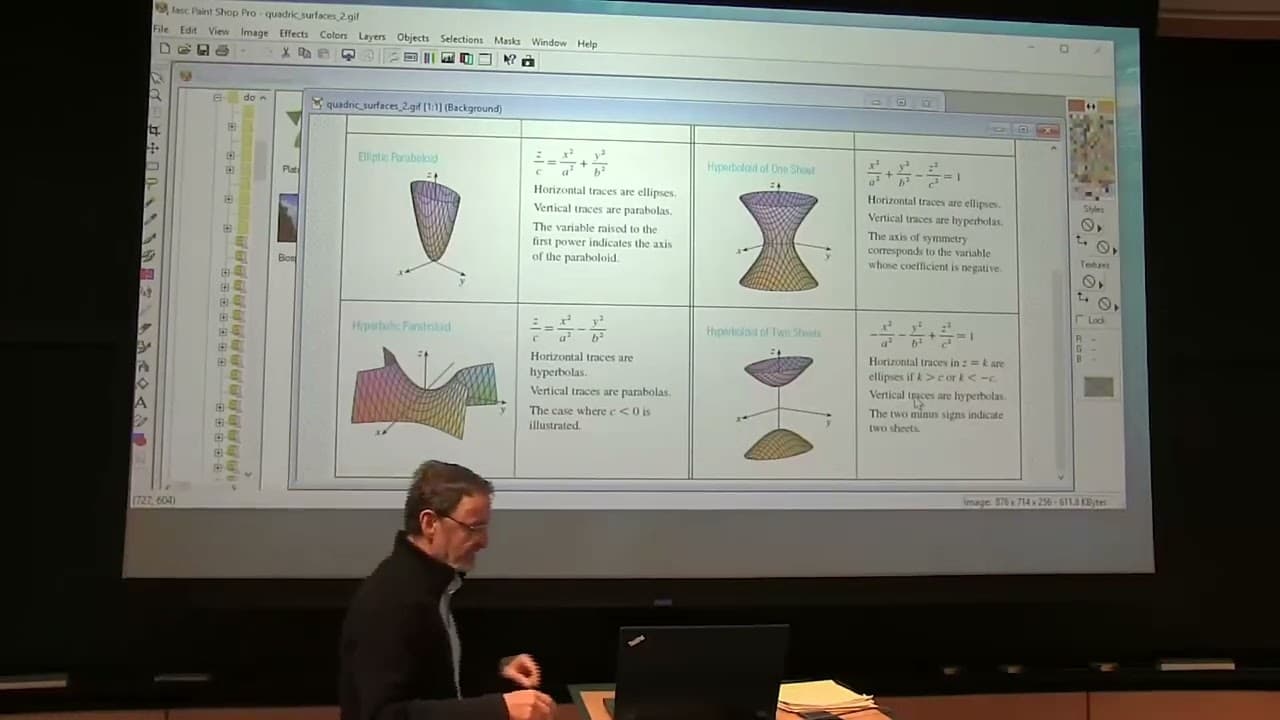
- 😄 Critical surfaces, such as U-shaped valleys and quadric surfaces, can introduce ambiguities and errors in relative orientation calculations.
- 🙌 Iterative optimization algorithms can be used to improve the accuracy of relative orientation calculations by minimizing the error between the rays in the image plane.
Install to Summarize YouTube Videos and Get Transcripts
Explore YouTube Video Summarizer or Get YouTube Transcript Extractor
Questions & Answers
Q: What is the triple product and how does it relate to relative orientation?
The triple product is a measure of the error between two intersecting rays. It is used to calculate the discrepancy between the two rays in order to determine the relative orientation between the cameras.
Q: What are critical surfaces and how do they impact relative orientation calculations?
Critical surfaces are surfaces that can introduce ambiguities and errors in relative orientation calculations. Examples include U-shaped valleys and quadric surfaces like hyperboloids of one sheet. These surfaces may cause the intersection of the rays to be behind the cameras, resulting in negative values for alpha and beta.
Q: How can we handle errors and ambiguities in relative orientation calculations?
One approach is to use iterative optimization algorithms, such as the Levenberg-Marquardt algorithm, to minimize the error between the rays in the image plane. Additionally, careful weighting and consideration of the geometric constraints can help improve the accuracy of the calculations.
Q: Are there any limitations to relative orientation calculations?
Relative orientation calculations can be challenging in cases where there are not enough correspondences or when dealing with critical surfaces that introduce ambiguities. It is important to carefully consider the geometry and constraints of the problem to ensure accurate and reliable results.
Summary & Key Takeaways
-
Relative orientation involves determining the geometric relationship between two cameras and is used to calculate 3D information from 2D images.
-
The triple product, a measure of error between two intersecting rays, is a key component in relative orientation calculations.
-
Critical surfaces, such as U-shaped valleys or quadric surfaces like hyperboloids of one sheet, can introduce ambiguities and errors in relative orientation calculations.
Read in Other Languages (beta)
Share This Summary 📚
Summarize YouTube Videos and Get Video Transcripts with 1-Click
Try YouTube Summary with ChatGPT & Claude or YouTube Transcript Generator
Explore More Summaries from MIT OpenCourseWare 📚


Summarize YouTube Videos and Get Video Transcripts with 1-Click
Try YouTube Summary with ChatGPT & Claude or YouTube Transcript Generator