Why elementary schools should teach poker | Liv Boeree | Big Think
TL;DR
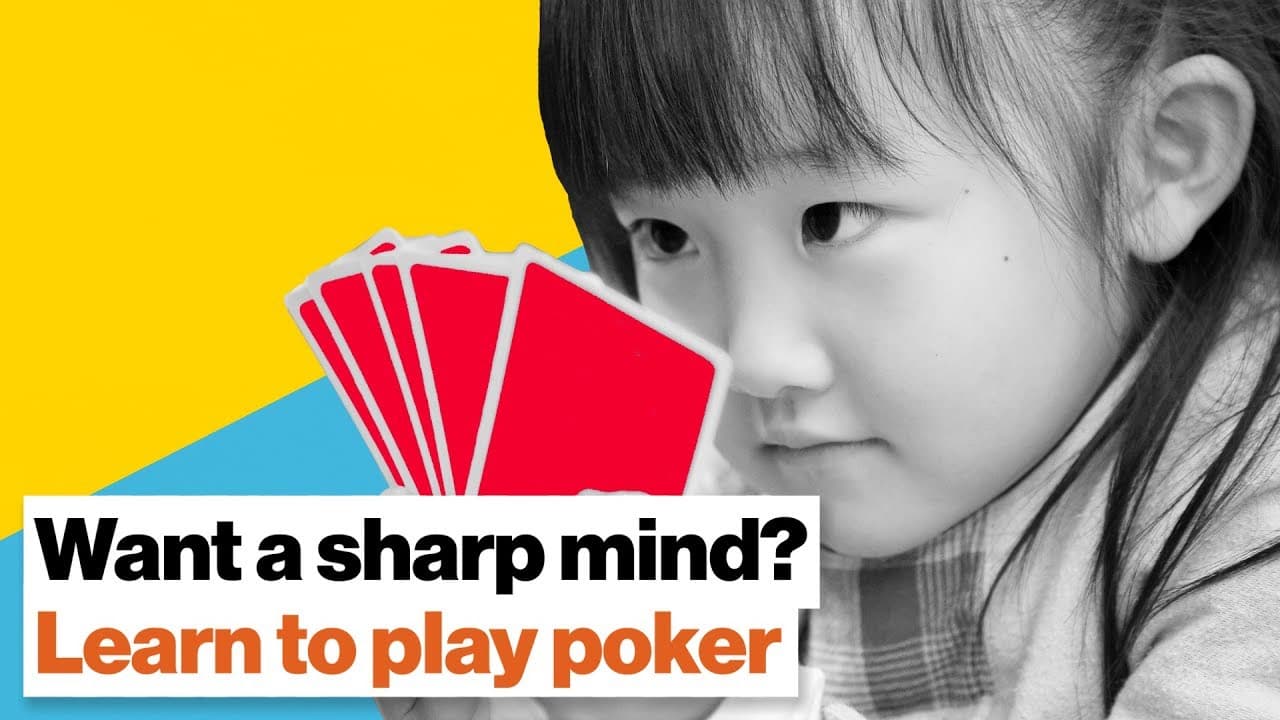
Poker teaches life skills like probability and critical thinking, valuable for children.
Transcript
Do I think we should teach poker in elementary schools? Yes, I think there are elements of the game that you should teach in terms of like—because what poker really does is teach you how to deal with probabilities and uncertainties, and that's so integral to life. Everything we try to do—“should we take this route or that route”, “should I go here ... Read More
Key Insights
- 🤝 Poker teaches valuable life skills like dealing with uncertainties and probabilities.
- 🤔 It fosters critical thinking by evaluating evidence and updating beliefs.
- ❓ Math skills can be significantly improved through practice and determination.
- ❎ Negative early math experiences can create barriers to learning that hinder skill development.
- ❓ Learning to be mathematically capable, especially in poker-related mathematics, is accessible to most individuals.
- 🤑 Poker can be played for skill development without involving money.
- 👾 Teaching children through games like poker can enhance their engagement and learning outcomes.
Install to Summarize YouTube Videos and Get Transcripts
Explore YouTube Video Summarizer or Get YouTube Transcript Extractor
Questions & Answers
Q: Why does the speaker believe poker should be taught in elementary schools?
The speaker believes poker teaches essential life skills such as dealing with uncertainties, probabilities, evaluating evidence, and changing beliefs, which are crucial for decision-making in various aspects of life.
Q: Can poker be played without involving money?
Yes, poker can be played for enjoyment and skill development without any monetary involvement. Winning can be in pride, matchsticks, or any agreed-upon reward, emphasizing the focus on strategy and critical thinking.
Q: How does poker help improve mathematical skills?
Poker involves basic mathematical concepts like probabilities, expected value, and mental arithmetic, which can be honed through practice, leading to a better understanding of numbers and enhancing overall mathematical capabilities.
Q: What impact does early negative experiences with math have on individuals?
Negative experiences with math at a young age can create barriers to learning and confidence in mathematical abilities, leading to a belief that math is not their forte. Overcoming such barriers through positive experiences and practice is crucial for skill improvement.
Summary & Key Takeaways
-
Poker teaches skills like dealing with uncertainties and probabilities essential in life decisions.
-
It fosters critical thinking by evaluating evidence and changing beliefs based on new information.
-
Math skills honed through poker demonstrate that anyone can improve with practice and determination.
Read in Other Languages (beta)
Share This Summary 📚
Summarize YouTube Videos and Get Video Transcripts with 1-Click
Try YouTube Summary with ChatGPT & Claude or YouTube Transcript Generator
Explore More Summaries from Big Think 📚



Summarize YouTube Videos and Get Video Transcripts with 1-Click
Try YouTube Summary with ChatGPT & Claude or YouTube Transcript Generator