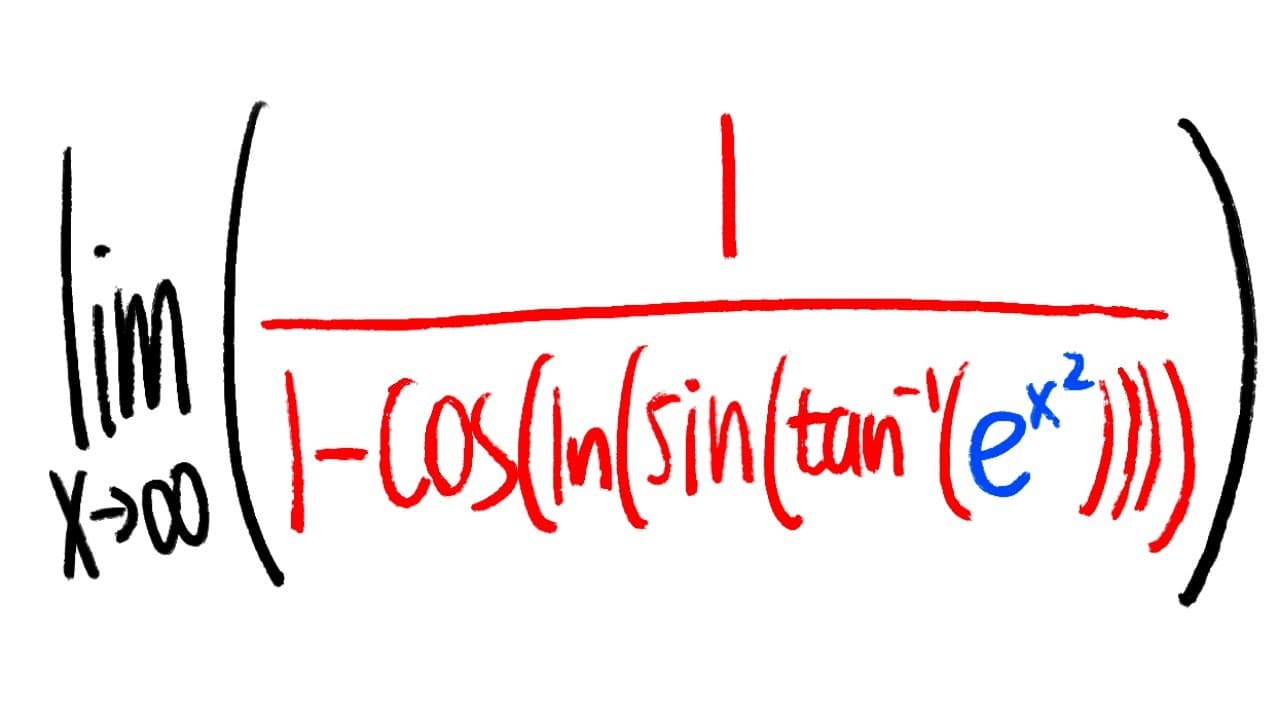
limit of 1/(1-cos(ln(sin(tan^-1(e^(x^2)))))) as x goes to infinity
TL;DR
Calculus teacher explains step-by-step how to calculate the limit of a complex mathematical expression approaching infinity.
Transcript
okay let's do some math for fun and here I have this limit for you guys and in fact I just created this limit today let's have a look we have the limit as X approaching Infinity of 1 over 1 minus ready cosine of Ln of sign of inverse tangent of e to the x s power yeah and I really wanted to put this on my calculus one quiz for my calculus ... Read More
Key Insights
- 😘 The limit expression contains various mathematical functions such as Ln, sin, arctan, and cosine.
- ☺️ The limit is determined by analyzing the behavior of each function as x approaches infinity.
- 😒 The teacher uses visual representations, like unit circles and graphs, to illustrate the concept.
Install to Summarize YouTube Videos and Get Transcripts
Explore YouTube Video Summarizer or Get YouTube Transcript Extractor
Questions & Answers
Q: What is the limit expression being solved in the video?
The limit expression is 1 divided by 1 minus cosine of Ln of sin of arctan of e to the x, as x approaches infinity.
Q: How does the limit approach infinity?
By analyzing the individual functions within the expression, such as Ln, sin, arctan, and cosine, the teacher shows that the limit approaches positive infinity.
Q: Why did the teacher decide not to include this limit question on their calculus quiz?
The teacher chose not to include this limit question on the quiz because it is too complex for students in only their third week of calculus.
Q: What are the values of each function within the limit expression as x approaches infinity?
As x approaches infinity, the values are: Ln(infinity) = infinity, sin(arctan(infinity)) = 1, and cosine(0) = 1.
Summary & Key Takeaways
-
The video features a calculus teacher explaining and solving a limit problem involving trigonometric and exponential functions.
-
The limit expression is 1 divided by 1 minus cosine of the natural logarithm of the sine of the inverse tangent of e to the power of x.
-
By reasoning out each step, the teacher shows how the limit approaches positive infinity.
Read in Other Languages (beta)
Share This Summary 📚
Summarize YouTube Videos and Get Video Transcripts with 1-Click
Try YouTube Summary with ChatGPT & Claude or YouTube Transcript Generator
Explore More Summaries from blackpenredpen 📚
Summarize YouTube Videos and Get Video Transcripts with 1-Click
Try YouTube Summary with ChatGPT & Claude or YouTube Transcript Generator