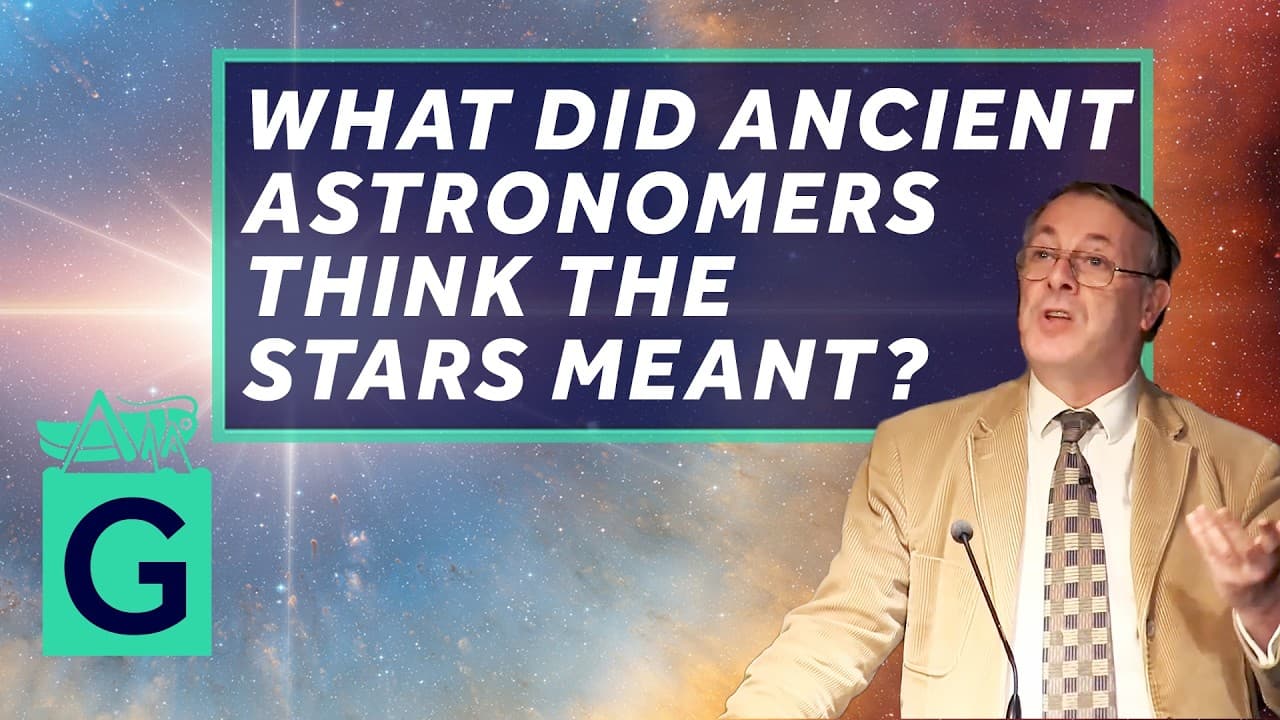
Watching the Heavens: Astronomy and the Meaning of Life - Professor Alister McGrath
TL;DR
Exploring the philosophical and existential questions raised by the beauty and vastness of the night sky.
Transcript
well good afternoon ladies and gentlemen and welcome to you all here in the Museum of London and also to those of you who are joining us by livestream for the second gresham lecture in divinity for the year 2017 to 18 and tonight we're looking at this fascinating theme of watching the heavens what what's that all about why might that be interesting... Read More
Key Insights
- 🤨 Watching the heavens raises questions about the nature of existence, meaning, and significance.
- ❓ The expansion of the universe and the discovery of other galaxies challenge our perception of being at the center of the universe.
- 💅 The beauty and vastness of the night sky can evoke a sense of wonder and yearning for something beyond ourselves.
Install to Summarize YouTube Videos and Get Transcripts
Explore YouTube Video Summarizer or Get YouTube Transcript Extractor
Questions & Answers
Q: What is the connection between watching the heavens and philosophical or existential thinking?
Looking at the night sky evokes a sense of wonder that can lead individuals to reflect on their place in the universe and the existence of something beyond themselves. It raises deep questions about meaning and significance.
Q: How did the scientific understanding of the universe change in the 16th and 17th centuries?
Copernicus challenged the prevailing model of a geocentric universe by proposing that the planets, including Earth, orbit the sun. This led to a growing understanding that humans are not the center of the universe but part of a much larger system.
Q: What is the "parallax effect" and how did it influence the understanding of the universe?
The parallax effect refers to the apparent change in the position of objects when viewed from different perspectives. Danish astronomer Tycho Brahe raised concerns about the lack of parallax observed in the stars, suggesting that the Earth might not be in motion as proposed by Copernicus.
Q: How does the expansion of the universe and the discovery of other galaxies affect our understanding of our place in the universe?
The expansion of the universe and the discovery of other galaxies beyond our own reveals that humans are small and insignificant in the grand scheme of things. It raises questions about the origins of the universe and our place within it.
Q: What is the relationship between science and religion when it comes to understanding the universe?
While the scientific understanding of the origins of the universe and religious narratives of creation are different, they can have points of convergence. Science can illuminate the workings of the universe, while religion provides a framework for meaning and value, allowing for a deeper understanding of ourselves and our place in the universe.
Summary & Key Takeaways
-
The lecture explores the theme of watching the heavens and its significance to religious individuals, raising questions about the bigger picture the stars may point towards.
-
It discusses the entanglement of astronomy and astrology in ancient times and how scientific observations fed into astronomical ways of thinking.
-
The speaker reflects on the insignificance and mortality humans feel when looking at the night sky, as well as the yearning for something significant that lies beyond it.
Read in Other Languages (beta)
Share This Summary 📚
Summarize YouTube Videos and Get Video Transcripts with 1-Click
Try YouTube Summary with ChatGPT & Claude or YouTube Transcript Generator
Explore More Summaries from Gresham College 📚

Summarize YouTube Videos and Get Video Transcripts with 1-Click
Try YouTube Summary with ChatGPT & Claude or YouTube Transcript Generator