The 3 ‘demons’ that haunted legendary scientists | Jimena Canales | Big Think
TL;DR
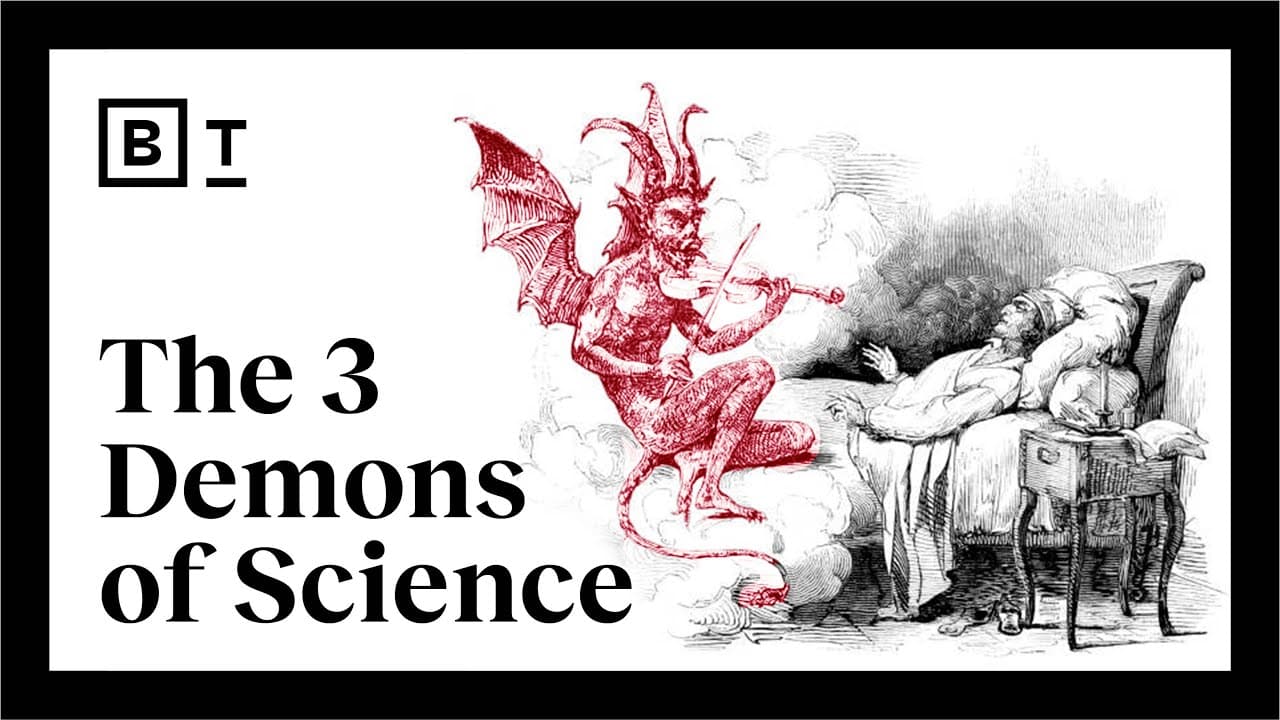
Scientists throughout history have personified unknown forces as demons in their quest to understand nature better.
Transcript
- If one opens any dictionary and you go to the entry of demon, one of the entries refers to the scientific demons. Descartes' demons, Laplace's demon, Maxwell's demon, they're not considered to be real when they're first mentioned, they're considered to be possibly real. They're trying to find a hole in their theories. They immediately anthropomor... Read More
Key Insights
- 😒 Scientists use demons figuratively to represent unknown forces or loopholes in their theories.
- 👨🔬 The concept of demons is deeply rooted in scientific history and continues to influence research and understanding.
- 🤔 Personifying scientific challenges as demons fosters critical thinking and exploration of unconventional ideas.
- 🤔 Descartes used the demon as a thought experiment to delve into the nature of reality.
- ❓ Maxwell's demon contributed significantly to the understanding of thermodynamics and technological advancements.
- ❓ Darwin's demon inspired his theory of natural selection, revolutionizing the scientific understanding of evolution.
- 🙂 Tracking the concept of demons in science sheds light on the evolution of scientific thought and technological progress.
Install to Summarize YouTube Videos and Get Transcripts
Explore YouTube Video Summarizer or Get YouTube Transcript Extractor
Questions & Answers
Q: What is the significance of scientists personifying unknown forces as demons?
Scientists use the concept of demons to represent unexplained phenomena, debunking theories, or highlighting areas of manipulation in nature, which aids in scientific advancement.
Q: How did Descartes use the idea of a demon to explore the concept of virtual reality?
Descartes introduced the concept of a demon that could create an alternate reality, prompting philosophical debates about perception and reality, leading to the foundation of modern logic.
Q: Why was Maxwell's demon crucial in understanding thermodynamics?
Maxwell's demon was pivotal in explaining exceptions to statistical laws in thermodynamics by manipulating atoms in a container, leading to the development of electronic gadgets.
Q: How did Darwin's demon influence his theory of natural selection?
Darwin's demon conceptually explored the idea of a being that could manipulate species, eventually evolving into the theory of natural selection, shaping his research on evolution.
Summary & Key Takeaways
-
Renowned scientists like Descartes, Maxwell, and Darwin used the concept of demons to explain uncertainties in their theories.
-
These "scientific demons" are not evil but represent the unexplained or manipulative aspects of nature.
-
Scientists continue to study and utilize the concept of demons to push the boundaries of science.
Read in Other Languages (beta)
Share This Summary 📚
Summarize YouTube Videos and Get Video Transcripts with 1-Click
Try YouTube Summary with ChatGPT & Claude or YouTube Transcript Generator
Explore More Summaries from Big Think 📚




Summarize YouTube Videos and Get Video Transcripts with 1-Click
Try YouTube Summary with ChatGPT & Claude or YouTube Transcript Generator