Trigonometry Law of Sines / Sine Rule
TL;DR
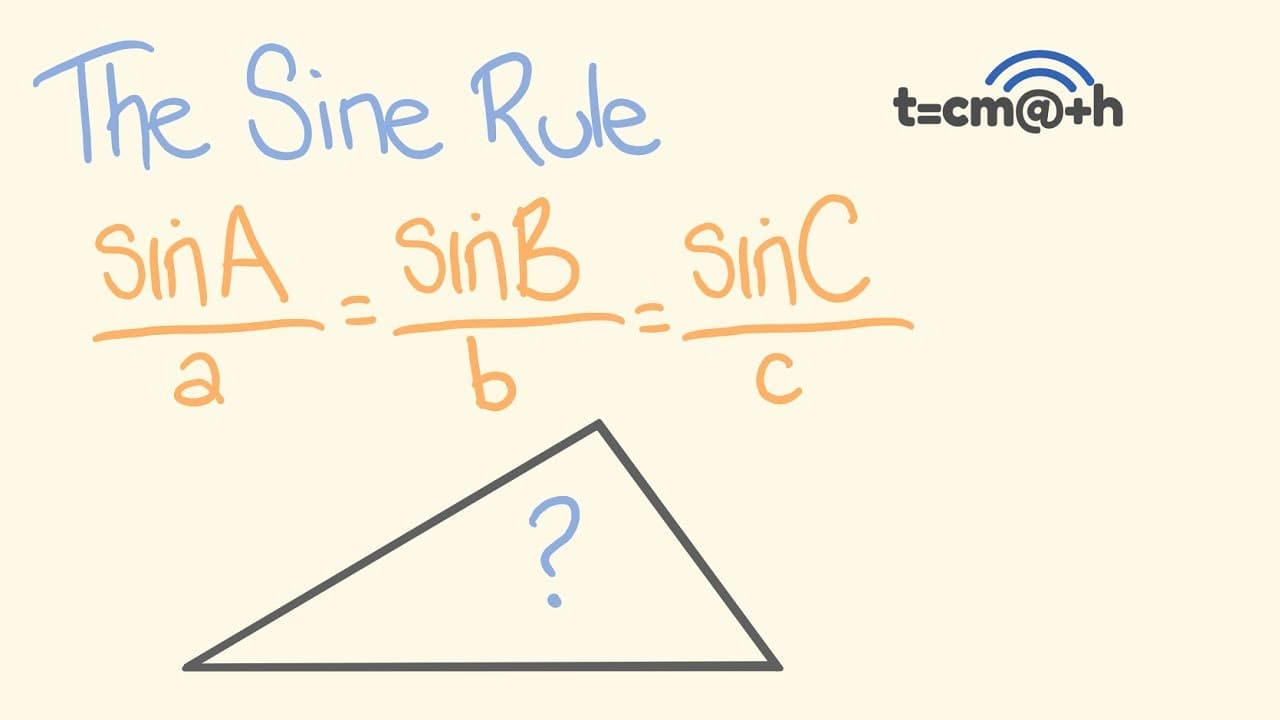
The sign rule is a useful method to calculate unknown sides and angles in non-right angle triangles.
Transcript
good day welcome to Tech maath Channel what we're going to be having a look at in this video is the sign rule so sit back and enjoy and before we start a big shout out to my latest Patron Zoya uh your support is well appreciated anybody who wants to become a patreon and support the techmath channel you'll see a link in the description below so the ... Read More
Key Insights
- 🔺 The sign rule is a method used to solve for unknown sides and angles in non-right angle triangles.
- 🔺 It is based on the ratio of a side length to its corresponding angle's sine, which is equal for all sides and angles in a triangle.
- 😫 By knowing at least one full set of angles and side lengths, the sign rule can be used to find the remaining unknowns.
- 🥳 The sign rule can be simplified by using the ratio of one side length to its corresponding angle's sine.
- 🔺 It is important to properly label the angles and side lengths in a triangle when applying the sign rule.
- 📏 The sign rule can be used in conjunction with the cosine rule to solve more complex trigonometric problems.
- 🤘 A helpful trick when using the sign rule is to multiply two given numbers to find the value of an unknown side length or angle.
Install to Summarize YouTube Videos and Get Transcripts
Explore YouTube Video Summarizer or Get YouTube Transcript Extractor
Questions & Answers
Q: What is the sign rule used for in trigonometry?
The sign rule is used to calculate unknown side lengths and angles in non-right angle triangles.
Q: How does the sign rule work?
The sign rule states that the ratio of a side length to its corresponding angle's sine is equal for all sides and angles in a triangle.
Q: Can the sign rule be used if only partial information about the sides and angles is known?
Yes, as long as at least one full set of angles and side lengths is known, the sign rule can be used to find the remaining unknowns.
Q: How can the sign rule be simplified for easier use?
The sign rule can be condensed to a simpler form by using the ratio of one side length to its corresponding angle's sine.
Summary & Key Takeaways
-
The sign rule is used to solve for unknown sides and angles in non-right angle triangles.
-
It states that the ratio of a side length to its corresponding angle's sine is equal for all sides and angles in a triangle.
-
By knowing at least one full set of angles and side lengths, the sign rule can be used to find the remaining unknowns.
Read in Other Languages (beta)
Share This Summary 📚
Summarize YouTube Videos and Get Video Transcripts with 1-Click
Try YouTube Summary with ChatGPT & Claude or YouTube Transcript Generator
Explore More Summaries from tecmath 📚
Summarize YouTube Videos and Get Video Transcripts with 1-Click
Try YouTube Summary with ChatGPT & Claude or YouTube Transcript Generator