DC Shunt motor | Characteristics | DC machines | Lec-53
TL;DR
This content explains the characteristics and applications of DC shunt motors.
Transcript
so we have three characteristics we have to discuss we have different types of dc motors in that we will discuss these three characteristics in that first is characteristics of the dc shunt model so you know how dc shunt motor is working so this is a decision motor armature and yeah this is the dc center motor winding so this winding have resistanc... Read More
Key Insights
- 🥺 The DC shunt motor operates with a consistent supply voltage and armature current, leading to stable performance.
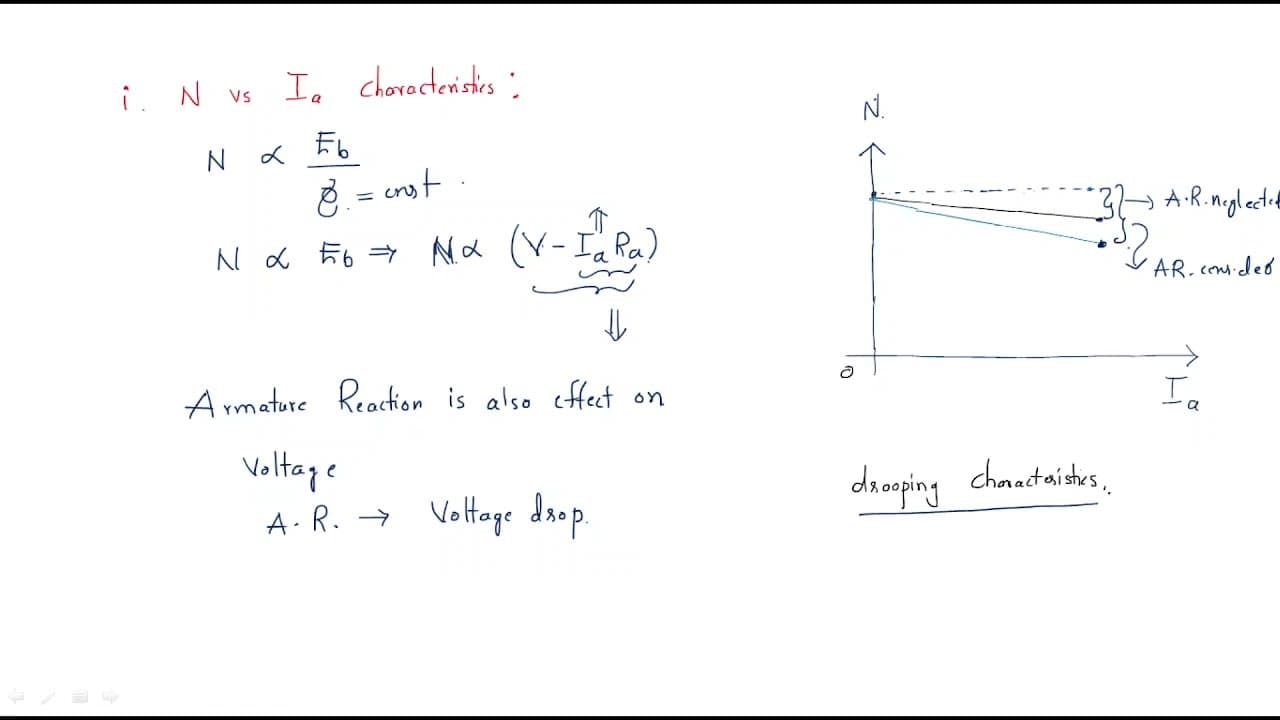
- 🚄 The relationship between speed and armature current is characterized as drooping, indicating that speed decreases slightly with higher current draw.
- ❓ Torque in DC shunt motors increases linearly with armature current, showcasing effective performance under stable flux conditions.
- 🖐️ Armature reaction plays a crucial role in determining the true behavior of speed and torque, causing variations from ideal characteristics.
- 🧑🦼 Despite their utility, DC shunt motors are outmatched by induction motors in many real-world applications due to their efficiency.
- 🤩 Key characteristics of DC shunt motors include speed vs. armature current and torque vs. armature current, which define their operational profiles.
- 🧑🦼 Applications of DC shunt motors mostly involve constant speed operations, making them suitable for fans and similar mechanisms.
Install to Summarize YouTube Videos and Get Transcripts
Explore YouTube Video Summarizer or Get YouTube Transcript Extractor
Questions & Answers
Q: What makes the DC shunt motor a constant flux machine?
The DC shunt motor is termed a constant flux machine because its operating conditions keep the flux constant. Specifically, the supply voltage and the resistance in the shunt winding remain unchanged, resulting in a consistent shunt current and, consequently, a stable magnetic flux during operation.
Q: How does armature current affect the speed of a DC shunt motor?
The speed of a DC shunt motor inversely relates to armature current. As armature current increases, it affects the back emf negatively. The greater the armature current, the more the voltage drop occurs, leading to a slight decrease in the motor's speed, thus representing a "drooping characteristic."
Q: Can you elaborate on the relationship between torque and armature current in DC shunt motors?
The torque produced by a DC shunt motor is directly proportional to armature current, under the condition that magnetic flux remains constant. Hence, as the armature current increases, the torque also increases linearly. Any impacts from armature reaction may modify this linearity slightly but generally maintain the positive correlation.
Q: What practical applications are most common for DC shunt motors, and why?
DC shunt motors are often used in applications requiring constant speed, such as fans, air circulators, and centrifugal pumps. However, while they serve specific purposes well, induction motors are generally preferred in practical settings due to their higher efficiency and lower operational losses.
Summary & Key Takeaways
-
The content details the functioning and characteristics of DC shunt motors, emphasizing their constant flux and voltage conditions that keep their operating parameters stable.
-
An exploration of the relationships among speed, torque, and armature current highlights the linear behaviors of DC shunt motors and how they respond to variations in armature current and reactions.
-
Practical applications such as fans, centrifugal pumps, and blowers are discussed, noting the dominance of induction motors due to their efficiency over DC machines in many scenarios.
Read in Other Languages (beta)
Share This Summary 📚
Summarize YouTube Videos and Get Video Transcripts with 1-Click
Try YouTube Summary with ChatGPT & Claude or YouTube Transcript Generator