Beyond the well-mixed room: Short-range transmission
TL;DR
Turbulent plume theory explains how particles are distributed in the air and transmitted over short and long distances, with long-range airborne transmission being the primary risk factor in most indoor spaces.
Transcript
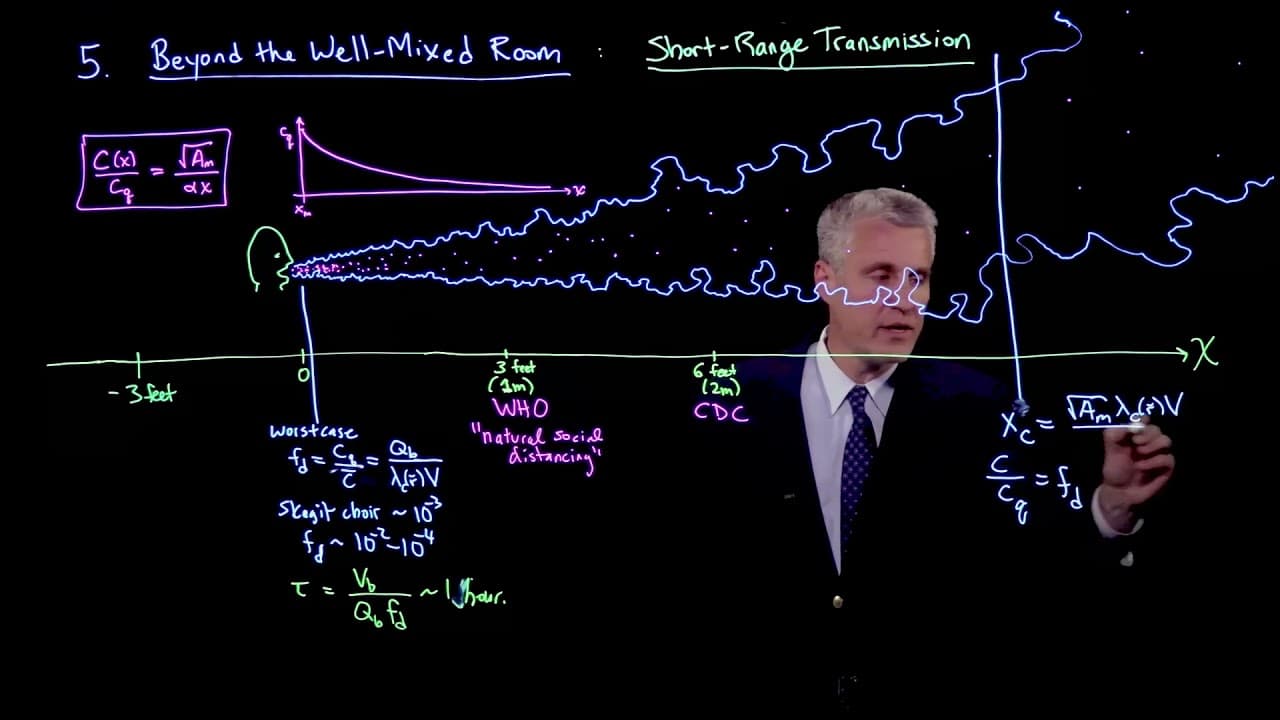
PROFESSOR: So the next important part of turbulent plume theory that we need is the distribution of concentration of particles or droplets, in this case, that are injected with the fluid at the source. So as we've just arrived, the concentration C in this case, we could have referred to infection quanta and infectious aerosols relative to that leav... Read More
Key Insights
- 🧡 The concentration of particles in short-range transmission scenarios is significantly higher, but it dilutes rapidly in a well-mixed room.
- 🧡 Short-range transmission cannot fully explain outbreaks like the Skagit Valley Chorale incident, emphasizing the importance of long-range airborne transmission.
- 🧡 The xC value, representing the distance where the respiratory jet's concentration matches that of the well-mixed room, determines the boundary between short-range and long-range transmission.
- 🔸 Outdoor transmission follows similar theoretical arguments, where dilution is extensive in big spaces and short-range transmission becomes the primary concern in smaller rooms.
Install to Summarize YouTube Videos and Get Transcripts
Explore YouTube Video Summarizer or Get YouTube Transcript Extractor
Questions & Answers
Q: What is the difference between short-range and long-range transmission of airborne particles?
Short-range transmission occurs when an individual is in close proximity to an infected person's respiratory jet, resulting in higher particle concentration. Long-range transmission refers to the spread of particles in well-mixed rooms, where the concentration decreases significantly due to mixing processes.
Q: How does the dilution factor affect the risk of infection in different settings?
The dilution factor determines the concentration of infection quanta or viruses relative to the well-mixed room. In smaller rooms with better ventilation, the dilution factor is around 10^-3, while in typical indoor spaces like offices or classrooms, it ranges from 10^-2 to 10^-4. Higher dilution factors indicate a lower risk of infection.
Q: What is the significance of the xC value in determining the boundary between short-range and long-range transmission?
The xC value represents the distance at which the concentration of the respiratory jet matches that of the well-mixed room. This boundary separates short-range transmission, where the risk is higher, from long-range transmission. In many cases, xC is larger than 6 feet, and it can even exceed the size of the room.
Q: How does the risk of infection vary with natural social distancing distances?
Natural social distancing, where individuals prefer to maintain a space bubble of 2-3 feet apart, reduces the risk of infection. However, in crowded spaces where people are closer, the risk increases. The 6-foot rule imposed by the Center for Disease Control is considered a standard for social distancing, but even standing 3 feet away can still pose a significant risk.
Summary & Key Takeaways
-
Turbulent plume theory focuses on the distribution of particles or droplets in the air and their transmission as a result of turbulent flows.
-
Short-range transmission refers to being in close proximity to an infected person's respiratory jet, while long-range transmission refers to the spread of airborne particles in well-mixed rooms.
-
The concentration of particles is significantly higher in short-range transmission scenarios, but dilutes rapidly in a well-mixed room due to ventilation and thermal effects.
-
The boundary between short-range and long-range transmission occurs at a certain distance, where the concentration of the respiratory jet matches that of the well-mixed room.
Read in Other Languages (beta)
Share This Summary 📚
Summarize YouTube Videos and Get Video Transcripts with 1-Click
Try YouTube Summary with ChatGPT & Claude or YouTube Transcript Generator
Explore More Summaries from MIT OpenCourseWare 📚



Summarize YouTube Videos and Get Video Transcripts with 1-Click
Try YouTube Summary with ChatGPT & Claude or YouTube Transcript Generator