Cosmic Vision: Watching the Radio
TL;DR
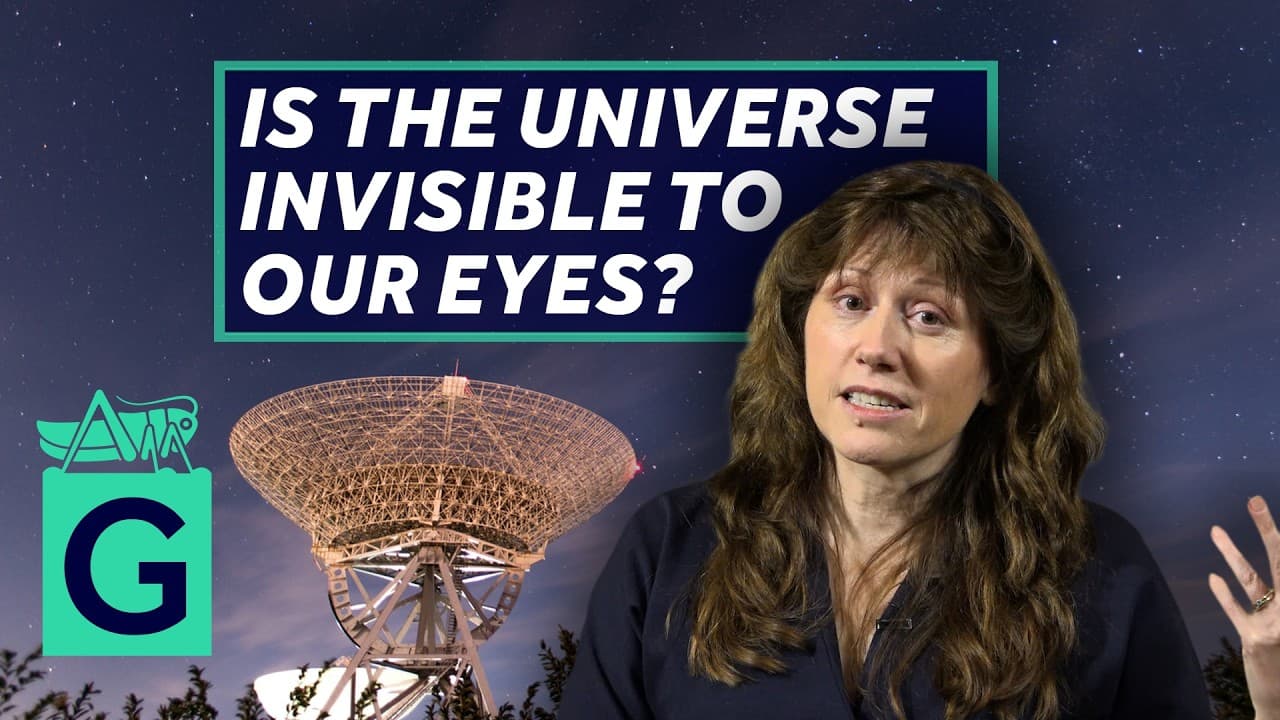
Radio astronomy allows us to study the universe beyond what is visible to the human eye, revealing dynamic structures and extreme energies. Category Tag: Astronomy
Transcript
- Good afternoon. I'm Katherine Blundell, Gresham Professor of Astronomy. I'd like to welcome you to a new academic year of lectures on astronomy. And the title of this year's course is "Cosmic Vision." Today, I'm going to be speaking about the radio universe. So for a millennia, astronomy was, of course, solely a by eye activity. As I described in... Read More
Key Insights
- 😃 Radio telescopes offer a unique perspective on the universe, allowing us to study phenomena beyond what is visible to the human eye.
- 🫢 Radio waves can penetrate dust and gas, providing clear views of distant galaxies and allowing us to study black holes, supernova remnants, and jets.
- ✋ Radio telescopes, such as the MeerKAT, provide high-resolution images and contribute to our understanding of galaxy formation and the intergalactic medium.
- 📻 Building a radio telescope on the far side of the moon would eliminate interference from Earth's atmosphere, enabling clearer observations of radio waves.
Install to Summarize YouTube Videos and Get Transcripts
Explore YouTube Video Summarizer or Get YouTube Transcript Extractor
Questions & Answers
Q: How are radio waves converted into colored images in radio astronomy?
Color mapping is used to assign colors to different levels of radio emission, with brighter emissions represented by warm colors such as orange and yellow, and fainter emissions represented by cooler colors like purple.
Q: Where does the energy come from to produce the giant jets observed in radio astronomy?
The energy comes from gravitational potential energy near black holes. Matter is accelerated and heated as it falls into the black hole, and the resulting jets propel energized plasma away from the black hole.
Q: What would be the advantages of building a radio telescope on the far side of the moon?
Building a radio telescope on the far side of the moon would eliminate interference from Earth's atmosphere, ionosphere, and troposphere, allowing clearer observations of radio waves. This would be especially beneficial for studying longer wavelengths.
Q: How does a shock wave form in low-density interstellar matter?
While space has low density compared to Earth's atmosphere, density discontinuities still exist. These discontinuities can create shock waves that give rise to particle acceleration and other astrophysical phenomena.
Q: Does radio astronomy allow us to look further back in time than optical astronomy?
Radio astronomy can see through dust, allowing us to observe distant galaxies that might be invisible to optical telescopes. Additionally, radio astronomy can pick up signals from the cosmic microwave background radiation, which originated shortly after the Big Bang. However, it does not provide a direct view of the earliest moments of the universe.
Summary & Key Takeaways
-
Astronomy has evolved from solely visual observations to using telescopes that can detect radio waves, which provide a different perspective on the universe.
-
Radio waves can penetrate dust and gas, allowing us to see deep into space and study phenomena like black holes, jets, and supernova remnants.
-
Radio telescopes, such as the MeerKAT in South Africa, provide high-resolution images and help us understand the formation and evolution of galaxies and the intergalactic medium.
Read in Other Languages (beta)
Share This Summary 📚
Summarize YouTube Videos and Get Video Transcripts with 1-Click
Try YouTube Summary with ChatGPT & Claude or YouTube Transcript Generator
Explore More Summaries from Gresham College 📚

Summarize YouTube Videos and Get Video Transcripts with 1-Click
Try YouTube Summary with ChatGPT & Claude or YouTube Transcript Generator