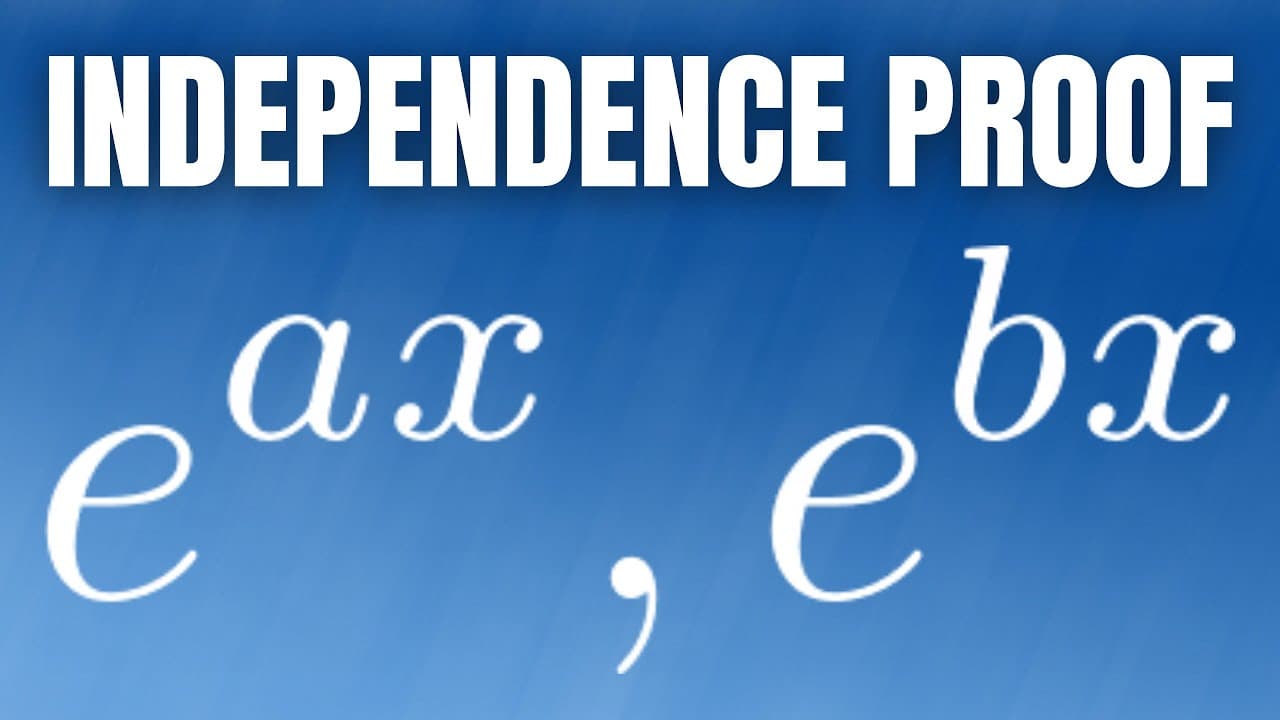
Prove the Functions e^(ax) and e^(bx) are Linearly Independent (Direct Proof Example)
TL;DR
Direct proof shows functions (e^ax, e^bx) are linearly independent over real numbers.
Transcript
hi in this problem we're going to prove that these functions are linearly independent and there's a couple ways to do this we're going to give a direct proof show that they are independent so we're going to use the definition so to use the definition we start by assuming that we have a linear combination of these functions and it's equal to zero so... Read More
Key Insights
- 📁 Direct proof utilized to show linear independence of functions e^ax and e^bx.
- 0️⃣ Assumption of linear combination equating to zero leads to coefficients being identically zero.
- 👍 Demonstrates necessity of proving linear independence in mathematical contexts.
- 😒 Importance of establishing independence for effective use in linear algebra and differential equations.
- 📁 Comparison of direct proof method with alternative approaches like the Wronskian.
- 👾 Significance of proving linear independence in creating a basis for vector spaces.
- 🈸 Practical applications in solving differential equations and modeling mathematical scenarios.
Install to Summarize YouTube Videos and Get Transcripts
Explore YouTube Video Summarizer or Get YouTube Transcript Extractor
Questions & Answers
Q: How does the content prove the linear independence of functions e^ax and e^bx?
The content starts by assuming a linear combination of the functions equals zero and shows that the coefficients must be zero for the functions to be independent over the entire set of real numbers.
Q: Why is it necessary to prove the linear independence of functions?
Proving the linear independence of functions is crucial in various mathematical contexts, as it ensures that the functions are not redundant and can be used effectively in linear algebra and differential equations.
Q: What alternative method can be used to prove the linear independence of functions?
Another common method to prove the linear independence of functions is by using the Wronskian, which can provide a more efficient and straightforward approach compared to the direct proof shown in the content.
Q: What significance does proving linear independence have in mathematical applications?
Demonstrating the linear independence of functions is essential for establishing a basis in vector spaces, solving differential equations, and understanding the behavior of mathematical models in various fields.
Summary & Key Takeaways
-
The content proves the linear independence of functions e^ax and e^bx through a direct proof.
-
By assuming a linear combination of the functions equals zero, it shows that the coefficients must be zero.
-
The proof demonstrates that the functions are independent over the entire set of real numbers.
Read in Other Languages (beta)
Share This Summary 📚
Summarize YouTube Videos and Get Video Transcripts with 1-Click
Try YouTube Summary with ChatGPT & Claude or YouTube Transcript Generator
Explore More Summaries from The Math Sorcerer 📚



Summarize YouTube Videos and Get Video Transcripts with 1-Click
Try YouTube Summary with ChatGPT & Claude or YouTube Transcript Generator