Euler's Work on Ballistics
TL;DR
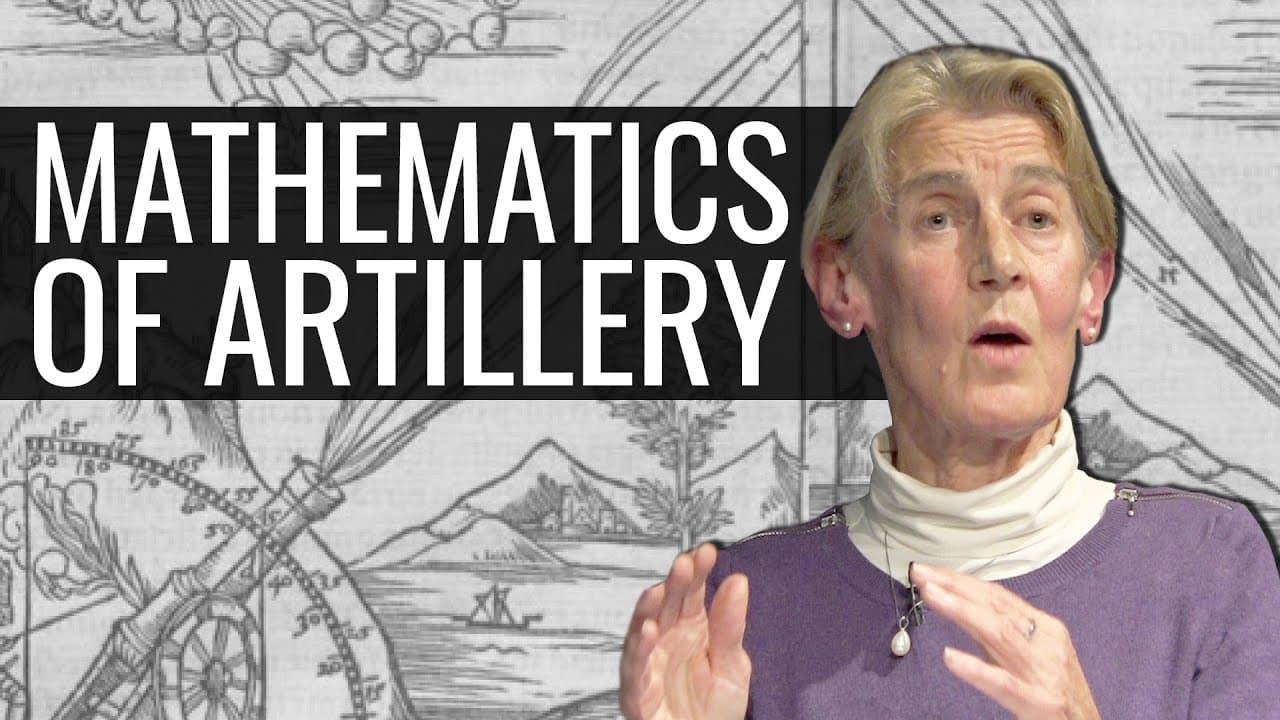
This analysis explores the evolution of ballistics from Aristotle's theories to Euler's influential work in the 18th century.
Transcript
so where do we begin well really in the fourth century BC with Aristotle and his theory of projective projectile motion and and for Aristotle the idea was that if you fired something it basically it went in a straight line until it's sort of stopped moving and then it just dropped down now I'm sure most of you will have seen a projectile moving and... Read More
Key Insights
- ❤️🔥 Aristotle's theories of projectile motion were applicable when firing at stationary objects but did not accurately represent the reality of projectile motion.
- 🫥 Niccolo Fontana, or Tartaglia, was the first mathematician to analyze projectile motion and ballistics in-depth, using curved lines to describe motion.
- 🥺 Galileo's experiments with inclined planes led to the discovery that a projectile's path is parabolic.
- 🔬 Benjamin Robbins transformed ballistics into a Newtonian science, studying both interior and exterior ballistics and developing innovative measurement devices.
- 💦 Euler's work in ballistics expanded on Robbins' principles, introducing comprehensive calculations and providing valuable ballistics tables.
Install to Summarize YouTube Videos and Get Transcripts
Explore YouTube Video Summarizer or Get YouTube Transcript Extractor
Questions & Answers
Q: How did Aristotle's theory of projectile motion differ from the reality seen in projectiles?
Aristotle believed that projectiles moved in a straight line until they stopped and dropped vertically. In reality, projectiles experience both a curved and dropping motion.
Q: Who was the first mathematician to analyze projectile motion and ballistics in depth?
Niccolo Fontana, also known as Tartaglia, was the first to analyze projectile motion and ballistics in his book "Lenovo Senti."
Q: What did Galileo discover about the paths of projectiles?
Galileo's experiments with inclined planes led him to discover that the path of a projectile is parabolic, reaching a maximum height before descending.
Q: How did Benjamin Robbins contribute to ballistics?
Robbins transformed ballistics into a Newtonian science, studying interior and exterior ballistics, and developing the ballistics pendulum to measure air resistance.
Q: What did Euler's work in ballistics focus on?
Euler expanded on Robbins' principles by integrating calculations, analyzing the true curve of projectiles, and providing ballistics tables.
Summary & Key Takeaways
-
In the 4th century BC, Aristotle proposed his theory of projectile motion, suggesting that a fired object moves in a straight line until it drops. This theory was applicable when firing at stationary objects.
-
Italian mathematician Niccolo Fontana, also known as Tartaglia, was the first to analyze projectile motion and ballistics in his book Lenovo Senti. He used curved lines to describe the motion.
-
Galileo conducted experiments with inclined planes to determine the paths of projectiles and discovered the parabolic nature of their trajectories.
-
Benjamin Robbins transformed ballistics into a Newtonian science in the 18th century, studying interior and exterior ballistics and developing the ballistics pendulum to measure air resistance.
-
Euler's influential work in ballistics expanded on Robbins' principles, integrating calculations, analyzing the true curve of projectiles, and providing ballistics tables.
Read in Other Languages (beta)
Share This Summary 📚
Summarize YouTube Videos and Get Video Transcripts with 1-Click
Try YouTube Summary with ChatGPT & Claude or YouTube Transcript Generator
Explore More Summaries from Gresham College 📚

Summarize YouTube Videos and Get Video Transcripts with 1-Click
Try YouTube Summary with ChatGPT & Claude or YouTube Transcript Generator