How to Implement Proximal Policy Optimization in PyTorch
TL;DR
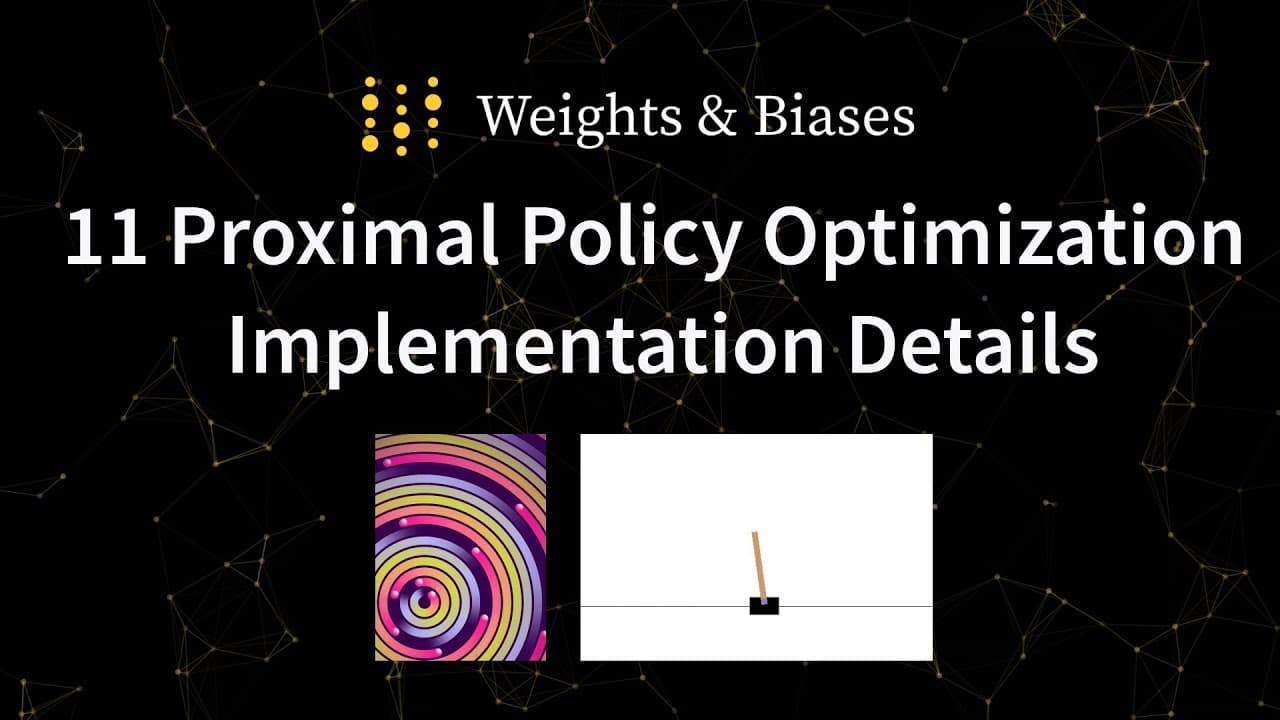
To implement Proximal Policy Optimization (PPO) in PyTorch, start by setting up your development environment and defining key parameters. Next, create vector environments, an agent class, and a training loop, while incorporating techniques such as advantage estimation, value loss clipping, and gradient clipping. Utilize tools like TensorBoard and Weights and Biases for effective experiment tracking and visualization.
Transcript
hey what's up everyone my name is costa and i am a machine learning engineer intern at weights and biases i'm also a fourth year phd student at drexel university specializing in reinforcement learning today i want to talk about proximal policy optimization or ppo ppo is a deep reinforcement learning algorithm proposed by openai in 2017 and it has s... Read More
Key Insights
- ❓ Proximal Policy Optimization (PPO) is a popular deep reinforcement learning algorithm used to optimize policies.
- 🌼 Implementation details covered in the video include logistics setup, TensorBoard and Weights and Biases integration, random seed initialization, vector environments, agent class and neural network implementation, training loop, advantage estimation, value loss clipping, entropy loss, global gradient clipping, and early stopping.
- 🦮 The video provides a step-by-step guide on implementing PPO in PyTorch, making it accessible to intermediate and advanced reinforcement learning practitioners.
- 🔰 Recommended resources for beginners include the official PyTorch tutorials and Joshua Achiam's "OpenAI Spinning Up".
- 👻 Using Weights and Biases and TensorBoard allows for easy experiment tracking, visualization, and debugging.
Install to Summarize YouTube Videos and Get Transcripts
Explore YouTube Video Summarizer or Get YouTube Transcript Extractor
Questions & Answers
Q: What is Proximal Policy Optimization (PPO)?
Proximal Policy Optimization (PPO) is a deep reinforcement learning algorithm proposed by OpenAI in 2017, designed to optimize policies in a way that balances exploration and exploitation.
Q: What are the key implementation details covered in the video?
The video covers logistics setup, setting up TensorBoard and Weights and Biases, random seed initialization, vector environments, agent class and neural network implementation, training loop, advantage estimation, value loss clipping, entropy loss, global gradient clipping, and early stopping.
Q: Who is the target audience for this video?
The video is aimed at intermediate to advanced reinforcement learning practitioners who are familiar with PyTorch and have a general understanding of how PPO works.
Q: What are some recommended resources for beginners in PyTorch and reinforcement learning?
The video suggests starting with the official PyTorch tutorials, specifically the "16 minute blitz" tutorial. For reinforcement learning, the video recommends Joshua Achiam's "OpenAI Spinning Up" as a beginner-friendly educational resource.
Key Insights:
- Proximal Policy Optimization (PPO) is a popular deep reinforcement learning algorithm used to optimize policies.
- Implementation details covered in the video include logistics setup, TensorBoard and Weights and Biases integration, random seed initialization, vector environments, agent class and neural network implementation, training loop, advantage estimation, value loss clipping, entropy loss, global gradient clipping, and early stopping.
- The video provides a step-by-step guide on implementing PPO in PyTorch, making it accessible to intermediate and advanced reinforcement learning practitioners.
- Recommended resources for beginners include the official PyTorch tutorials and Joshua Achiam's "OpenAI Spinning Up".
- Using Weights and Biases and TensorBoard allows for easy experiment tracking, visualization, and debugging.
- The implementation details covered in the video provide a solid foundation for building and training PPO agents in PyTorch.
Summary & Key Takeaways
-
Proximal Policy Optimization (PPO) is a widely used deep reinforcement learning algorithm proposed by OpenAI.
-
This video provides a step-by-step guide on implementing PPO in PyTorch, covering 11 implementation details.
-
The video covers logistics setup, setting up TensorBoard and Weights and Biases, random seed initialization, vector environments, agent class and neural network implementation, training loop, advantage estimation, value loss clipping, entropy loss, global gradient clipping, and early stopping.
Read in Other Languages (beta)
Share This Summary 📚
Summarize YouTube Videos and Get Video Transcripts with 1-Click
Try YouTube Summary with ChatGPT & Claude or YouTube Transcript Generator
Explore More Summaries from Weights & Biases 📚

Summarize YouTube Videos and Get Video Transcripts with 1-Click
Try YouTube Summary with ChatGPT & Claude or YouTube Transcript Generator