How to Ask for Directions in Vietnamese
TL;DR
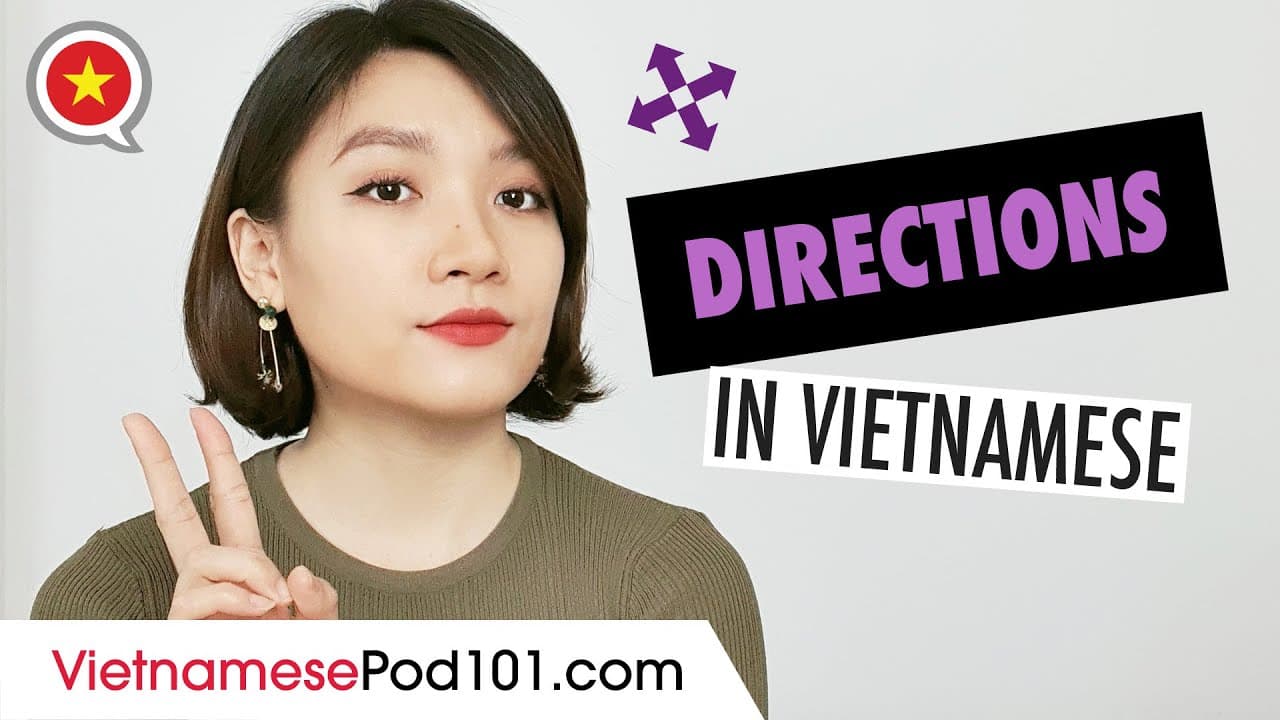
Learn Vietnamese directions and positions with simple explanations.
Transcript
want to speak real vietnamese from your first lesson sign up for your free lifetime account at vietnamesepod101.com hello everyone my name is lin welcome back to vietnameseport101.com the fact is easiest and most fun way to learn vietnamese today we're going to talk about positions and directions let's get started for direction in vietnamese the wo... Read More
Key Insights
- The video provides a comprehensive guide to Vietnamese directions, including north, south, east, and west, with pronunciation tips.
- Vietnamese uses a single preposition 'ở' for various positional contexts, unlike English which uses 'at', 'in', and 'on'.
- The lesson includes opposite word pairs to aid memory retention, such as 'near' and 'far', 'inside' and 'outside'.
- Questions about location in Vietnamese often place the question word at the end of the sentence, a key structural difference from English.
- The lesson introduces additional useful vocabulary such as 'next to', 'in the middle', and 'facing', enhancing spatial description skills.
- Practical examples using everyday objects help illustrate the use of directional and positional vocabulary in Vietnamese.
- The video encourages active learning through note-taking and re-watching, emphasizing the importance of practice for language acquisition.
- VietnamesePod101 offers a structured approach to learning Vietnamese, with resources available for free to enhance language skills.
Install to Summarize YouTube Videos and Get Transcripts
Explore YouTube Video Summarizer or Get YouTube Transcript Extractor
Questions & Answers
Q: What is the main focus of the video?
The main focus of the video is to teach viewers how to ask for directions in Vietnamese. It covers essential vocabulary related to directions and positions, such as north, south, east, west, and various positional terms. The video aims to help beginners sound like native Vietnamese speakers by providing simple explanations and examples.
Q: How does Vietnamese handle prepositions differently from English?
In Vietnamese, a single preposition 'ở' is used for various positional contexts, unlike English, which uses different prepositions such as 'at', 'in', and 'on'. This simplifies the language learning process for beginners, as they only need to remember one word to describe different positions, making it easier to construct sentences accurately.
Q: What are some opposite words introduced in the video?
The video introduces several pairs of opposite words to aid memory retention. Examples include 'near' and 'far', 'inside' and 'outside', and 'here' and 'there'. These pairs help learners understand and remember the vocabulary more effectively by associating words with their opposites, enhancing their language skills.
Q: How are questions about location structured in Vietnamese?
In Vietnamese, questions about location often place the question word at the end of the sentence, which is a key structural difference from English. For example, instead of starting with 'where', the Vietnamese equivalent would place the location question at the end, requiring learners to adjust their sentence construction accordingly.
Q: What additional vocabulary is introduced in the lesson?
The lesson introduces additional vocabulary such as 'next to', 'in the middle', and 'facing'. These terms enhance learners' ability to describe spatial relationships and locations more precisely in Vietnamese, providing them with a broader range of expressions to use in everyday conversations.
Q: How does the video encourage active learning?
The video encourages active learning by suggesting viewers take notes and re-watch the content to reinforce their understanding. This approach emphasizes the importance of practice and repetition in language acquisition, helping learners internalize the vocabulary and sentence structures more effectively.
Q: What resources does VietnamesePod101 offer for learning Vietnamese?
VietnamesePod101 offers a range of resources for learning Vietnamese, including free online materials that help learners quickly become conversational. By signing up for a free lifetime account, users can access structured lessons, vocabulary lists, and practice exercises designed to enhance their Vietnamese language skills efficiently.
Q: What is the benefit of using practical examples in the lesson?
Using practical examples with everyday objects, the lesson illustrates the use of directional and positional vocabulary in real-life contexts. This approach helps learners understand how to apply the vocabulary in conversations, making the learning process more relatable and effective, as they can visualize and practice the language in familiar situations.
Summary & Key Takeaways
-
The video is a beginner-friendly guide to learning how to ask for directions in Vietnamese, focusing on essential vocabulary and sentence structure. It introduces the four cardinal directions and explains how to use the preposition 'ở' for various positional contexts.
-
The lesson highlights the importance of understanding opposite words for better memory retention and provides practical examples using common objects to demonstrate the use of Vietnamese directional and positional terms effectively.
-
Viewers are encouraged to actively engage with the content by taking notes, re-watching the video, and utilizing the free resources provided by VietnamesePod101 to enhance their learning experience and improve their Vietnamese language skills.
Read in Other Languages (beta)
Share This Summary 📚
Summarize YouTube Videos and Get Video Transcripts with 1-Click
Try YouTube Summary with ChatGPT & Claude or YouTube Transcript Generator
Explore More Summaries from Learn Vietnamese with VietnamesePod101.com 📚


Summarize YouTube Videos and Get Video Transcripts with 1-Click
Try YouTube Summary with ChatGPT & Claude or YouTube Transcript Generator