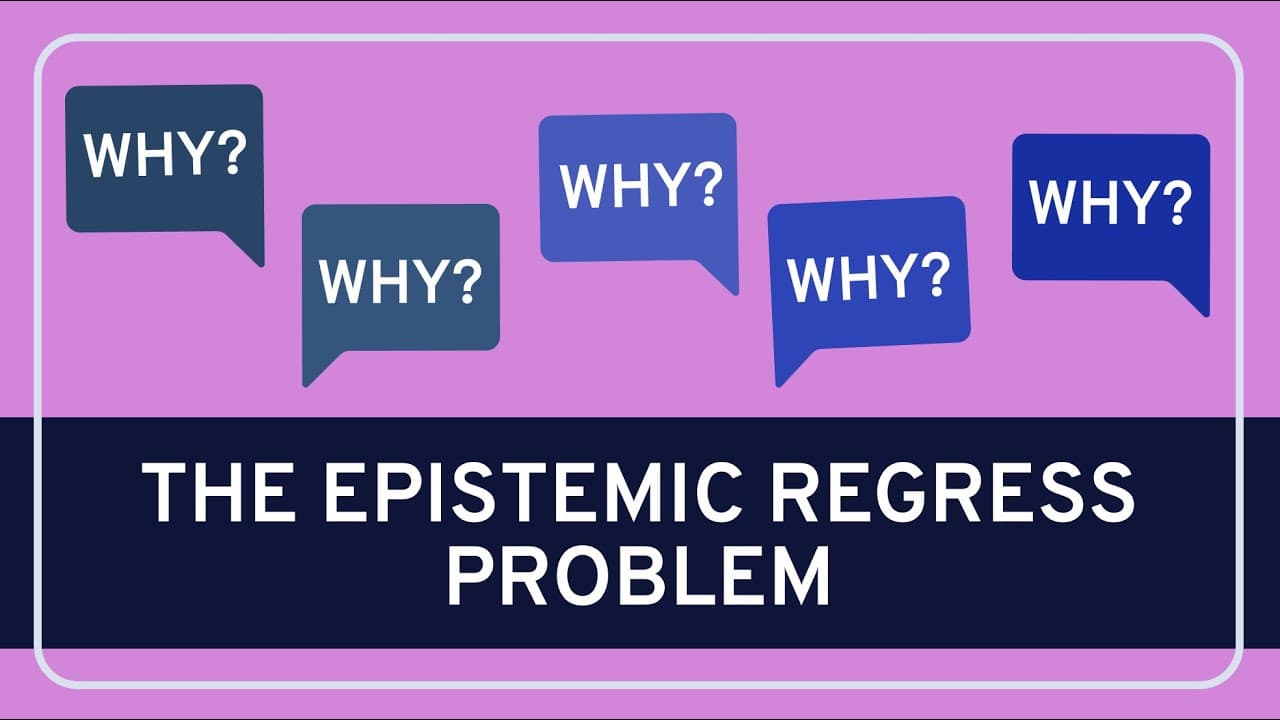
What Is the Epistemic Regress Problem?
TL;DR
The epistemic regress problem questions the justification of beliefs by demanding reasons for each reason given. Three main solutions are proposed: foundationalism, which posits a base of justified beliefs; infinitism, which suggests an infinite chain of reasons; and coherentism, which views justification as a web of interconnected beliefs.
Transcript
hello I'm Kevin McCain I teach philosophy at the University of Alabama at Birmingham and today I'll be discussing the epistemic regress problem the epistemic regress problem is a very old problem in epistemology we find reference to this issue as early as the writings of Aristotle and while it's sometimes used as a way of arguing in support of skep... Read More
Key Insights
- The epistemic regress problem involves questioning the justification of beliefs by asking for reasons for each reason given.
- Foundationalism suggests that justified beliefs ultimately rest on a foundation of basic beliefs that do not require further justification.
- Infinitism posits that justification involves an infinite chain of reasons, with each reason having another reason in support.
- Coherentism views justification as a web of interconnected beliefs, where the right relationships between beliefs provide justification.
- The regress problem has historically been used to argue for skepticism, suggesting that no beliefs are truly justified.
- Skeptics argue that none of the three solutions—foundationalism, infinitism, or coherentism—can provide genuine justification.
- Foundationalism is the most popular view in contemporary epistemology, tracing back to Aristotle.
- Infinitism and coherentism offer alternative perspectives on the structure of epistemic justification, challenging traditional views.
Install to Summarize YouTube Videos and Get Transcripts
Explore YouTube Video Summarizer or Get YouTube Transcript Extractor
Questions & Answers
Q: What is the epistemic regress problem?
The epistemic regress problem questions the justification of beliefs by requiring reasons for each reason given. It suggests that for any belief, one must provide a reason, and for that reason, another reason, leading to an infinite chain, circular reasoning, or foundational beliefs. This problem challenges the structure of epistemic justification.
Q: How does foundationalism address the regress problem?
Foundationalism addresses the regress problem by positing that justified beliefs ultimately rest on a foundation of basic beliefs that do not require further justification. These foundational beliefs are often justified by experience, which foundationalists claim does not need additional reasons for support, thereby stopping the regress.
Q: What is infinitism in epistemology?
Infinitism in epistemology is the view that justification involves an infinite chain of reasons, where each reason has another reason in support. This perspective suggests that as long as reasons can continue indefinitely, justification is possible. Infinitism is a relatively new view that challenges traditional epistemological theories.
Q: How does coherentism differ from foundationalism?
Coherentism differs from foundationalism by viewing justification as a web of interconnected beliefs rather than a linear chain ending in foundational beliefs. Coherentists argue that justification arises when beliefs are connected in the right relationships within this web, rather than relying on basic beliefs that require no further justification.
Q: Why is the regress problem used to argue for skepticism?
The regress problem is used to argue for skepticism because it suggests that no belief can be fully justified. Skeptics claim that if every belief requires a reason, and every reason requires another reason, this leads to an infinite regress, circular reasoning, or unjustified foundational beliefs, thus challenging the possibility of true justification.
Q: What is the role of experience in foundationalism?
In foundationalism, experience plays a crucial role as it is often the basis for foundational beliefs. Foundationalists argue that experiences justify certain basic beliefs without requiring further reasons. For example, seeing a tree justifies the belief in the tree's existence without needing additional support, providing a foundation for other beliefs.
Q: How does coherentism view the structure of justification?
Coherentism views the structure of justification as a web of interconnected beliefs, where justification arises from the right relationships between these beliefs. Unlike linear models, coherentism suggests that beliefs support each other in a holistic system, and justification is achieved when this system is coherent and interconnected appropriately.
Q: What are the main views on epistemic justification?
The main views on epistemic justification are foundationalism, infinitism, and coherentism. Foundationalism posits that justified beliefs rest on basic beliefs; infinitism suggests an infinite chain of reasons; and coherentism sees justification as a web of interconnected beliefs. Each view offers a different solution to the epistemic regress problem.
Summary & Key Takeaways
-
The epistemic regress problem challenges the justification of beliefs by requiring reasons for each reason given. Foundationalism, infinitism, and coherentism offer different solutions. Foundationalism suggests a base of justified beliefs; infinitism proposes an infinite chain of reasons; and coherentism sees justification as a web of interconnected beliefs.
-
Foundationalism posits that justified beliefs rest on basic beliefs that require no further justification, often based on experience. Infinitism, a newer view, suggests an infinite chain of reasons. Coherentism, the second most popular view, sees justification as a web of beliefs connected in the right ways.
-
The regress problem has been used to argue for skepticism, claiming no beliefs are justified. However, most epistemologists believe it informs the structure of justification. Foundationalism, infinitism, and coherentism each offer insights into how beliefs can be justified despite the regress problem.
Read in Other Languages (beta)
Share This Summary 📚
Summarize YouTube Videos and Get Video Transcripts with 1-Click
Try YouTube Summary with ChatGPT & Claude or YouTube Transcript Generator
Explore More Summaries from Wireless Philosophy 📚
Summarize YouTube Videos and Get Video Transcripts with 1-Click
Try YouTube Summary with ChatGPT & Claude or YouTube Transcript Generator