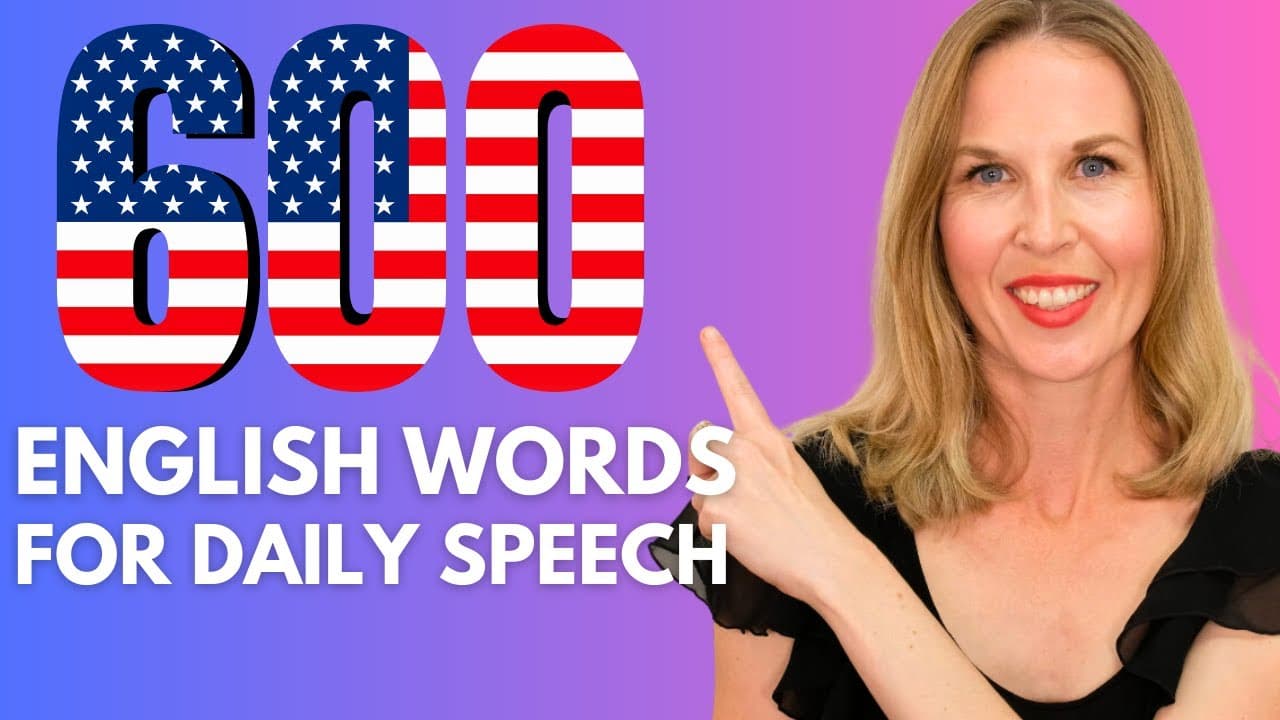
600 English Words for Every Day Life | English Vocabulary Masterclass
TL;DR
Learn 600 essential English expressions for fluent conversation.
Transcript
In this vocabulary master class, you're going to learn 600 words for your daily speech to help you sound fluent and natural like a native speaker. I'm Jennifer from JForrest English. Now let's get started. First, let's start with some greetings that you must know to understand native speakers and to sound natural yourself. How's it going? H... Read More
Key Insights
- 🤪 Casual greetings like "How's it going?" and "Long time no see" help you interact more naturally with native speakers.
- 😑 Using versatile expressions such as "thanks a million" or "you're the best" enhances your gratitude and makes conversations warmer.
- 🙇 Knowing polite decline phrases such as "I'll pass, but thanks" contributes to smoother social interactions.
- 🤗 Clarification requests like "I didn't catch that" or "Can you repeat that slower?" can maintain open communication channels.
- 👂 Transitioning to colloquial language can help you sound more relatable and less formal in everyday interactions.
- 😑 Mastering idiomatic expressions enables you to understand native speaker nuances and convey your thoughts effectively.
- 😑 Using expressions like "I'm on fire" to describe performance establishes positive reinforcement in conversations.
Install to Summarize YouTube Videos and Get Transcripts
Explore YouTube Video Summarizer or Get YouTube Transcript Extractor
Questions & Answers
Q: What are some common ways to greet someone in casual English?
In casual English, you can greet someone by asking, "How's it going?" or "What have you been up to lately?" These phrases help convey a friendlier tone and make conversations feel more natural. Another casual greeting is "Long time no see," which is ideal for reconnecting with someone after a while.
Q: How can I express gratitude in a natural-sounding way?
Instead of the formal "thank you," you could say "Thanks a bunch" or "Thanks a million." These expressions are warm and casual, making them feel more intimate. Additionally, you can say "I really appreciate it," which conveys a heartfelt thank you, or use phrases like "You're the best" for a more personal touch.
Q: What is a polite way to decline an offer?
You can politely decline an offer by saying, "I'm good, but thanks anyway," or "I'll pass, but thanks for asking." These phrases acknowledge the offer while clearly expressing your lack of interest without sounding rude. Adding "but thanks" emphasizes your appreciation for the offer.
Q: How can I ask for clarification if I don't understand something?
If you need clarification, you can ask, "Sorry, I didn't catch that" or "Could you speak up a little, please?" These expressions show your awareness of the situation and your willingness to engage further. Alternatively, you might say, "Can you explain that differently?" to guide the speaker in helping you understand.
Summary & Key Takeaways
-
This content presents a comprehensive master class aimed at teaching 600 English expressions to enhance conversational fluency.
-
It covers various everyday situations, offering casual phrases, polite responses, and idiomatic expressions to help learners sound more natural and relatable.
-
The video includes insights into greeting, thanking, and apologizing in a way that mimics native speakers, alongside colloquial language usage.
Read in Other Languages (beta)
Share This Summary 📚
Summarize YouTube Videos and Get Video Transcripts with 1-Click
Try YouTube Summary with ChatGPT & Claude or YouTube Transcript Generator
Explore More Summaries from JForrest English 📚





Summarize YouTube Videos and Get Video Transcripts with 1-Click
Try YouTube Summary with ChatGPT & Claude or YouTube Transcript Generator