Lesson 6 Kanji
TL;DR
This comprehensive analysis explores the meanings and readings of various kanji symbols, including their components and usage in different contexts.
Transcript
置 Tsugi no kanji desu keredo mo, mazu, kono component; ue no component kore wa, kanji no yon to onaji nan desu keredo mo, imagine this type of net, soshite, shita no part, kore nan desu keredo mo, kono kanji desu keredo mo, kore dake de “straighten up,” “correct,” “naosu,” to iu kanji desu. So when you place a net, you have to straighten up the net... Read More
Key Insights
- 🤬 Kanji symbols are composed of various components that contribute to their overall meanings.
- 🤬 Both onyomi and kunyomi readings are used for kanji symbols.
- 😑 Kanji symbols can express a wide range of concepts, including ceremonies, investigation, urgency, and measurements.
- 🤬 Counters are commonly used with kanji symbols to indicate quantity.
- 🤬 Kanji symbols can have diverse meanings depending on the context in which they are used.
- 🤬 Kanji symbols are an integral part of the Japanese writing system and reflect the cultural and historical aspects of the language.
- 🤬 Learning and understanding kanji symbols is essential for mastering the Japanese language.
Install to Summarize YouTube Videos and Get Transcripts
Explore YouTube Video Summarizer or Get YouTube Transcript Extractor
Questions & Answers
Q: What is the significance of the components in kanji symbols?
The components in kanji symbols contribute to the overall meaning. For example, the "stone" component in the symbol for "stone" represents its literal meaning, while the "person" component in the symbol for "individual" signifies its relation to individuals.
Q: How are kanji readings determined?
Kanji readings can be onyomi (pronunciations derived from Chinese) or kunyomi (native Japanese readings). The choice of reading depends on the specific word or context in which the kanji is used.
Q: How are kanji symbols used as counters?
Kanji symbols can be combined with counting words to indicate quantity or measurement. For example, "ko" is used as a counter in expressions like "ikko" (one) or "sanko" (three).
Q: Can kanji symbols have multiple meanings?
Yes, kanji symbols often have multiple meanings depending on the context in which they are used. For example, the symbol for "add" can also mean "join" or "process," based on the specific usage.
Summary & Key Takeaways
-
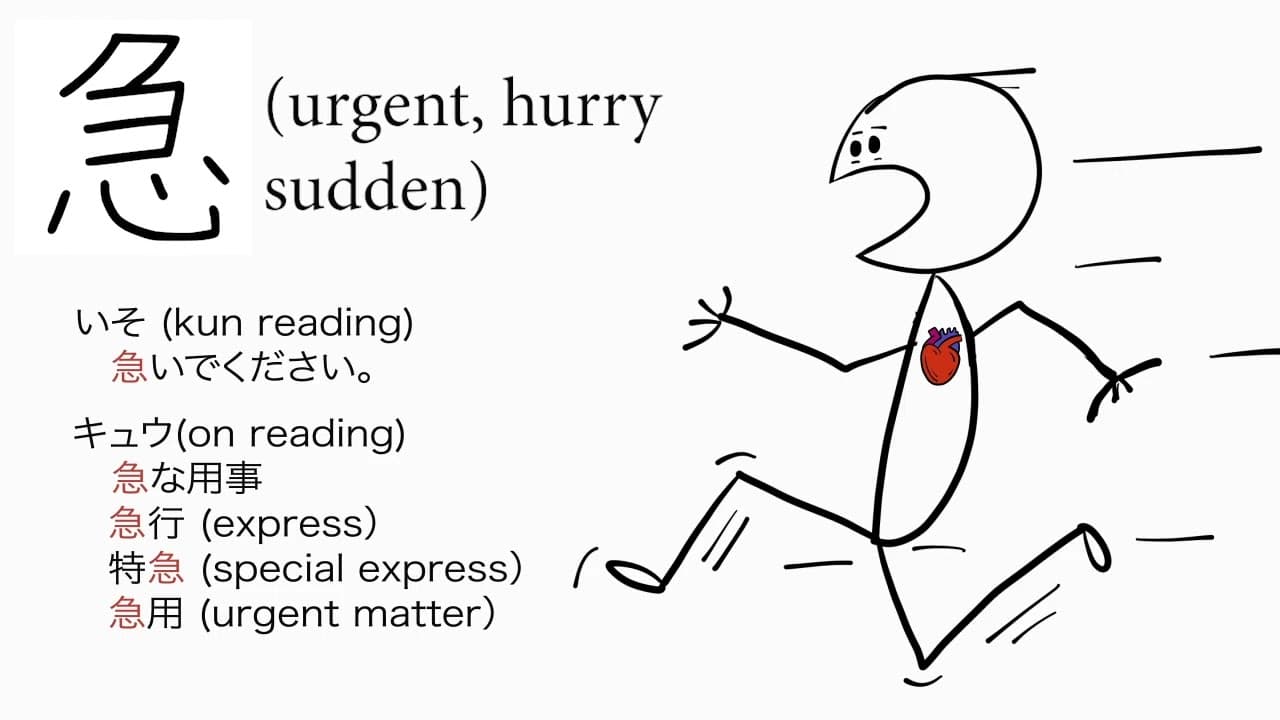
Kanji symbols consist of different components that contribute to their meanings, such as "straighten up," "position," "stone," "look into," "heat," "people," "hurry," "era," "twice," "to participate," "to add," "individual," "to oppose," and "fruit."
-
Each kanji has unique readings, including both onyomi and kunyomi. For example, "heat" can be read as "netsu" or "atsui," depending on the context.
-
These kanji symbols can be used to express various concepts, including ceremonies, investigation, fever, counter usage, worship, social concepts, urgency, measurements, and agreement.
Read in Other Languages (beta)
Share This Summary 📚
Summarize YouTube Videos and Get Video Transcripts with 1-Click
Try YouTube Summary with ChatGPT & Claude or YouTube Transcript Generator
Explore More Summaries from MIT OpenCourseWare 📚



Summarize YouTube Videos and Get Video Transcripts with 1-Click
Try YouTube Summary with ChatGPT & Claude or YouTube Transcript Generator