Problem No 7on Concept of Temperature Stresses and Strain - Stress and Strain -Strength of Materials
TL;DR
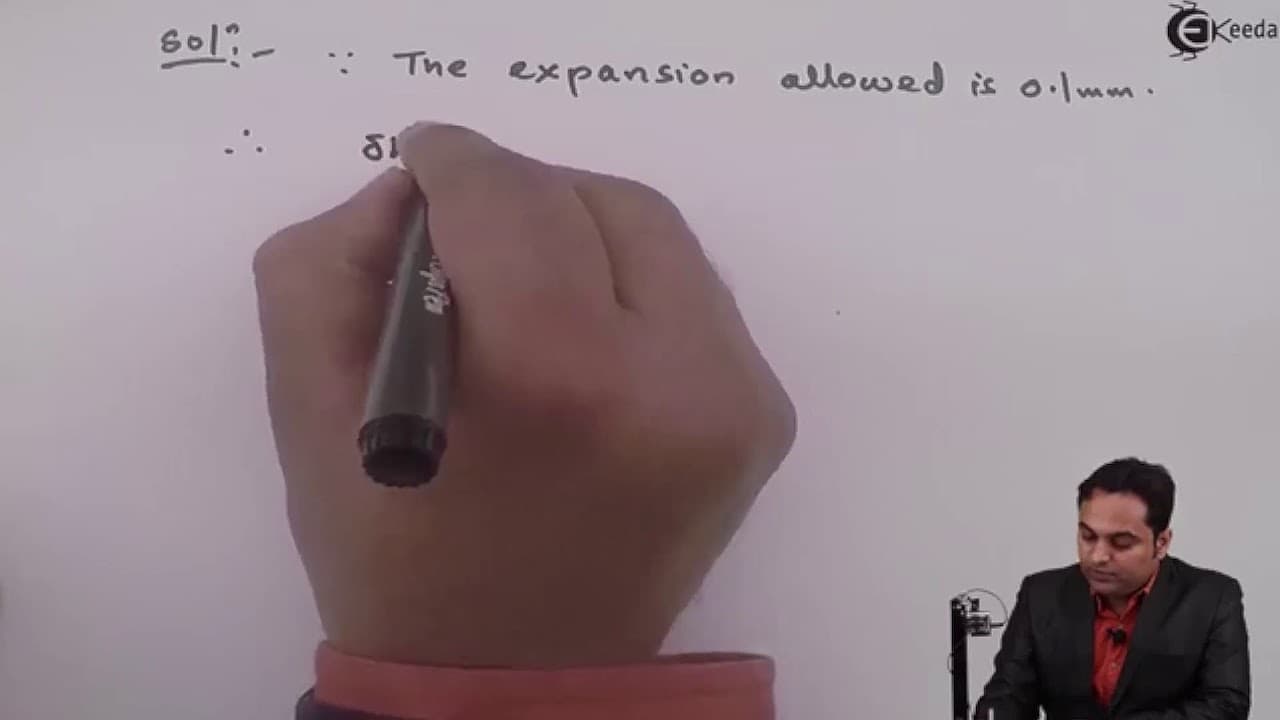
Calculate the temperature at which a 0.1 mm gap in a copper tube will close, and determine the thermal stress induced by a 60-degree Celsius temperature rise.
Transcript
hello friends here in this video we will see a problem on temperature stress and strain here is the question a copper tube whatever is given here i'll write that in the form of data first so in the given data the first thing is it is given that there is a copper tube and since it is a tube we know that it will be hollow section hollow section havin... Read More
Key Insights
- 😚 The temperature at which the 0.1 mm gap in the copper tube will close is 62.5 degrees Celsius.
- 😮 The thermal stress induced in the tube due to a 60-degree Celsius temperature rise is 153.6 newton per mm square.
- 🍗 The nature of the stress is compressive, as the tube tries to expand but is restrained by the walls, causing a compressive force.
- 🦖 The formula for expansion, delta L1 = alpha x delta T x L, is used to calculate the temperature at which the gap will close.
- ☺️ Hooke's law is used to calculate thermal stress, where stress = strain x Young's modulus.
- 💬 The dimensions and properties of the copper tube are given as a 10 mm outside diameter, 8 mm inside diameter, 100 mm length, coefficient of thermal expansion of 16x10^-6, and a Young's modulus of 160x10^3.
- 😮 The problem involves calculating the temperature for gap closure and thermal stress for a given temperature rise.
Install to Summarize YouTube Videos and Get Transcripts
Explore YouTube Video Summarizer or Get YouTube Transcript Extractor
Questions & Answers
Q: What are the dimensions and properties of the given copper tube?
The copper tube has an outside diameter of 10 mm, an inside diameter of 8 mm, and a length of 100 mm. The coefficient of thermal expansion is 16x10^-6, and the Young's modulus is 160x10^3.
Q: What is the formula used to calculate the temperature at which the gap in the tube will close?
The formula used is delta L1 = alpha x delta T x L, where delta L1 is the expansion allowed (0.1 mm), alpha is the coefficient of thermal expansion, delta T is the temperature change, and L is the length of the tube.
Q: What is the temperature at which the gap in the tube will close?
The temperature at which the gap will close is found to be 62.5 degrees Celsius.
Q: How is thermal stress calculated in this problem?
Thermal stress is calculated using the formula stress = strain x Young's modulus, where strain is alpha x delta T and Young's modulus is 160x10^3.
Summary & Key Takeaways
-
A copper tube is given with a 10 mm outside diameter and 8 mm inside diameter, and a length of 100 mm.
-
The tube is fixed at one end and has a 0.1 mm gap at the other end.
-
By using the formula for expansion and Hooke's law, the temperature at which the gap will close and the thermal stress induced by a 60-degree Celsius temperature rise can be calculated.
Read in Other Languages (beta)
Share This Summary 📚
Summarize YouTube Videos and Get Video Transcripts with 1-Click
Try YouTube Summary with ChatGPT & Claude or YouTube Transcript Generator
Explore More Summaries from Ekeeda 📚

Summarize YouTube Videos and Get Video Transcripts with 1-Click
Try YouTube Summary with ChatGPT & Claude or YouTube Transcript Generator