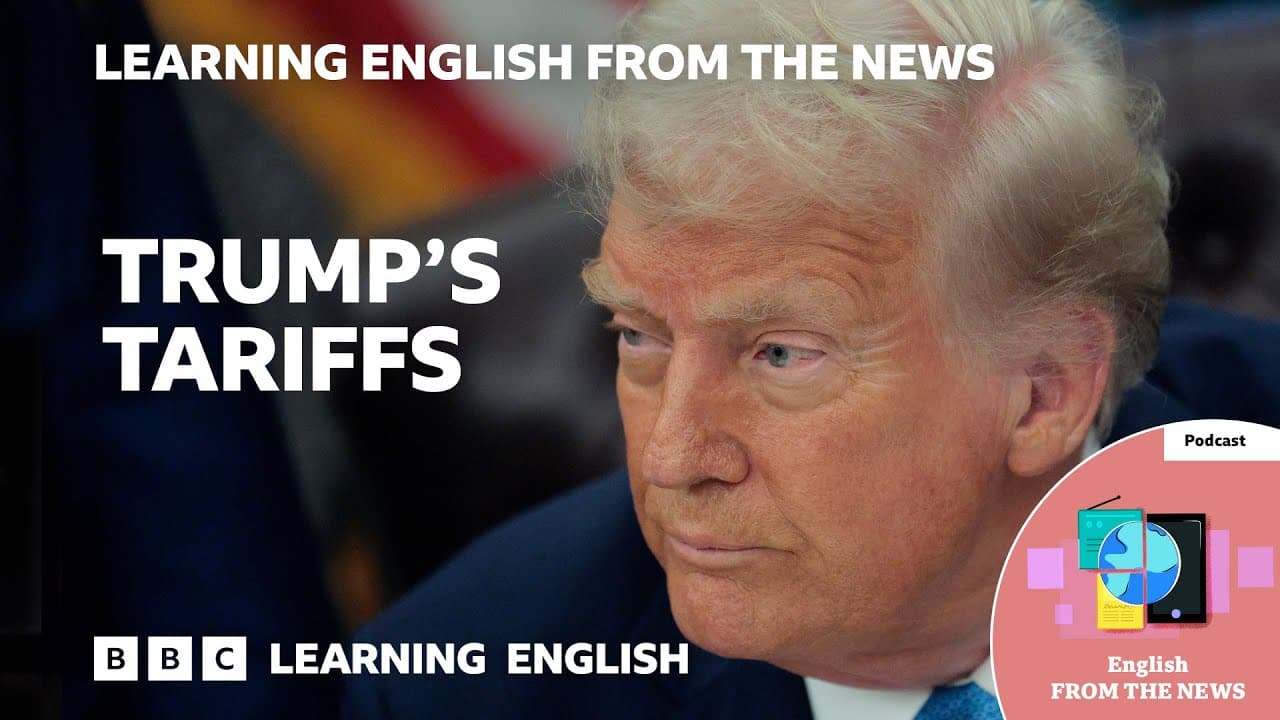
Trump’s tariffs: BBC Learning English from the News
TL;DR
Trump imposes tariffs on Chinese imports, sparking tit-for-tat response.
Transcript
From BBC Learning English, this is Learning English from the News - our podcast about the news headlines. In this programme - Trump's tariffs. Hello, I'm Beth. And I'm Neil. In this programme, we look at one big news story and the vocabulary in the headlines that will help you understand it. You can find all the vocabulary and headlines from this e... Read More
Key Insights
- Trump's tariffs aim to make imports more expensive, affecting consumer prices in the US.
- China responded to US tariffs with their own, exemplifying a tit-for-tat economic retaliation.
- Trump's tariffs are part of his election campaign promises, following through on his pledges.
- The term 'tit for tat' describes retaliatory actions, as seen in international trade disputes.
- Following through on promises involves completing actions as initially pledged, relevant in both politics and daily life.
- Trump's tariffs are reportedly yielding results, influencing Canada and Mexico's policies on border security.
- The expression 'bearing fruit' metaphorically indicates successful outcomes from an action, such as Trump's tariffs.
- Economic strategies like tariffs can have broader implications, influencing international relations and domestic policies.
Install to Summarize YouTube Videos and Get Transcripts
Explore YouTube Video Summarizer or Get YouTube Transcript Extractor
Questions & Answers
Q: Why has Trump started imposing tariffs on imports into the USA?
Trump has started imposing tariffs on imports into the USA to address trade imbalances and economic issues with countries like China. He believes that making imports more expensive will benefit the US economy and has used tariffs as a strategic tool to influence international trade relations and domestic economic policies.
Q: What is the meaning of 'tit for tat' in the context of the tariffs?
In the context of the tariffs, 'tit for tat' refers to the retaliatory measures taken by China in response to the US imposing tariffs on Chinese imports. It describes a situation where one party takes action against another, prompting a similar response in kind, often seen in international trade disputes as countries react to each other's economic policies.
Q: How are Trump's tariffs related to his election campaign promises?
Trump's tariffs are directly related to his election campaign promises as he had pledged to impose tariffs on other countries to protect US economic interests. By implementing these tariffs, Trump is following through on his commitments to address trade imbalances and promote domestic industry, fulfilling a key aspect of his campaign agenda.
Q: What does 'bearing fruit' mean in the context of Trump's tariffs?
In the context of Trump's tariffs, 'bearing fruit' means that the tariffs are producing successful outcomes or results. Specifically, it refers to the impact of these tariffs on international negotiations, where countries like Canada and Mexico have agreed to stricter policies that align with Trump's objectives, indicating that the tariffs are achieving their intended effects.
Q: What impact do Trump's tariffs have on consumer prices in the US?
Trump's tariffs on imports are likely to increase consumer prices in the US, as the added costs of tariffs are often passed down from importers to consumers. This means that products imported from countries like China become more expensive, potentially affecting the affordability of goods for American consumers and impacting overall consumer spending.
Q: How has China responded to the US tariffs?
China has responded to the US tariffs by imposing its own tariffs on American goods, exemplifying a tit-for-tat response. This means that China is taking retaliatory measures to counteract the economic impact of US tariffs on Chinese imports, contributing to the escalation of trade tensions between the two countries.
Q: What are some broader implications of economic strategies like tariffs?
Economic strategies like tariffs have broader implications beyond immediate trade impacts. They can influence international relations, as countries negotiate and retaliate to protect their economic interests. Domestically, tariffs can affect consumer prices, industry competitiveness, and employment. They can also shape political landscapes, as leaders use them to fulfill campaign promises and address economic challenges.
Q: How can the expression 'follow through on' be used in everyday life?
The expression 'follow through on' can be used in everyday life to describe completing a promise or commitment. For example, if someone promises to help a friend move and they actually show up and assist until the task is done, they have followed through on their promise. It emphasizes the importance of seeing commitments through to completion, applicable in both personal and professional contexts.
Summary & Key Takeaways
-
US President Donald Trump has imposed tariffs on Chinese imports, escalating economic tensions between the two countries. China has responded with its own tariffs on US goods, illustrating a tit-for-tat response. These measures are part of Trump's campaign promises, aiming to address trade imbalances and other economic issues.
-
The expression 'tit for tat' is used to describe retaliatory actions, as seen in the US-China trade dispute. Trump's tariffs are intended to make imports more expensive, a cost often passed on to consumers. This economic strategy is also influencing Canada and Mexico's approach to border security.
-
The phrase 'bearing fruit' is used to describe successful outcomes, as Trump's tariffs reportedly achieve desired results in international negotiations. The podcast explores these economic concepts and their implications, providing vocabulary and context for understanding the ongoing trade tensions.
Read in Other Languages (beta)
Share This Summary 📚
Summarize YouTube Videos and Get Video Transcripts with 1-Click
Try YouTube Summary with ChatGPT & Claude or YouTube Transcript Generator
Explore More Summaries from BBC Learning English 📚
Summarize YouTube Videos and Get Video Transcripts with 1-Click
Try YouTube Summary with ChatGPT & Claude or YouTube Transcript Generator