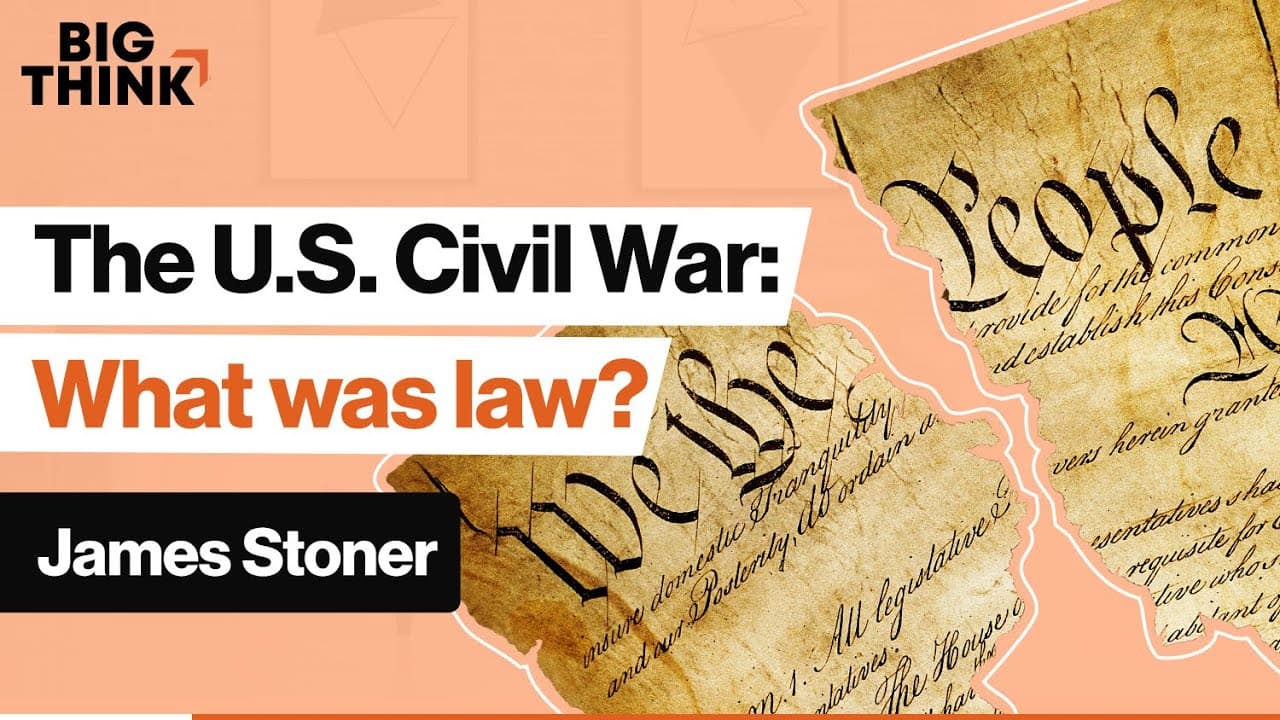
Lincoln’s law: How did the Civil War change the Constitution? | James Stoner | Big Think
TL;DR
The conflict between the rule of law and rule of men emerged in American history during crises like the Civil War and post-9/11 security threats.
Transcript
the United States Constitution is certainly dedicated to the rule of law John Adams famously said quoting Harrington who himself is quoting Aristotle or alluding to Aristotle that the United States aims to establish the rule of law not the rule of men and the Constitution lays out a number of rules about how government should act some of that is in... Read More
Key Insights
- 👮♂️ The US Constitution prioritizes the rule of law over the rule of men, guiding government actions and restrictions.
- 🔒 Crises like the Civil War and post-9/11 security threats tested the balance between civil liberties and national security.
- 🥺 Leaders like Abraham Lincoln faced challenges in interpreting the Constitution during crises, leading to decisions that set precedents for future governance.
Install to Summarize YouTube Videos and Get Transcripts
Explore YouTube Video Summarizer or Get YouTube Transcript Extractor
Questions & Answers
Q: How did Abraham Lincoln navigate the conflict between civil liberties and national security during the Civil War?
Lincoln suspended habeas corpus, imprisoned individuals without trial, and put wartime necessities above strict adherence to the rule of law to maintain the Union.
Q: What role did the US Constitution play in guiding government responses to crises like secession?
The lack of explicit provisions in the Constitution for secession or extraordinary circumstances forced leaders like Lincoln to interpret and apply the rule of law with flexibility.
Q: How did the post-9/11 security threats influence the balance between civil liberties and security measures in the US?
The Patriot Act introduced measures that blurred the line between security and civil liberties, sparking debates on the limits of government actions in times of crisis.
Summary & Key Takeaways
-
The US Constitution emphasizes the rule of law over the rule of men, outlining government actions and restrictions on institutions.
-
During the Civil War, Abraham Lincoln faced a conflict between upholding civil liberties and preserving the Union, leading to suspension of habeas corpus.
-
Post-9/11, the Patriot Act raised debates on balancing security needs with civil liberties, highlighting the delicate balance between the rule of law and government actions.
Read in Other Languages (beta)
Share This Summary 📚
Summarize YouTube Videos and Get Video Transcripts with 1-Click
Try YouTube Summary with ChatGPT & Claude or YouTube Transcript Generator
Explore More Summaries from Big Think 📚




Summarize YouTube Videos and Get Video Transcripts with 1-Click
Try YouTube Summary with ChatGPT & Claude or YouTube Transcript Generator