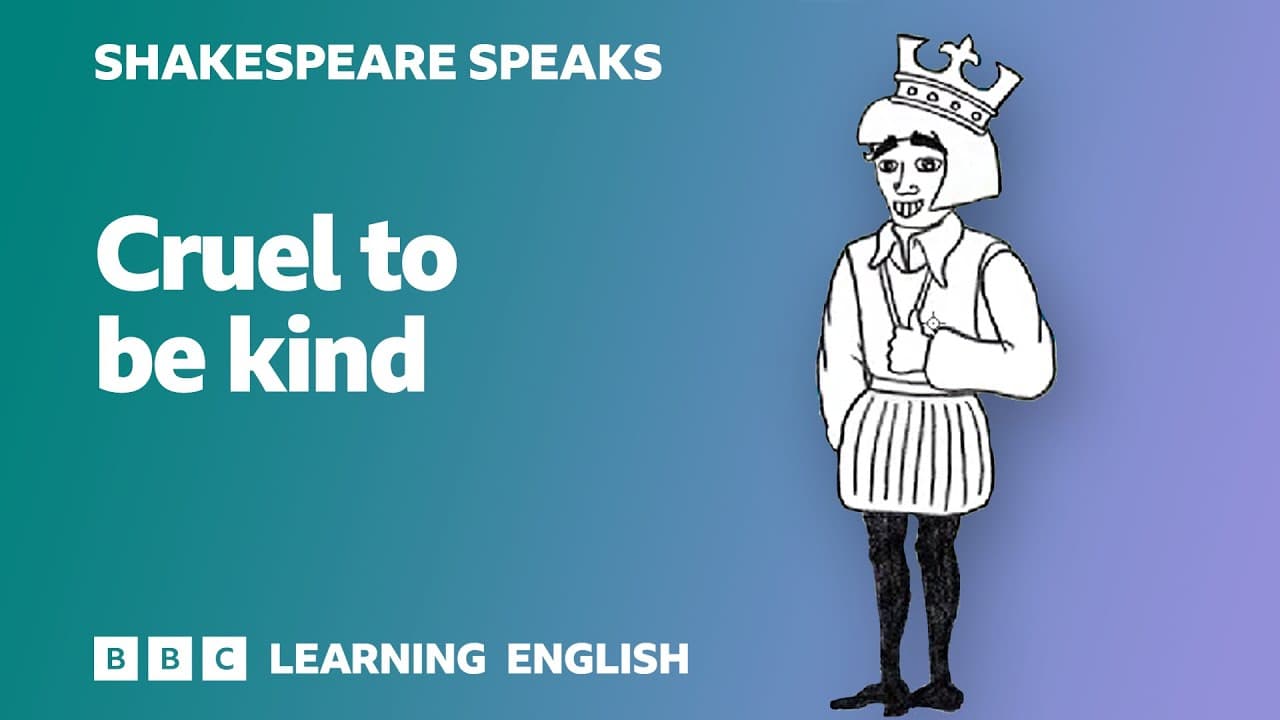
🎭 I must be cruel, only to be kind - Learn English vocabulary & idioms with 'Shakespeare Speaks'
TL;DR
Shakespeare uses 'cruel to be kind' to teach moral lessons.
Transcript
It was a windy November day. William Shakespeare is at the palace of King James I. He's having dinner with the King and Queen. Mr Shakespeare, have some more wine. What's this? Water? Where's my wine?! Now dear, you know you mustn't drink too much wine. The doctor says it's bad for your health! No wine?! Madam, you are very cruel to me. Don't you a... Read More
Key Insights
- The phrase 'cruel to be kind' originates from Shakespeare's play Hamlet, where Hamlet uses harsh words to guide his mother towards self-realization.
- Shakespeare's characters often embody complex emotions and moral dilemmas, making his works timeless and relevant to modern audiences.
- In the video, King James I interacts with Shakespeare, referencing Hamlet's advice to his mother, showcasing the phrase's application in real-life scenarios.
- The phrase 'cruel to be kind' suggests that sometimes harsh actions are necessary for a person's benefit, a concept explored through Hamlet's confrontation with his mother.
- Shakespeare's plays often include themes of revenge, morality, and the consequences of actions, as seen in Hamlet's struggle with his mother's remarriage.
- The video encourages viewers to reflect on situations where they might have been 'cruel to be kind,' highlighting the ethical complexities of such actions.
- Shakespeare's works are co-produced by BBC Learning English and The Open University, making his literature accessible for educational purposes.
- The video provides additional resources for teachers and learners, offering lesson plans and worksheets to explore Shakespeare's language and themes further.
Install to Summarize YouTube Videos and Get Transcripts
Explore YouTube Video Summarizer or Get YouTube Transcript Extractor
Questions & Answers
Q: What does 'cruel to be kind' mean in the context of Hamlet?
In Hamlet, 'cruel to be kind' refers to Hamlet's harsh words towards his mother, intended to make her realize the moral wrongness of her marriage to Claudius. He believes that by being cruel, he can guide her towards redemption, illustrating the complex nature of moral actions.
Q: How does the video illustrate the use of 'cruel to be kind' in real life?
The video illustrates the use of 'cruel to be kind' through a fictional dinner scene with King James I, where Shakespeare explains Hamlet's reasoning. This interaction shows how the phrase can apply to real-life situations where difficult actions are taken for someone's benefit.
Q: Why is Shakespeare's work still relevant today?
Shakespeare's work remains relevant due to its exploration of timeless themes such as morality, revenge, and human emotions. His characters often face complex dilemmas, making his plays relatable and thought-provoking for modern audiences, as demonstrated in the video through the discussion of Hamlet.
Q: What educational resources does the video offer?
The video offers educational resources such as a free lesson plan and worksheets available for download. These materials are designed to help teachers and learners explore Shakespeare's language and themes, making his literature accessible and engaging for educational purposes.
Q: How does the video encourage viewer engagement?
The video encourages viewer engagement by prompting questions about personal experiences with being 'cruel to be kind.' It invites viewers to reflect on ethical dilemmas and share their thoughts, fostering a deeper understanding of the phrase's implications in everyday life.
Q: What role does King James I play in the video?
In the video, King James I interacts with Shakespeare during a dinner scene, discussing the moral lesson from Hamlet. His character serves as an audience surrogate, questioning and engaging with the concept of 'cruel to be kind,' thereby illustrating its application in real-life scenarios.
Q: How does the video connect Shakespeare's language to modern English?
The video connects Shakespeare's language to modern English by explaining how phrases like 'cruel to be kind' have been shortened and adapted over time. It demonstrates the enduring impact of Shakespeare's expressions and their continued use in contemporary language, maintaining their original meaning.
Q: What themes from Hamlet are highlighted in the video?
The video highlights themes from Hamlet such as moral complexity, the consequences of actions, and the struggle with familial relationships. It focuses on Hamlet's confrontation with his mother and the ethical implications of his harsh words, emphasizing the enduring relevance of these themes.
Summary & Key Takeaways
-
The phrase 'cruel to be kind' from Shakespeare's Hamlet is explored in this educational video, illustrating its meaning and relevance. The video features a dinner scene with King James I and Shakespeare, discussing the moral implications of Hamlet's advice to his mother.
-
Shakespeare's works, known for their emotional depth and moral complexity, are made accessible through this co-production by BBC Learning English and The Open University. The video highlights how Shakespeare's language and themes continue to resonate today.
-
The video encourages viewers to consider the ethical dilemmas of being 'cruel to be kind,' prompting reflection on personal experiences. Resources for further learning, including lesson plans and worksheets, are provided to enhance understanding of Shakespeare's literature.
Read in Other Languages (beta)
Share This Summary 📚
Summarize YouTube Videos and Get Video Transcripts with 1-Click
Try YouTube Summary with ChatGPT & Claude or YouTube Transcript Generator
Explore More Summaries from BBC Learning English 📚
Summarize YouTube Videos and Get Video Transcripts with 1-Click
Try YouTube Summary with ChatGPT & Claude or YouTube Transcript Generator