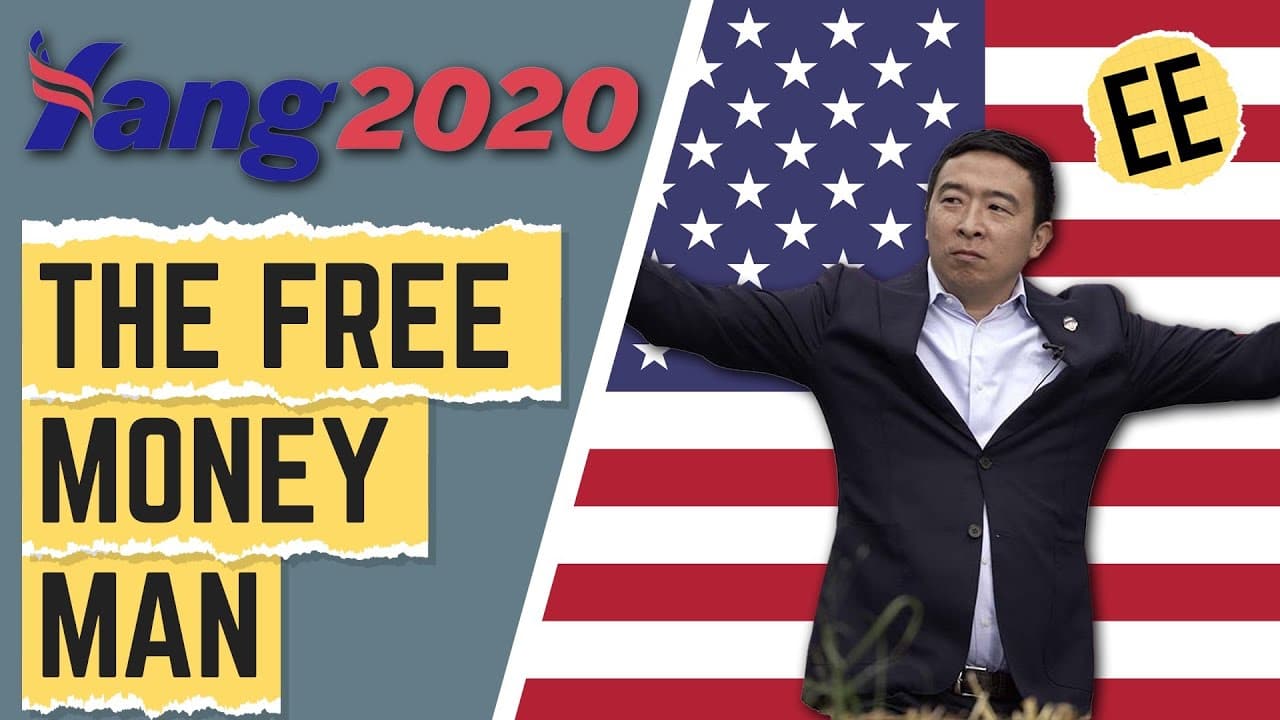
The Economics of Andrew Yang
TL;DR
Andrew Yang proposes unique economic policies, including Universal Basic Income.
Transcript
yeah ganks 20/20 yangyang 20/20 this is Andrew yang a tech entrepreneur and a bit of an underdog surprise Democratic candidate for president right off the back I want to stress that this channel avoids politics at all costs so I am not politically advocating for or against Andrew yang or any of the other candidates a plan to discuss between now and... Read More
Key Insights
- Andrew Yang is a tech entrepreneur and Democratic candidate with a detailed economic plan, focusing on unique policies like Universal Basic Income (UBI).
- Yang's UBI proposal, branded as the Freedom Dividend, offers $12,000 annually to every U.S. citizen over 18, regardless of employment status.
- To fund UBI, Yang suggests a 10% value-added tax on businesses and a 0.1% levy on financial transactions, targeting corporations like Amazon.
- Yang's policies aim to stimulate economic activity through the multiplier effect, where increased spending leads to more jobs and growth.
- Yang proposes a $100 government account for political donations to balance corporate lobbying power, enabling citizens to support candidates.
- His economic policies combine socialist elements with libertarian principles, emphasizing individual freedom in spending the UBI.
- Yang's approach has gained attention for bringing discussions about UBI into mainstream political discourse in the U.S.
- Despite being an underdog, Yang's innovative policies have sparked significant interest and debate among voters and economists.
Install to Summarize YouTube Videos and Get Transcripts
Explore YouTube Video Summarizer or Get YouTube Transcript Extractor
Questions & Answers
Q: What is Andrew Yang's most prominent economic policy?
Andrew Yang's most prominent economic policy is the Universal Basic Income (UBI), branded as the Freedom Dividend. It proposes providing every U.S. citizen over the age of 18 with $12,000 annually. The goal is to support citizens financially, regardless of their employment status, and stimulate economic activity.
Q: How does Andrew Yang plan to fund the Universal Basic Income?
Yang plans to fund the Universal Basic Income through several taxes, primarily targeting corporate America. This includes a 10% value-added tax on business transactions and a 0.1% levy on financial transactions. These taxes aim to collect revenue from large corporations like Amazon and high-frequency trading firms.
Q: What is the multiplier effect in Yang's economic policy?
The multiplier effect in Yang's policy refers to the economic principle that increased consumer spending leads to more job creation and economic growth. By providing citizens with additional income through UBI, Yang believes it will lead to more spending, benefiting businesses and generating a cycle of economic expansion.
Q: How does Yang's $100 political donation proposal work?
Yang proposes awarding every U.S. citizen a $100 government account for political donations. This initiative aims to counteract the influence of corporate lobbying by enabling citizens to financially support political candidates or parties of their choice, thus promoting a more balanced and democratic political process.
Q: Why are Yang's policies considered a mix of socialist and libertarian ideas?
Yang's policies are considered a mix because they incorporate socialist elements like government handouts through UBI, while also emphasizing libertarian principles of individual freedom. Citizens can choose how to spend their UBI, whether on personal needs or savings, allowing personal economic decision-making.
Q: What impact has Yang had on U.S. political discourse?
Yang has significantly impacted U.S. political discourse by bringing the concept of Universal Basic Income into the mainstream. His candidacy has sparked discussions about innovative economic policies and the future of work, challenging traditional political and economic norms in the U.S. political landscape.
Q: How does Yang's policy address corporate influence in politics?
Yang's policy addresses corporate influence by proposing a $100 donation account for citizens, empowering them to contribute to political campaigns. This initiative aims to level the playing field, allowing candidates with less corporate backing to compete effectively by relying on grassroots financial support.
Q: What challenges does Yang face as a presidential candidate?
As a presidential candidate, Yang faces challenges such as being an underdog compared to established politicians like Bernie Sanders and Joe Biden. Despite this, his innovative policies have garnered attention, but he must overcome skepticism and build broader support to compete effectively in the political arena.
Summary & Key Takeaways
-
Andrew Yang, a tech entrepreneur, is running for U.S. president with a focus on innovative economic policies like Universal Basic Income (UBI). His Freedom Dividend proposes giving $12,000 annually to every U.S. citizen over 18, funded by taxes on corporations and financial transactions.
-
Yang's economic policies aim to stimulate spending and job creation through the multiplier effect. By providing citizens with additional income, he believes businesses will benefit from increased consumer spending, ultimately fostering economic growth.
-
Yang also seeks to balance corporate lobbying power by providing citizens with $100 for political donations. His policies blend socialist and libertarian elements, emphasizing individual freedom in spending UBI, and have brought UBI discussions into mainstream U.S. politics.
Read in Other Languages (beta)
Share This Summary 📚
Summarize YouTube Videos and Get Video Transcripts with 1-Click
Try YouTube Summary with ChatGPT & Claude or YouTube Transcript Generator
Explore More Summaries from Economics Explained 📚
Summarize YouTube Videos and Get Video Transcripts with 1-Click
Try YouTube Summary with ChatGPT & Claude or YouTube Transcript Generator