Momentum Contrastive Learning
TL;DR
Momentum contrastive learning improves representation learning efficiency and accuracy by dynamically updating key representations.
Transcript
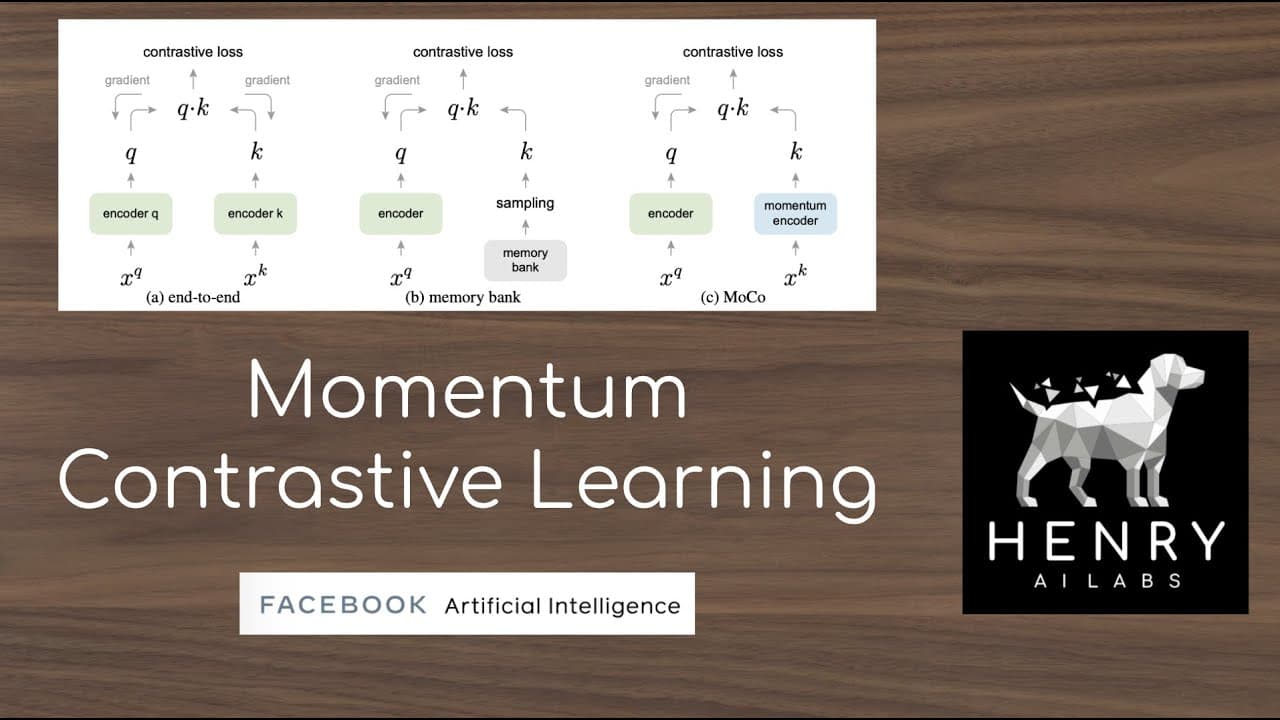
this video will explain momentum contrastive learning from researchers at Facebook AI contrastive learning is about forming representations that help distinguish one object from another such as being able to distinguish a lion from a bottle of water momentum contrast views this problem as a dictionary problem to match a query with its positive key ... Read More
Key Insights
- 🤩 Momentum contrastive learning streamlines self-supervised representation building by dynamically evolving key encodings, enhancing memory efficiency.
- 👻 The method’s queue system allows for effective extraction and utilization of dynamically updated data representations to maintain learning accuracy.
- 💻 Incorporating innovations from the SimCLR framework significantly boosts momentum contrast’s performance on various computer vision tasks.
- 🔠 This approach has been instrumental in advancing reinforcement learning, especially in scenarios using pixel-only inputs, providing simpler input mechanisms.
- ❣️ Self-supervised learning is bolstered by the ability to leverage unlabeled datasets, fostering efficient model training without heavy reliance on labeled data.
- 👻 Dynamic targets during training facilitate adaptation and stability, allowing networks to adjust as representations evolve throughout learning.
- 🏦 Momentum contrast significantly outperforms traditional memory bank methods by avoiding issues with outdated representations and enabling larger batch sizes.
Install to Summarize YouTube Videos and Get Transcripts
Explore YouTube Video Summarizer or Get YouTube Transcript Extractor
Questions & Answers
Q: What is momentum contrastive learning?
Momentum contrastive learning is a method developed by Facebook AI that enhances self-supervised representation learning. It works by dynamically updating key encodings in a more memory-efficient manner compared to traditional end-to-end learning, leading to more accurate object distinction without requiring massive labeled datasets.
Q: How does the queue system function in momentum contrast?
The queue system operates on a last-in, first-out basis, where new image encodings are added at the front and older encodings are pushed out. This approach allows for the use of a large and dynamically updated set of representations, improving the efficiency of contrastive learning by sampling the most relevant data.
Q: What advantages does momentum contrast offer over traditional end-to-end learning?
Momentum contrast avoids memory inefficiencies by requiring only gradients from the query encoder, not the key encoder, which minimizes resource consumption. This leads to faster training times, the ability to handle larger batch sizes, and better performance due to more consistent representations that evolve with the training process.
Q: How has momentum contrastive learning impacted reinforcement learning?
It has allowed for successful implementation of reinforcement learning tasks using only pixel inputs, without the need for physical state data. This approach simplifies the learning process for models controlling robots, significantly reducing the complexity of input requirements while still achieving effective outcomes.
Q: What improvements have been achieved with the integration of the SimCLR framework?
The integration of techniques from SimCLR, such as larger batch sizes, multi-layer perceptron projection heads, and stronger data augmentations, has improved momentum contrast execution, leading to better performance in unsupervised learning tasks, including achieving notable accuracy rates on benchmarks like ImageNet.
Q: Why is self-supervised learning important in computer vision?
Self-supervised learning allows researchers to utilize vast amounts of unlabeled data, which is easier to collect than labeled data. This paradigm helps create robust models by constructing supervised tasks automatically, leading to effective learning without extensive manual annotation.
Q: What role do dynamic targets play in momentum contrast learning?
Dynamic targets in momentum contrast learning adjust as training progresses. Unlike fixed labels in supervised learning, this method allows the queries and keys to evolve together, potentially improving model flexibility and reducing the risk of overfitting by avoiding local optima during training.
Q: How does momentum contrast compare to methods using memory banks?
Unlike memory bank approaches that hold outdated representations, momentum contrast updates key encoder weights gradually and in real-time. This method ensures that the representations remain consistent and relevant throughout the training process, thus improving the learning efficacy.
Summary & Key Takeaways
-
The video discusses momentum contrastive learning, a method that optimizes self-supervised representation learning by distinguishing objects efficiently using dynamic key encodings.
-
It details how momentum contrast leverages a queue system for shared key representations, avoiding memory inefficiencies associated with traditional end-to-end learning approaches.
-
The framework shows significant improvements in unsupervised learning tasks, achieving high accuracy on benchmarks such as ImageNet, while enabling advances in reinforcement learning applications.
Read in Other Languages (beta)
Share This Summary 📚
Summarize YouTube Videos and Get Video Transcripts with 1-Click
Try YouTube Summary with ChatGPT & Claude or YouTube Transcript Generator
Explore More Summaries from Connor Shorten 📚
Summarize YouTube Videos and Get Video Transcripts with 1-Click
Try YouTube Summary with ChatGPT & Claude or YouTube Transcript Generator