Strain Gauge | Passive Transducers | Electrical Instruments ( EIM ) | Lec - 63
TL;DR
This video explains strain gauges, their types, functions, and applications in measuring resistance changes due to mechanical strain.
Transcript
hi everyone in this video I'm going to explain about completely strain gauges so what do you mean by strain gauge what are the different types of strain gauges we have how they are working I will tell everything so strain gauge is nothing but the strain gaze is a passive resistive netork passive resistive transer which converts mechanical elong elo... Read More
Key Insights
- 🦾 Strain gauges convert mechanical deformation into electrical signals, making them vital in stress analysis and applications across engineering fields.
- 🥺 The application of force to a strain gauge leads to changes in dimensions, directly impacting resistance as per the principles of electrical conductivity.
- ⚾ The classification of strain gauges into metallic and semiconductor types reflects their differentiated usage based on precision and application requirements.
- 👻 Utilizing Wheatstone bridges with strain gauges allows engineers to create sensitive measurements of strain, critical in ensuring structural integrity.
- ♻️ Bounded strain gauges provide stable measurements when affixed to surfaces, while unbounded types are versatile for measuring forces in dynamic environments.
- ❓ Calibration is crucial for strain gauges, as environmental conditions can significantly influence their readings, necessitating compensatory adjustments for accuracy.
- 👻 Various strain gauge designs, including rosette types, allow for multi-directional strain measurements, enhancing the versatility of applications.
Install to Summarize YouTube Videos and Get Transcripts
Explore YouTube Video Summarizer or Get YouTube Transcript Extractor
Questions & Answers
Q: What is the main function of a strain gauge?
The main function of a strain gauge is to measure mechanical strain by converting physical changes, like elongation or compression, into a change in electrical resistance. When a strain gauge experiences pressure, its physical dimensions change, altering its resistance, which can then be measured and quantified.
Q: How do metallic and semiconductor strain gauges differ?
Metallic strain gauges are commonly used in various applications due to their durability and ease of use, whereas semiconductor strain gauges offer higher sensitivity and are typically used in precision applications. The choice between the two often depends on the specific measurement requirements and environmental conditions.
Q: Can you explain how a Wheatstone bridge is used with strain gauges?
A Wheatstone bridge is a circuit used to measure unknown resistance by balancing two legs of a bridge circuit. In the context of strain gauges, one leg contains the strain gauge, allowing resistance changes due to applied pressure to create an imbalance, which results in a measurable voltage, indicating the amount of strain.
Q: What are bounded and unbounded strain gauges?
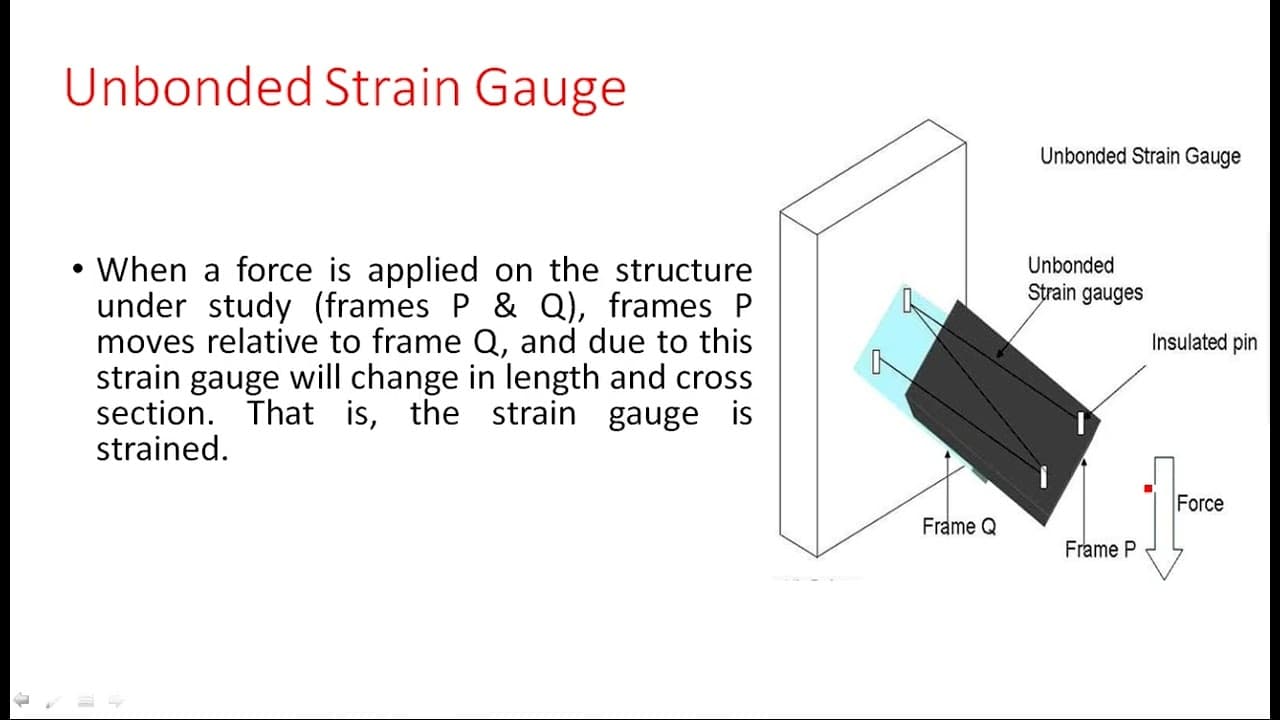
Bounded strain gauges are affixed to a surface, ensuring a direct transfer of strain, while unbounded strain gauges are not fixed and can vary slightly in position, making them suitable for measuring strains in moving structures. Their application depends on the necessity for precision and stability in measurements.
Q: What are some specific applications of strain gauges in real-world scenarios?
Strain gauges are widely used in engineering to monitor the integrity of structures like bridges and railway tracks, assess electrical components under mechanical stress, and in automotive engineering to evaluate components subjected to various forces. They are critical for safety and performance analysis.
Q: How do environmental factors influence strain gauge performance?
Strain gauge performance can be affected by temperature fluctuations, humidity, and mechanical conditions, which may alter their resistance readings and consequently require careful calibration and compensation techniques in order to achieve accurate measurements across varying environmental conditions.
Summary & Key Takeaways
-
Strain gauges are passive resistive devices that convert mechanical pressure (elongation or compression) into changes in electrical resistance, allowing for precise measurements in various engineering applications.
-
They can be classified into metallic and semiconductor types, with further subcategories based on whether they are bounded or unbounded, impacting their functionality and application in stress measurement.
-
The video also details the use of the Wheatstone bridge to quantify the resistance change in strain gauges, illustrating how resistance variations correlate to applied forces.
Read in Other Languages (beta)
Share This Summary 📚
Summarize YouTube Videos and Get Video Transcripts with 1-Click
Try YouTube Summary with ChatGPT & Claude or YouTube Transcript Generator