Image segmentation with a U-Net-like architecture - Keras Code Examples
TL;DR
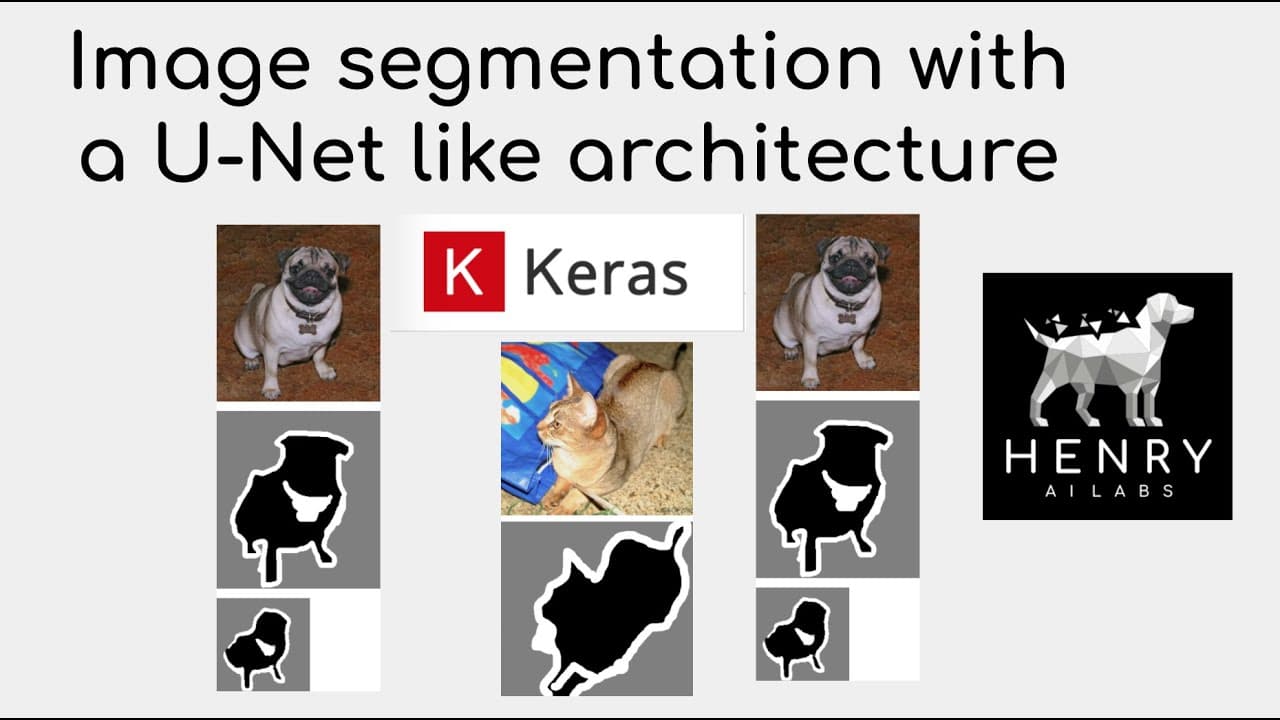
This video walks through Keras code examples for image segmentation using a U-Net architecture.
Transcript
welcome to the henry ai labs walkthrough of keras code examples keras has provided 56 code examples implementing popular ideas in deep learning this ranges from the basics such as simple mnist and imdb text classification all the way to cutting edge research ideas such as knowledge distillation supervised contrastive learning and transformers we'll... Read More
Key Insights
- 😥 Keras provides extensive code examples to help understand deep learning concepts, with image segmentation being a focal point in its offerings.
- 🥘 The U-Net architecture's unique design allows for effective image segmentation by preserving the spatial hierarchies of feature maps.
- 😷 Correct alignment of original images to their segmentation masks is critical in achieving accurate training outcomes in deep learning.
- 😒 Custom data loading via Keras sequences not only facilitates efficient memory use but also ensures that batches of data are loaded consistently during each training epoch.
- 💄 Utilizing data augmentation can significantly enhance model performance by making it more robust to variations in input data.
- 👋 Implementing model checkpoints is a best practice to safeguard against overfitting and ensures model integrity during training.
- 🚄 The choice between CPU and GPU can profoundly impact the efficiency and speed of training deep learning models.
Install to Summarize YouTube Videos and Get Transcripts
Explore YouTube Video Summarizer or Get YouTube Transcript Extractor
Questions & Answers
Q: What is the main purpose of the U-Net architecture in image segmentation?
The U-Net architecture is designed to effectively handle image segmentation tasks by utilizing a series of downsampling and upsampling layers. It compresses the spatial dimensions of an input image down to a lower resolution, captures semantic information, and then reconstructs the image back to its original size with preserved contextual features. This makes it particularly useful in tasks like medical imaging and autonomous vehicles.
Q: How does the video suggest preprocessing images for segmentation tasks?
The video emphasizes the necessity of aligning original images with their corresponding pixel annotations during preprocessing. It shows how to sort the images and annotations to ensure that each image is properly paired with its corresponding segmentation mask, which is critical for accurate model training and evaluation.
Q: Why is data augmentation mentioned in the video, and how can it help?
Data augmentation is referenced as a technique to improve the model's ability to generalize by artificially increasing the diversity of the training dataset. By applying various transformations (like flips, rotations, or color changes) to the training images, the model can learn more robust features and potentially reduce overfitting, which is especially crucial when validation loss does not decrease alongside training loss.
Q: What role does the Keras sequence class play in this image segmentation example?
The Keras sequence class is utilized to create a custom data loader that facilitates efficient batch loading and preprocessing of images and respective pixel maps during model training. It ensures that the model receives the right data format and manages memory effectively by loading batches rather than the entire dataset, enhancing the training process.
Q: How does the inclusion of checkpoints during training benefit model performance?
Implementing checkpoints during training allows for saving the model’s weights at various stages, particularly when it achieves the best performance on the validation set. This prevents the risk of losing progress due to overfitting or degradation in performance after several epochs, providing a reliable way to select the best-performing model for deployment or further testing.
Q: What significant difference is noted between running the model on CPU versus GPU?
The video highlights a dramatic difference in training time when moving from CPU to GPU. While training on a CPU took around 40 minutes for certain epochs, utilizing a GPU reduced this time dramatically to about 30 seconds. This illustrates the enhanced processing power of GPUs for complex computations required in deep learning tasks.
Summary & Key Takeaways
-
The video presents a detailed walkthrough of Keras code examples focused on image segmentation, specifically using a U-Net architecture. It explains how these models compress and expand image dimensions while preserving important features.
-
Viewers learn the importance of data preprocessing, including aligning images and annotations, and how to implement a custom data loader using Keras sequences for effective training of deep learning models.
-
The training process is demonstrated on both CPU and GPU, highlighting significant performance improvements on the GPU. The video concludes with model predictions and visualizations of segmentation results.
Read in Other Languages (beta)
Share This Summary 📚
Summarize YouTube Videos and Get Video Transcripts with 1-Click
Try YouTube Summary with ChatGPT & Claude or YouTube Transcript Generator
Explore More Summaries from Connor Shorten 📚
Summarize YouTube Videos and Get Video Transcripts with 1-Click
Try YouTube Summary with ChatGPT & Claude or YouTube Transcript Generator