Trees might not connect by fungal networks after all, two new studies say
TL;DR
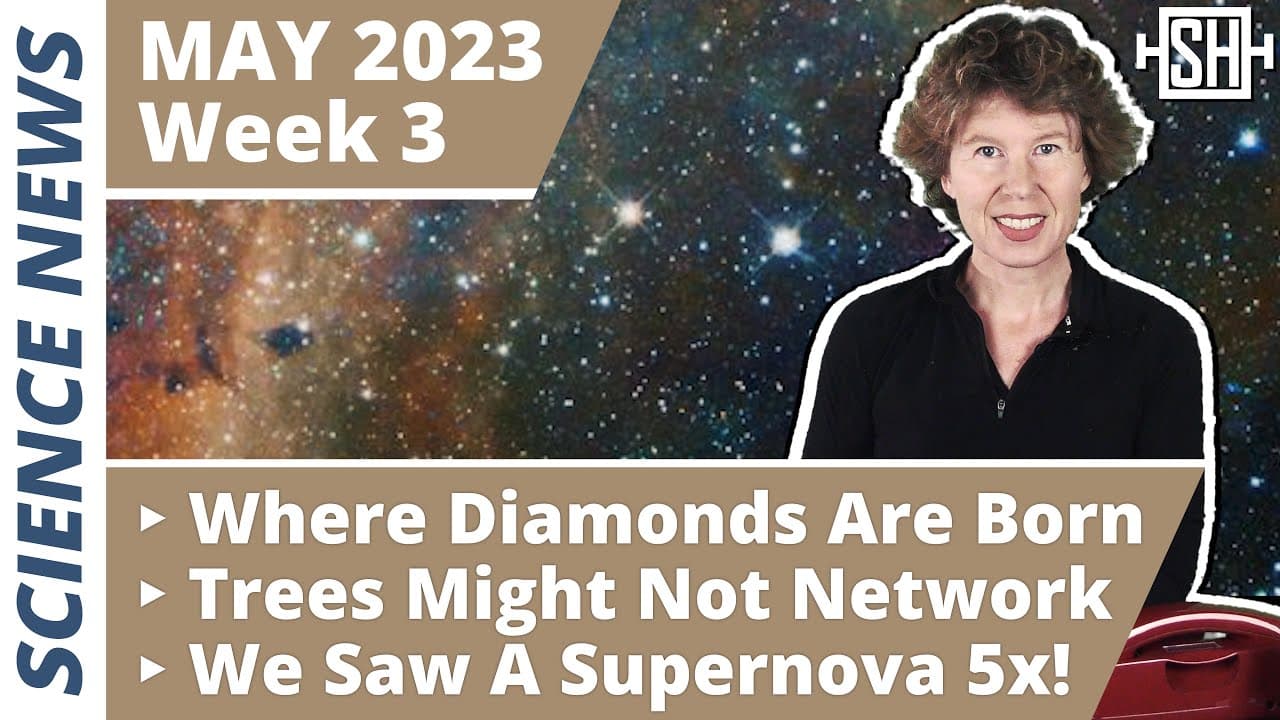
Physicists make progress in topological Quantum Computing; new study questions the evidence behind the mother tree theory; geophysicists propose a new theory to explain diamond birth; Caltech researchers improve microscopy with entangled light; astronomers discover new measurements in the Hubble tension; NASA funds a project to develop fluidic space telescopes; a study compares optical lenses for myopia prevention; SETI launches a new initiative to search for signs of alien life.
Transcript
foreign to this week's science news today we'll talk about Quantum Computing mother trees diamonds microscopy with entangled photons a supernova that we saw five times a telescope made of fluid better glasses a new alien search initiative and of course the telephone ring a group of German and American physicists together with the quantum Computing ... Read More
Key Insights
- 🇱🇧 Physicists have made significant progress in topological Quantum Computing by creating a physical simulation of non-abelions and observing their interactions.
- 🎄 The mother tree theory, while popularized in scientific and popular culture, is being questioned by researchers due to insufficient evidence and uncertainties about the importance and prevalence of fungal networks in tree communication.
- 👶 Geophysicists propose a new theory explaining diamond birth and their journey from deep underground to the Earth's surface through volcanic eruptions.
- ✈️ Quantum microscopy, utilizing entangled light particles, offers improved speed, precision, and noise reduction in imaging, potentially advancing various fields such as cancer research.
- 👶 Astronomers' new measurements in the Hubble tension contribute to the ongoing puzzle of cosmic expansion and highlight discrepancies between different measurement techniques.
- 🔭 NASA's funding of the fluidic space telescope project aims to develop telescopes using liquid lenses, which could revolutionize astronomy with greater light collection capabilities.
- 🅰️ Certain types of optical lenses, such as dims and dot lenses, show promise in preventing myopia progression in children by providing better vision correction and improved sharpness and contrast.
Install to Summarize YouTube Videos and Get Transcripts
Explore YouTube Video Summarizer or Get YouTube Transcript Extractor
Questions & Answers
Q: What are non-abelions, and why are they significant in Quantum Computing?
Non-abelions are a type of quasi-particle that exists in two dimensions and exhibits topological properties. These quantum particles are of interest in Quantum Computing because their topological properties make them robust to noise, making them ideal for creating Quantum states.
Q: What is the mother tree theory, and what do researchers question about its validity?
The mother tree theory suggests that certain trees serve as central nodes that support and communicate with other trees through fungal networks. However, a new study questions the evidence supporting this theory, casting doubt on the importance and widespread occurrence of these fungal networks and their role in resource sharing.
Q: How do geophysicists explain the birth of diamonds and their journey to the Earth's surface?
Geophysicists propose a new theory suggesting that diamonds are formed deep underground and brought to the surface through volcanic eruptions of kimberlite, a specific type of volcanic rock. This theory is based on a 3D model of heat convection in the Earth's mantle, which shows that eruptions are fueled by pillars of heat connecting the mantle to the surface.
Q: How have Caltech researchers improved microscopy using entangled light?
Caltech researchers have developed Quantum microscopy, a technique that utilizes entangled light particles to achieve greater speed and precision in imaging. By reducing noise from stray light, Quantum microscopy provides clearer and sharper images, as demonstrated in the study's results.
Q: What is the Hubble tension, and how does a new measurement contribute to this phenomenon?
The Hubble tension refers to the discrepancy in measurements for the current rate of expansion of the universe. Astronomers have discovered new measurements utilizing gravitational lensing, which provide additional evidence for the Hubble tension and further complicate the understanding of cosmic expansion.
Q: How do fluidic telescopes differ from conventional telescopes, and what are their potential advantages?
Fluidic telescopes use liquid lenses instead of solid mirrors to collect and focus light. This approach allows for larger and more precise mirrors, potentially enabling telescopes to see further and with greater precision. Fluidic telescopes could revolutionize the field of astronomy with their increased light collection capabilities.
Q: What are dims and dot lenses, and how do they compare to standard lenses for myopia prevention?
Dims and dot lenses are two types of optical lenses that aim to slow down the progression of nearsightedness in children. A study comparing these lenses found that they were more effective at reducing myopia progression and provided greater sharpness and contrast at the peripheral retina compared to standard lenses.
Q: What is the purpose of SETI's new initiative, Cosmic?
SETI's Cosmic initiative aims to search for signs of alien life by analyzing radio telescope signals. By looking for technosignatures, which would indicate artificially created signals, SETI hopes to detect the presence of extraterrestrial intelligence and expand our understanding of the universe.
Key Insights:
- Physicists have made significant progress in topological Quantum Computing by creating a physical simulation of non-abelions and observing their interactions.
- The mother tree theory, while popularized in scientific and popular culture, is being questioned by researchers due to insufficient evidence and uncertainties about the importance and prevalence of fungal networks in tree communication.
- Geophysicists propose a new theory explaining diamond birth and their journey from deep underground to the Earth's surface through volcanic eruptions.
- Quantum microscopy, utilizing entangled light particles, offers improved speed, precision, and noise reduction in imaging, potentially advancing various fields such as cancer research.
- Astronomers' new measurements in the Hubble tension contribute to the ongoing puzzle of cosmic expansion and highlight discrepancies between different measurement techniques.
- NASA's funding of the fluidic space telescope project aims to develop telescopes using liquid lenses, which could revolutionize astronomy with greater light collection capabilities.
- Certain types of optical lenses, such as dims and dot lenses, show promise in preventing myopia progression in children by providing better vision correction and improved sharpness and contrast.
- SETI's Cosmic initiative leverages radio telescope signals to search for signs of alien life, focusing on technosignatures that may indicate the presence of extraterrestrial intelligence.
Summary & Key Takeaways
-
Physicists have made breakthroughs in topological Quantum Computing, creating a physical simulation of non-abelians and observing their interactions. This development has the potential to revolutionize Quantum Computing.
-
A new study raises doubts about the mother tree theory, which suggests that certain trees serve as central nodes in a network, connecting and supporting other trees through fungal networks. The evidence for this theory is questioned, casting doubt on its validity.
-
Geophysicists have proposed a new theory that explains how diamonds are formed deep underground and brought to the surface through volcanic eruptions. This discovery sheds light on the origin of diamonds and may have implications for mining and resource extraction.
-
Caltech researchers have improved the speed and precision of microscopy by using entangled light. This new technique, called Quantum microscopy, allows for more accurate imaging and could have applications in various fields, including cancer research.
-
Astronomers have uncovered new measurements in the Hubble tension, which refers to the discrepancy in measurements of the current rate of expansion of the universe. This finding adds to the puzzling nature of the Hubble tension and raises further questions about the nature of cosmic expansion.
-
NASA is funding a project to develop fluidic space telescopes, which could potentially revolutionize the field of astronomy. These telescopes would use liquid lenses instead of solid mirrors, allowing for greater light collection and precision.
-
A study compares different types of optical lenses for myopia prevention in children. The results show that certain lenses, such as dims and dot lenses, offer better vision correction and reduce the progression of nearsightedness more effectively than conventional lenses.
-
SETI has launched a new initiative to search for signs of alien life using radio telescope signals. This project, named Cosmic, aims to detect technosignatures in the received radio signals, potentially indicating the presence of extraterrestrial intelligence.
Read in Other Languages (beta)
Share This Summary 📚
Summarize YouTube Videos and Get Video Transcripts with 1-Click
Try YouTube Summary with ChatGPT & Claude or YouTube Transcript Generator
Explore More Summaries from Sabine Hossenfelder 📚






Summarize YouTube Videos and Get Video Transcripts with 1-Click
Try YouTube Summary with ChatGPT & Claude or YouTube Transcript Generator