Physics Light Part 19 (Question 2) Class 8 VIII
TL;DR
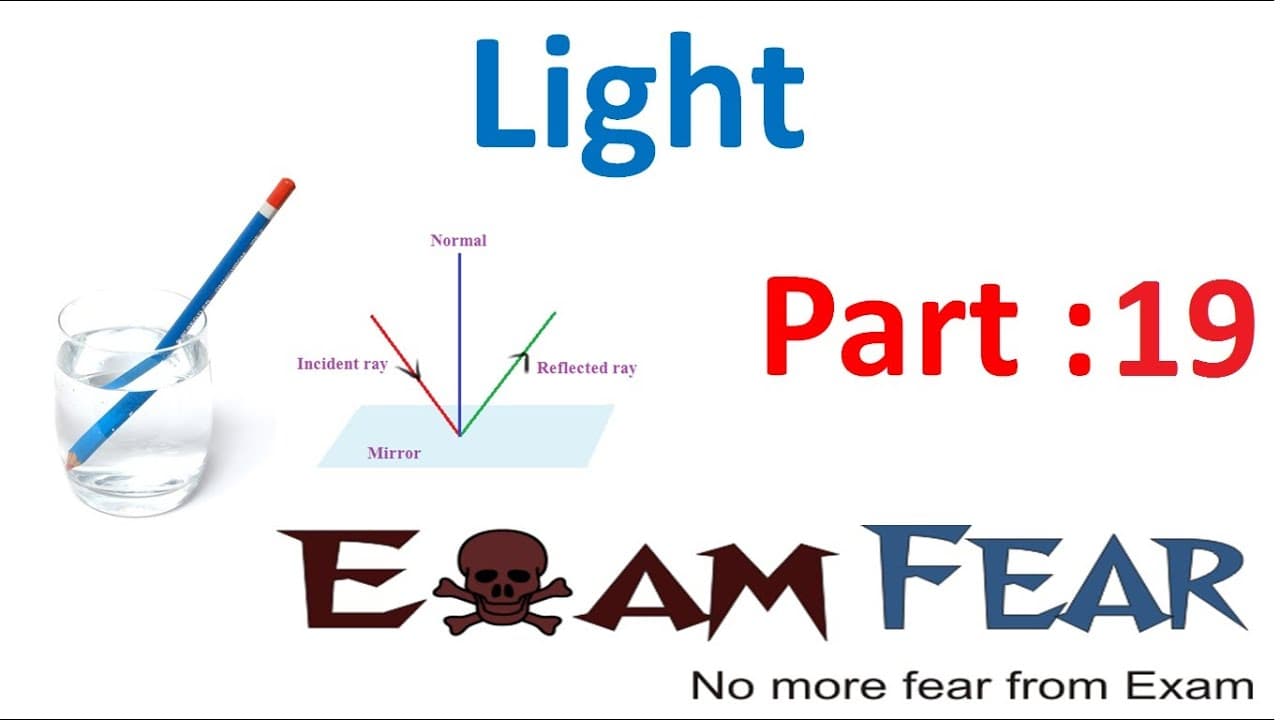
This video discusses reflection and image formation, covering topics such as the formation of virtual images, the angle of incidence, the number of images formed between parallel mirrors, and the laws of reflection.
Transcript
hello friends this video online part 19 is brought to you by example comm no more fear from exam question number 7 image formed by a plain middle is you have so many different options now playing mirror never produces real image so CIMB options are gone so it has to be virtual and where is the image form yes it has gone to behind the mirror because... Read More
Key Insights
- 🪩 Plain mirrors only form virtual images, which are located behind the mirror.
- 🔺 The law of reflection states that the angle of incidence is equal to the angle of reflection.
- 💁 The number of images formed between parallel mirrors is proportional to the angle of orientation between them.
Install to Summarize YouTube Videos and Get Transcripts
Explore YouTube Video Summarizer or Get YouTube Transcript Extractor
Questions & Answers
Q: How does a plain mirror form an image?
Plain mirrors form virtual images, which are located behind the mirror where light rays appear to diverge. The size of the image is the same as the size of the object.
Q: What is the angle of incidence if a reflected ray is at a 90-degree angle to the incident ray?
According to the law of reflection, the angle of incidence is equal to the angle of reflection. Since the reflected ray is at 90 degrees to the incident ray, the angle of incidence is determined to be 45 degrees.
Q: How many images are formed when a canvas is placed between two parallel plane mirrors?
The number of images formed does not depend on the distance of separation between the mirrors. As long as the mirrors are parallel, an infinite number of images will be formed.
Q: In the case of two mirrors meeting at right angles, how is the reflected ray determined?
The angle of incidence on the first mirror determines the angle of reflection. The reflected ray from the first mirror then becomes the incident ray for the second mirror, which reflects it at an angle equal to the angle of incidence.
Summary & Key Takeaways
-
The video explains that a plain mirror never produces a real image, only virtual images, which are formed behind the mirror.
-
The angle of incidence of a ray of light reflected at a 90-degree angle is determined to be 45 degrees using the law of reflection.
-
When two parallel plane mirrors are arranged facing each other, an infinite number of images can be formed, regardless of the distance of separation between the mirrors.
-
In the case of two mirrors meeting at right angles, a ray of light incident at 30 degrees on the first mirror is reflected at the same angle. The second mirror reflects the ray at an angle of 60 degrees.
Read in Other Languages (beta)
Share This Summary 📚
Summarize YouTube Videos and Get Video Transcripts with 1-Click
Try YouTube Summary with ChatGPT & Claude or YouTube Transcript Generator
Explore More Summaries from LearnoHub - Class 11, 12 📚





Summarize YouTube Videos and Get Video Transcripts with 1-Click
Try YouTube Summary with ChatGPT & Claude or YouTube Transcript Generator