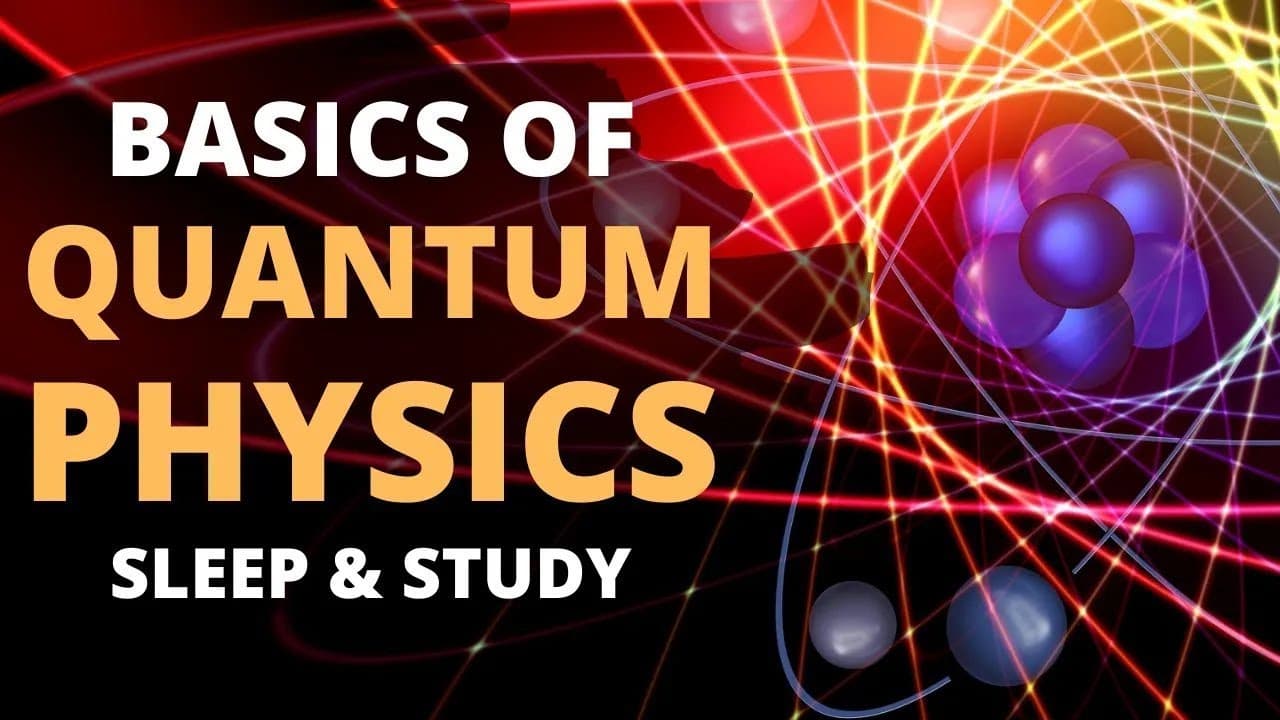
Fundamentals of Quantum Physics. Basics of Quantum Mechanics 🌚 Lecture for Sleep & Study
TL;DR
Lecture covers basics and necessity of quantum mechanics.
Transcript
sleep and study don't forget to subscribe welcome to quantum mechanics my name is brent carlson since this is the first lecture on quantum mechanics um we had to have some sort of an introduction and what i want to do to introduce quantum mechanics is to explain first of all why it's necessary and second of all to put it in historic... Read More
Key Insights
- Quantum mechanics emerged due to limitations in classical physics, particularly in explaining phenomena like black body radiation and the photoelectric effect.
- The historical context of the early 20th century saw scientists like Einstein and Planck developing quantum theories to address unexplained experiments.
- Quantum mechanics introduces concepts like wave functions and probability distributions, which differ significantly from classical deterministic views.
- The wave function, denoted as psi, is a complex function that provides probabilities rather than definite outcomes for the state of a system.
- Operators in quantum mechanics, such as the Hamiltonian, are key to connecting wave functions with observable quantities like energy and momentum.
- The Schrödinger equation is fundamental in quantum mechanics, describing how the quantum state of a physical system changes over time.
- Complex numbers are integral to quantum mechanics, requiring an understanding of their manipulation and geometric interpretation.
- Probability and uncertainty are central to quantum mechanics, with the variance and standard deviation quantifying the spread of probability distributions.
Install to Summarize YouTube Videos and Get Transcripts
Explore YouTube Video Summarizer or Get YouTube Transcript Extractor
Questions & Answers
Q: Why was quantum mechanics necessary?
Quantum mechanics was necessary because classical physics could not explain certain phenomena, such as black body radiation, the photoelectric effect, and atomic spectra. These phenomena indicated that the classical view of physics, which was deterministic and based on continuous variables, was incomplete. Quantum mechanics introduced a probabilistic framework that could accurately describe these and other microscopic phenomena.
Q: What is the significance of the wave function in quantum mechanics?
The wave function, represented by the Greek letter psi, is a fundamental concept in quantum mechanics. It is a complex function that encapsulates all the information about a quantum system. The square of its absolute value gives the probability distribution of finding a particle in a particular state or position. Thus, the wave function provides a probabilistic description of the system, rather than a deterministic one.
Q: How do operators function in quantum mechanics?
Operators in quantum mechanics are mathematical entities that act on wave functions to extract observable quantities. For example, the Hamiltonian operator is associated with the total energy of the system. When applied to a wave function, an operator can yield information about measurable properties, such as momentum or position. Operators are essential for translating the abstract wave function into physically meaningful results.
Q: What role do complex numbers play in quantum mechanics?
Complex numbers are crucial in quantum mechanics because they form the basis of wave functions. A wave function is a complex-valued function, meaning it has both real and imaginary components. The manipulation of these complex numbers is essential for calculations involving probabilities and observables. Understanding the geometric and algebraic properties of complex numbers is necessary for interpreting quantum mechanical phenomena.
Q: How does probability differ in quantum mechanics compared to classical mechanics?
In quantum mechanics, probability is intrinsic to the description of physical systems, unlike in classical mechanics, where systems are deterministic. The outcome of a quantum event is not certain but is described by a probability distribution derived from the wave function. This probabilistic nature means that even with complete information about a system, only the likelihood of different outcomes can be predicted, not the exact result.
Q: What is the Schrödinger equation and its importance?
The Schrödinger equation is a fundamental equation in quantum mechanics that describes how the quantum state of a physical system changes over time. It is analogous to Newton's laws in classical mechanics but applies to quantum systems. The equation provides a way to calculate the wave function of a system, which in turn gives the probability distribution of all possible outcomes. Solving the Schrödinger equation is essential for predicting the behavior of quantum systems.
Q: How is uncertainty quantified in quantum mechanics?
Uncertainty in quantum mechanics is quantified using the concepts of variance and standard deviation, which measure the spread of a probability distribution. The uncertainty principle, a key feature of quantum mechanics, states that certain pairs of physical properties, like position and momentum, cannot both be known to arbitrary precision. The variance provides a quantitative measure of this uncertainty, reflecting the inherent limitations in predicting quantum states.
Q: What is the historical significance of the development of quantum mechanics?
The development of quantum mechanics marked a major shift in the understanding of physical reality. It arose from the need to explain phenomena that classical physics could not, leading to a new framework that incorporated probability and uncertainty. Key figures like Max Planck and Albert Einstein made foundational contributions, and the theory has since become essential for describing the behavior of particles at microscopic scales, influencing technology and our understanding of the universe.
Summary & Key Takeaways
-
The lecture introduces quantum mechanics, explaining its necessity due to classical physics' inability to account for certain phenomena. Historical context and contributions from key figures like Einstein and Planck are discussed.
-
Key concepts of quantum mechanics, such as wave functions, operators, and the Schrödinger equation, are explained. These concepts highlight the shift from deterministic classical physics to probabilistic quantum mechanics.
-
Complex numbers and probability are crucial to understanding quantum mechanics. The lecture covers their roles in wave functions, probability distributions, and the calculation of uncertainty through variance and standard deviation.
Read in Other Languages (beta)
Share This Summary 📚
Summarize YouTube Videos and Get Video Transcripts with 1-Click
Try YouTube Summary with ChatGPT & Claude or YouTube Transcript Generator
Explore More Summaries from LECTURES FOR SLEEP & STUDY 📚
Summarize YouTube Videos and Get Video Transcripts with 1-Click
Try YouTube Summary with ChatGPT & Claude or YouTube Transcript Generator