How Is Pi Proven to Be an Irrational Number?
TL;DR
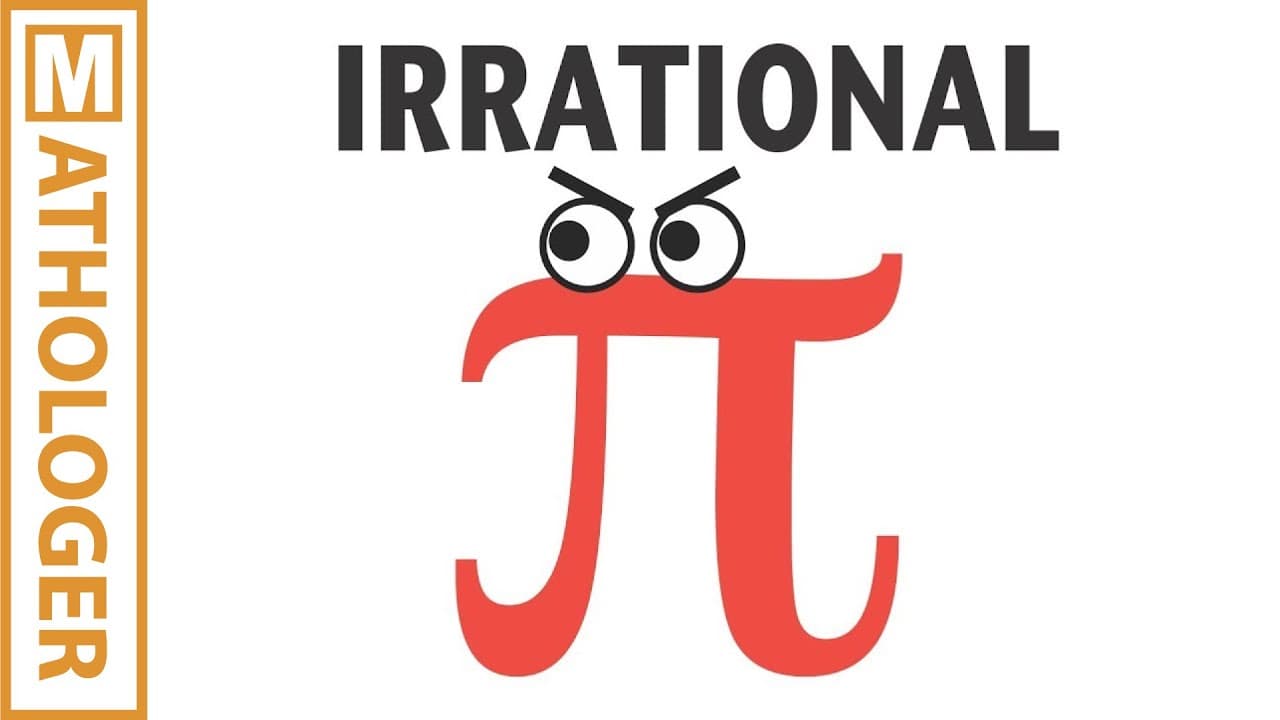
Pi is proven to be irrational through Johann Lambert's method, which involves showing that any rational input into his formula for tangent yields an irrational output. By demonstrating that tan(pi/4) equals 1, Lambert concludes that since pi/4 is irrational, pi itself must also be irrational.
Transcript
Welcome to the last Mathologer video of the year. Almost everybody who watches these videos knows that root 2, pi and e are irrational numbers, that these numbers cannot be written as ratios of integers. Also a lot of you will be familiar with proofs of these facts in the case of root 2 and e. On the other hand, my guess is that very few of you wil... Read More
Key Insights
- 🤨 Proofs of pi's irrationality are often technical and unintuitive, making Lambert's accessible proof valuable.
- 💦 Lambert's proof connects with Euler's work on infinite fractions and builds upon it.
- ❓ Assigning a value to the infinite fraction in Lambert's proof requires caution and justification.
Install to Summarize YouTube Videos and Get Transcripts
Explore YouTube Video Summarizer or Get YouTube Transcript Extractor
Questions & Answers
Q: Why do many mathematicians rely on others' proofs to believe that pi is irrational?
Most proofs of pi's irrationality are technical and unintuitive, making them inaccessible to many mathematicians. Lambert's proof offers a more visual and intuitive approach.
Q: What is the significance of proving the irrationality of log 3?
The proof of the irrationality of log 3 serves as a warm-up and demonstrates the simplicity of proving certain numbers are irrational.
Q: How does Lambert's proof connect to Euler's work?
Lambert builds upon Euler's use of infinite fractions and borrows ideas to derive a formula for the infinite fraction of tan x.
Q: What is the motivation for assigning a value to the infinite fraction in Lambert's proof?
By observing that the partial fractions of the infinite fraction converge to tan x, mathematicians are motivated to assign a value to the infinite fraction, although caution is required to ensure this is mathematically justified.
Q: What is the significance of Lambert's proof for other irrational numbers?
Lambert's proof demonstrates a general technique for proving the irrationality of numbers represented by infinite fractions, expanding the understanding of irrational numbers beyond simple infinite fractions.
Summary & Key Takeaways
-
Many people are familiar with the irrationality of root 2 and e, but not pi.
-
Lambert's proof of the irrationality of pi is unique and easier to understand.
-
Lambert's proof involves a three-step process: proving a formula for tangent, showing that rational inputs result in irrational outputs, and demonstrating that tan(pi/4) is equal to 1.
-
The proof involves manipulating an infinite fraction and showing that it cannot be a rational number.
Read in Other Languages (beta)
Share This Summary 📚
Summarize YouTube Videos and Get Video Transcripts with 1-Click
Try YouTube Summary with ChatGPT & Claude or YouTube Transcript Generator
Explore More Summaries from Mathologer 📚



Summarize YouTube Videos and Get Video Transcripts with 1-Click
Try YouTube Summary with ChatGPT & Claude or YouTube Transcript Generator