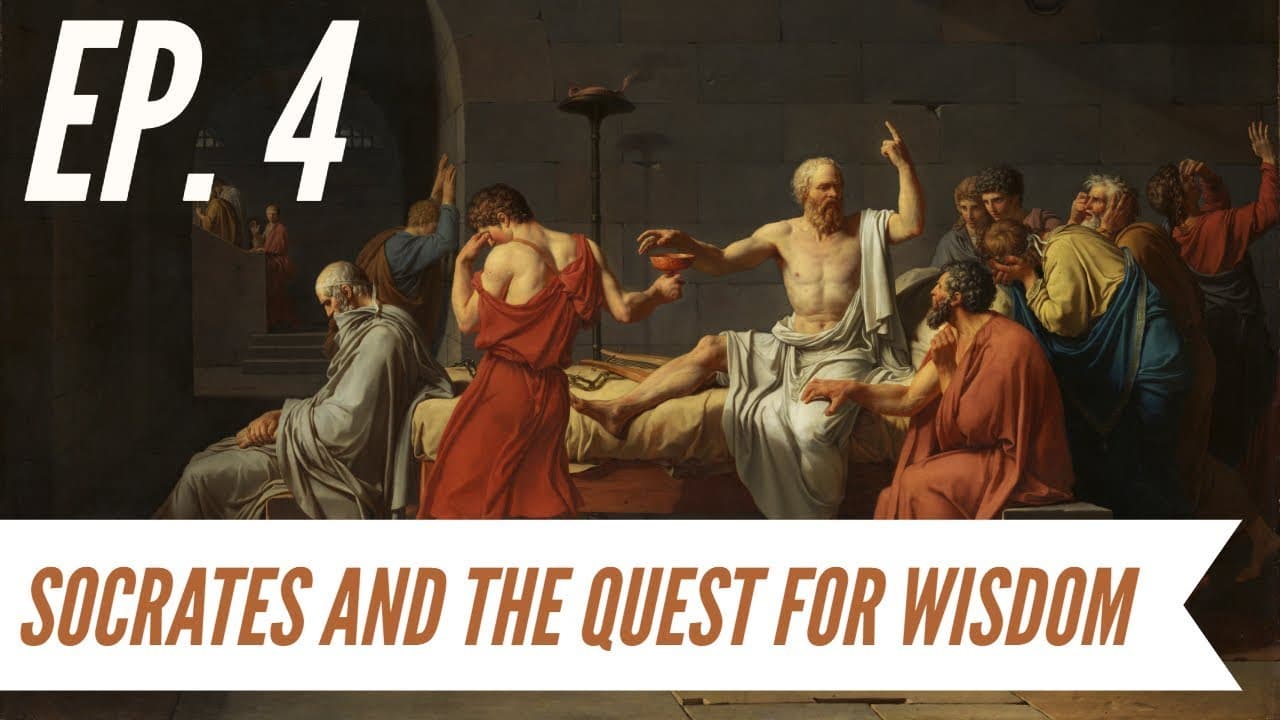
Ep. 4 - Awakening from the Meaning Crisis - Socrates and the Quest for Wisdom
TL;DR
Socrates challenges individuals to confront their capacity for self-deception and strive for wisdom in a world filled with misinformation.
Transcript
you welcome again to awakening from the meaning crisis this is episode four so last time we discussed the axial revolution and in particular how it moved into ancient Israel we talked about the advent of the psycho technology of time as cosmic history as a narrative and which there is an open future and in which your actions the moral quality of yo... Read More
Key Insights
- 🤳 Socrates challenges individuals to confront their capacity for self-deception and strive for wisdom through rational analysis and self-awareness.
- 🤳 He criticizes the natural philosophers for providing knowledge without facilitating self-transformation and the sophists for promoting relevance without truth.
- 🥊 Socrates emphasizes the interconnectedness of reason and love, arguing that both are necessary for a meaningful and authentic life.
- ❓ The pursuit of wisdom requires individuals to constantly examine their beliefs and align their actions with their values.
- 🤳 Socrates' teachings have had a profound impact on Western civilization and continue to inspire critical thinking and self-reflection.
- 🥇 His willingness to die for his philosophy highlights the importance he placed on the pursuit of truth and the examination of one's life.
Install to Summarize YouTube Videos and Get Transcripts
Explore YouTube Video Summarizer or Get YouTube Transcript Extractor
Questions & Answers
Q: How does Socrates differ from the natural philosophers and the sophists in his pursuit of wisdom?
Socrates criticizes the natural philosophers for providing factual knowledge without addressing the transformation of the self. He also challenges the sophists, who focus on relevance and rhetoric, by emphasizing the importance of truth and self-awareness in the pursuit of wisdom.
Q: What is the significance of Socrates' statement, "The unexamined life is not worth living"?
Socrates believes that a meaningful life requires constant self-examination and the pursuit of wisdom. Without introspection and self-awareness, individuals fall into self-deception and lead lives devoid of purpose.
Q: How does Socrates define wisdom?
Socrates defines wisdom as the ability to keep truth and relevance intertwined. It involves understanding what is truly important and pursuing knowledge that facilitates self-transformation.
Q: Why was Socrates willing to die for his philosophy?
Socrates considered the pursuit of wisdom and the examination of one's life to be of utmost importance. He believed that his philosophy was worth dying for, as it represented a meaningful and authentic existence.
Key Insights:
- Socrates challenges individuals to confront their capacity for self-deception and strive for wisdom through rational analysis and self-awareness.
- He criticizes the natural philosophers for providing knowledge without facilitating self-transformation and the sophists for promoting relevance without truth.
- Socrates emphasizes the interconnectedness of reason and love, arguing that both are necessary for a meaningful and authentic life.
- The pursuit of wisdom requires individuals to constantly examine their beliefs and align their actions with their values.
- Socrates' teachings have had a profound impact on Western civilization and continue to inspire critical thinking and self-reflection.
- His willingness to die for his philosophy highlights the importance he placed on the pursuit of truth and the examination of one's life.
- Socrates' legacy lives on in the works of his disciple, Plato, who further advances the axial revolution in ancient Greece.
Summary & Key Takeaways
-
Socrates engages in rational analysis to uncover the truth and challenges individuals to question their beliefs and pursue wisdom.
-
He criticizes the natural philosophers for providing knowledge without facilitating self-transformation and the sophists for promoting relevance without truth.
-
Socrates instills a sense of self-awareness and the importance of keeping truth and relevance intertwined in order to lead a meaningful life.
Read in Other Languages (beta)
Share This Summary 📚
Summarize YouTube Videos and Get Video Transcripts with 1-Click
Try YouTube Summary with ChatGPT & Claude or YouTube Transcript Generator
Explore More Summaries from John Vervaeke 📚



Summarize YouTube Videos and Get Video Transcripts with 1-Click
Try YouTube Summary with ChatGPT & Claude or YouTube Transcript Generator