What Are the Unique Properties and Uses of Lithium?
TL;DR
Lithium is the lightest metal with unique properties, such as floating on water and reacting differently with air and nitrogen. It has diverse applications, including treating bipolar disorder, contributing to thermonuclear bombs, and ongoing research into storing hydrogen for fuel cells, showcasing its significance in both medicine and energy sectors.
Transcript
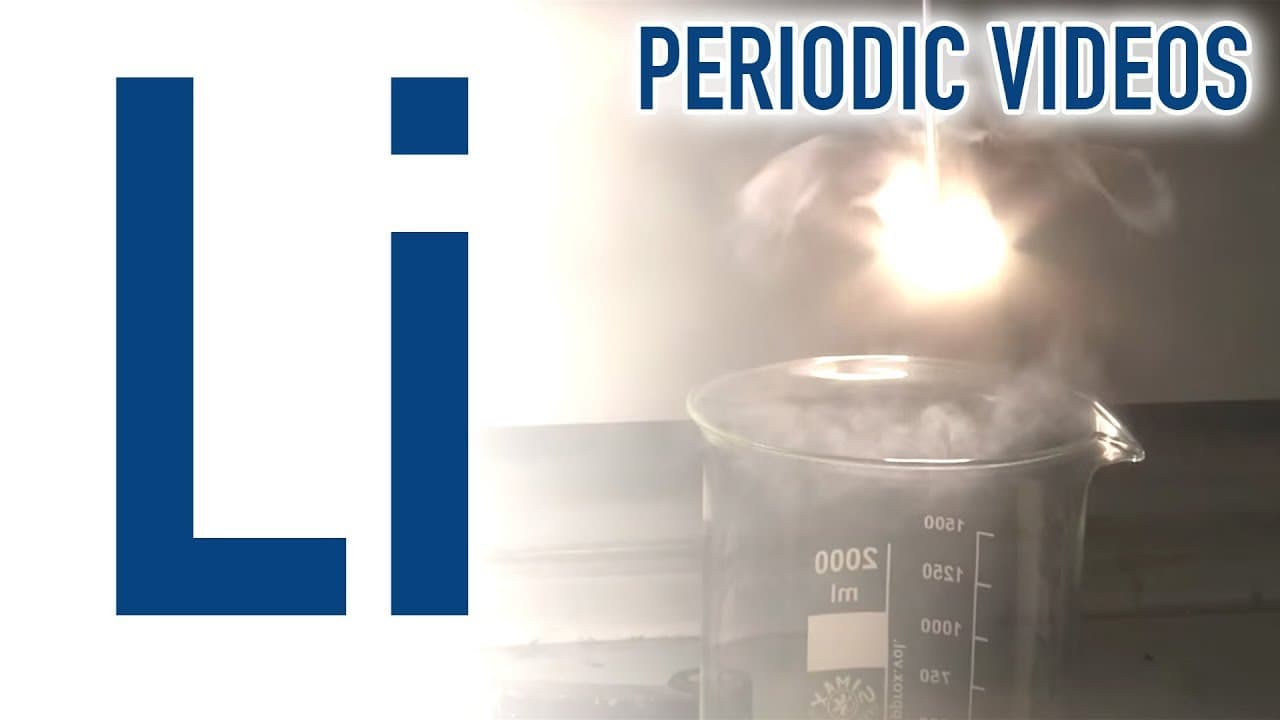
Lithium is the lightest metal. We all know that sodium is pretty light as a metal. If you drop it onto water and forget the reaction, it floats. You can see the orange sodium flame. Oh, It's on the camera. Of course, lithium will do the same, though, there are differences which I will show you in a minute. But what I wanted to see was whether we co... Read More
Key Insights
- 🙂 Lithium showcases unique properties like floating on water and being the lightest metal.
- 🈸 Its diverse applications range from medical treatments to military applications like hydrogen bombs.
- 😒 The potential use of lithium derivatives for hydrogen storage in fuel cells shows promise for renewable energy.
- 🫀 Understanding the reactions of lithium in different environments provides insights into its atomic and bonding properties.
- 😒 Historical uses of lithium, from Edison's battery experiments to thermonuclear bombs, highlight its versatility.
- 🧑⚕️ Lithium's contribution to multiple fields, from mental health treatment to energy storage, showcases its significance.
- 👨🔬 Research on lithium's applications highlights ongoing efforts to harness its properties for various technological advancements.
Install to Summarize YouTube Videos and Get Transcripts
Explore YouTube Video Summarizer or Get YouTube Transcript Extractor
Questions & Answers
Q: What unique reactions does lithium exhibit when dropped into water or burnt in air?
Lithium floats on water and reacts more slowly than sodium, producing a characteristic red flame. It burns brightly in air and continues glowing when plunged into nitrogen due to its tight bond formation.
Q: What historical and potential applications of lithium are discussed in the content?
The content discusses Edison's interest in lithium for batteries, its use in treating bipolar disorder, and its role in thermonuclear bombs. There's ongoing research on using lithium hydride for hydrogen storage in fuel cells.
Q: How does lithium play a significant role in thermonuclear bombs and what compound is crucial for their function?
Lithium deuteride (LiD) is essential in thermonuclear bombs as it undergoes fusion with deuterium to release massive energy. Neutrons trigger lithium atoms' conversion into tritium, which then fuses with deuterium.
Q: What historical test involving lithium deuteride in bombs is mentioned, and what were the consequences?
The Castle Bravo test in 1954 was a significant test involving lithium deuteride bombs, surpassing power calculations. However, it led to serious fallout and radiation exposure due to the bomb's unprecedented power.
Summary & Key Takeaways
-
Lithium is the lightest metal, showcasing unique reactions like floating on water and burning in air and nitrogen.
-
Its applications range from treating bipolar disorder to forming part of thermonuclear bombs.
-
Ongoing research explores the potential use of lithium and its derivatives in storing hydrogen for fuel cells.
Read in Other Languages (beta)
Share This Summary 📚
Summarize YouTube Videos and Get Video Transcripts with 1-Click
Try YouTube Summary with ChatGPT & Claude or YouTube Transcript Generator
Explore More Summaries from Periodic Videos 📚



Summarize YouTube Videos and Get Video Transcripts with 1-Click
Try YouTube Summary with ChatGPT & Claude or YouTube Transcript Generator