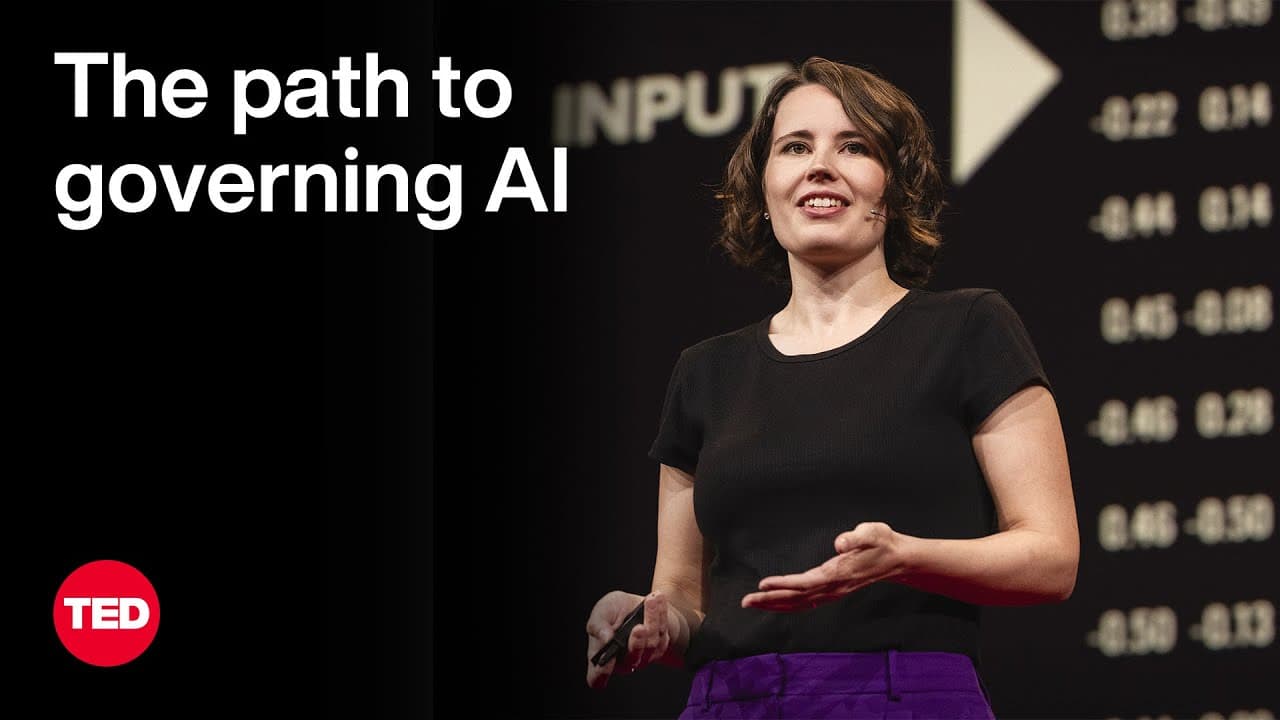
How to Govern AI — Even If It’s Hard to Predict | Helen Toner | TED
TL;DR
Artificial intelligence is difficult to understand and predict, but policies and measures can be implemented to govern its development and use.
Transcript
When I talk to people about artificial intelligence, something I hear a lot from non-experts is “I don’t understand AI.” But when I talk to experts, a funny thing happens. They say, “I don’t understand AI, and neither does anyone else.” This is a pretty strange state of affairs. Normally, the people building a new technology understand how it works... Read More
Key Insights
- 🖤 The lack of consensus on intelligence makes it challenging to define and develop AI systems.
- 🍽️ Deep neural networks pose challenges in understanding their inner workings due to their complex nature.
- 🖤 AI interpretability research offers promising solutions for unraveling the black box of deep neural networks.
- 🖐️ Non-experts have a role to play in shaping AI policies to ensure broad societal impact and fairness.
- 🔬 Effective AI governance requires a focus on adaptability, investing in measurement, transparency, and incident reporting mechanisms.
- ❓ Existing policies and measures are already being implemented in various regions to address AI governance challenges.
- ❓ AI's potential is vast and includes revolutionary advancements in energy, agriculture, and countless other domains.
Install to Summarize YouTube Videos and Get Transcripts
Explore YouTube Video Summarizer or Get YouTube Transcript Extractor
Questions & Answers
Q: Why is it difficult to understand and predict the capabilities of artificial intelligence?
The lack of agreement on what constitutes intelligence hinders the development and progress of AI systems, leading to uncertainty about their capabilities and future directions.
Q: How can we address the challenge of understanding AI systems?
Advances in AI interpretability research can shed light on the inner workings of AI systems, providing a clearer understanding of what the billions of numbers within deep neural networks are doing.
Q: Why should people who are not experts in AI have a role in shaping AI policies?
Just as with past technologies, it is crucial to involve the perspectives and voices of those affected by AI in policy-making. Expertise is valuable, but inclusive decision-making leads to more equitable outcomes.
Q: How can we govern AI effectively?
By focusing on adaptability rather than certainty, policymakers should invest in measuring AI capabilities, requiring transparency from AI companies, and establishing incident reporting mechanisms to address risks and ensure accountability.
Summary & Key Takeaways
-
Experts and non-experts alike struggle to fully understand artificial intelligence, posing challenges in predicting its future capabilities and impact.
-
The lack of consensus on what intelligence means hampers the development of AI systems and creates uncertainty about their potential.
-
The complexity of deep neural networks, the main type of AI, makes it difficult for experts to interpret and understand their inner workings.
Read in Other Languages (beta)
Share This Summary 📚
Summarize YouTube Videos and Get Video Transcripts with 1-Click
Try YouTube Summary with ChatGPT & Claude or YouTube Transcript Generator
Explore More Summaries from TED 📚



Summarize YouTube Videos and Get Video Transcripts with 1-Click
Try YouTube Summary with ChatGPT & Claude or YouTube Transcript Generator