Root locus | Construction rules | CS | Control Systems | Lec-59
TL;DR
The content explains the construction rules for root locus in control systems, focusing on symmetry and pole-zero relationships.
Transcript
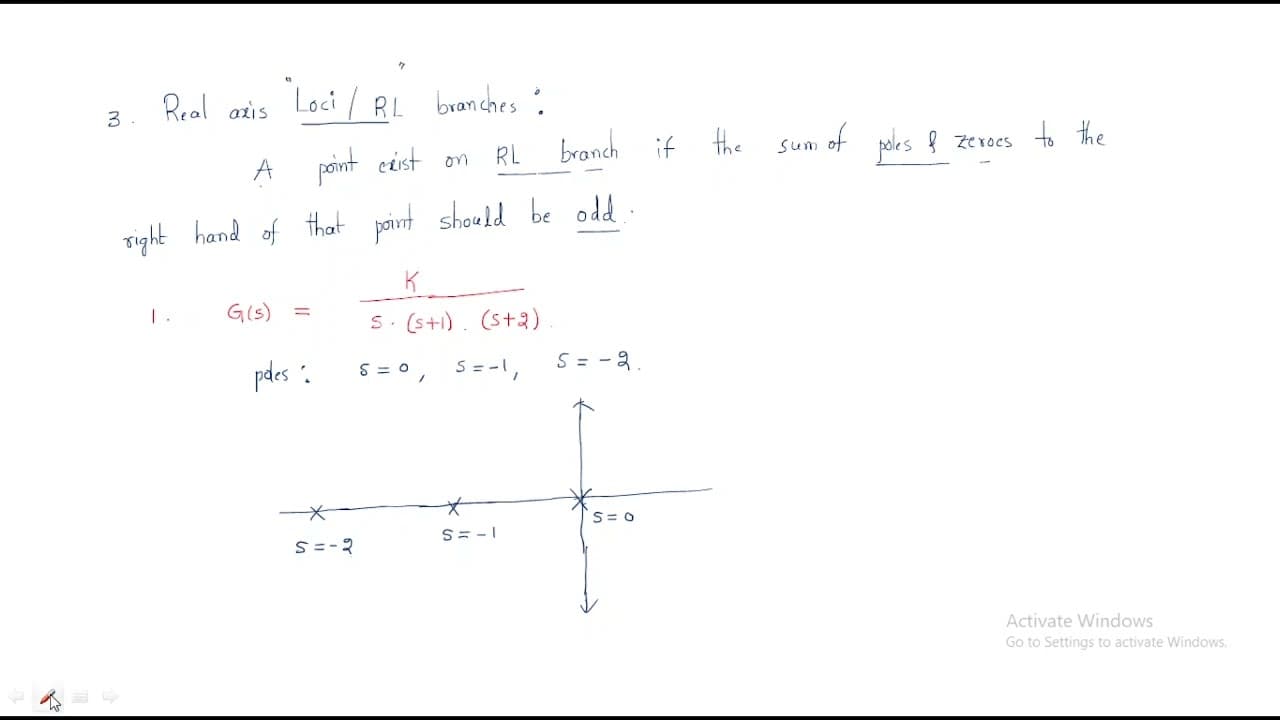
hello everyone in this session we will discuss some more points of the root locus so here we will discuss some rules of the construction source of the root locus so once again what is root locus which will give the path of the close loop pose close loopholes but we are using by this open loop transfer function open loop transfer function we are dis... Read More
Key Insights
- 😚 Root locus methods visualize the transition of closed-loop poles based on variations in system gain.
- 🫚 The symmetry of the root locus around the real axis is a fundamental property that simplifies analysis.
- 💈 The total number of path branches is determined by the maximum between poles and zeros.
- 🫚 Real axis root locus branches help identify stability regions in control systems.
- 🫚 The presence of poles and zeros dictates the behavior of the root locus significantly.
- 🫚 Understanding the fundamental theorem of root locus helps technicians predict system responses during changes in gain.
- 💈 The relationship between poles, zeros, and gain is pivotal for designing stable control systems.
Install to Summarize YouTube Videos and Get Transcripts
Explore YouTube Video Summarizer or Get YouTube Transcript Extractor
Questions & Answers
Q: What is the significance of the real axis symmetry in root locus diagrams?
The real axis symmetry is crucial because it determines the behavior of the closed-loop poles as gain changes. Since root locus paths are symmetric about this axis, analyzing only one side can often simplify the design and stability analysis of control systems.
Q: How do the number of poles and zeros affect the root locus branches?
The number of root locus branches is defined by the greater count between poles and zeros. If the poles exceed zeros, the branches correspond to the number of poles. Conversely, if zeros outnumber poles, the branches match the zeros, fundamentally influencing system stability and response.
Q: What does the existence of a root locus at a specific point indicate?
A root locus exists at a certain point if the sum of poles and zeros to the right of that point is odd. This odd count indicates a potential for closed-loop stability within the corresponding gain range, guiding control system designs.
Q: How are open-loop transfer functions structured for root locus analysis?
Open-loop transfer functions are typically structured as a function of k (gain) divided by a polynomial representing poles. This structure enables the analysis of varying gain and aids in understanding how the roots (closed-loop poles) shift in relation to gain adjustments during system design.
Summary & Key Takeaways
-
The root locus method visually represents the possible locations of closed-loop poles as a system's gain varies based on the open-loop transfer function.
-
Key characteristics include that root locus is always symmetric around the real axis, influenced by the number of poles and zeros in the system.
-
The number of root locus branches relates directly to the poles and zeros, where more poles than zeros indicate branches equivalent to the number of poles.
Read in Other Languages (beta)
Share This Summary 📚
Summarize YouTube Videos and Get Video Transcripts with 1-Click
Try YouTube Summary with ChatGPT & Claude or YouTube Transcript Generator