How Do Subsidies Affect Market Equilibrium?
TL;DR
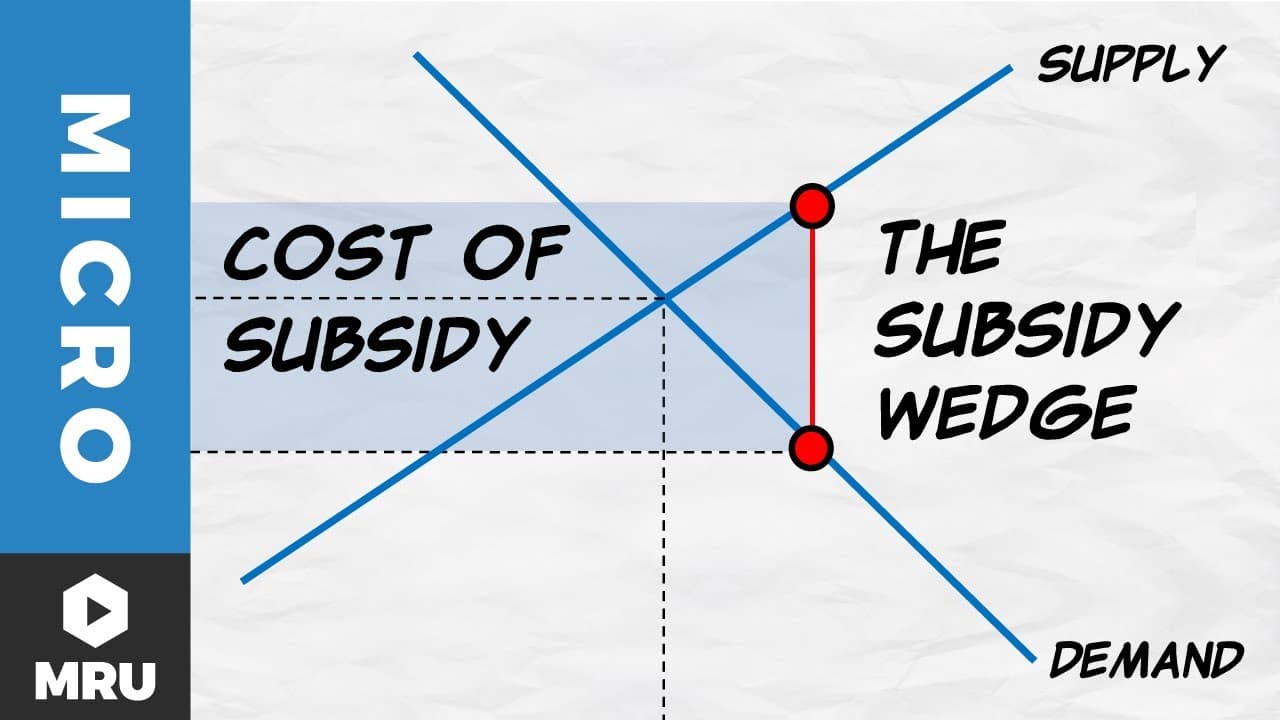
Subsidies act as a reverse tax, providing financial support to consumers or producers. They alter market prices by creating a wedge between the price paid by buyers and received by sellers, depending on the relative elasticities of demand and supply. This often results in deadweight loss due to inefficient trade increases.
Transcript
♪ [music] ♪ - [Prof. Alex Tabarrok] Today we're going to start looking at subsidies. We're going to move quite quickly because if you've understood the material on taxes, the material on subsidies should follow pretty easily. However, if you haven't understood the material on taxes, this is going to be even more mysterious. So make sure you underst... Read More
Key Insights
- A subsidy is a reverse tax where the government gives money instead of taking it.
- The economic incidence of a subsidy does not depend on who receives the government check.
- Subsidies create a wedge between the price paid by buyers and the price received by sellers.
- The benefit of a subsidy is influenced by the relative elasticities of supply and demand.
- Subsidies must be paid by taxpayers, creating costs rather than revenues for the government.
- Inefficient increases in trade due to subsidies result in deadweight loss.
- Inelastic supply or demand curves mean fewer entrants to capture subsidies, concentrating benefits.
- Political factors and special interest groups often drive the implementation of subsidies.
Install to Summarize YouTube Videos and Get Transcripts
Explore YouTube Video Summarizer or Get YouTube Transcript Extractor
Questions & Answers
Q: What is a subsidy in economics?
A subsidy in economics is a financial aid provided by the government to consumers or producers. It acts as a reverse tax, where instead of collecting money, the government gives money to lower the cost of goods and services. This intervention aims to encourage production and consumption, altering market prices and quantities.
Q: How does a subsidy affect market prices?
A subsidy affects market prices by creating a wedge between the price received by sellers and the price paid by buyers. This wedge increases the price sellers receive and decreases the price buyers pay, depending on the relative elasticities of demand and supply. The result is often an increase in the quantity traded, but it can also lead to inefficiencies.
Q: Who benefits from subsidies?
The benefits of subsidies depend on the relative elasticities of supply and demand. If supply is inelastic, suppliers gain more from the subsidy. Conversely, if demand is inelastic, consumers benefit more. The distribution of benefits is not determined by who receives the subsidy check, but by market dynamics and elasticity.
Q: What is the economic incidence of a subsidy?
The economic incidence of a subsidy refers to the actual distribution of benefits between consumers and producers, determined by the relative elasticities of demand and supply. It is separate from the legal incidence, which is who directly receives the subsidy payment from the government. Economic incidence is crucial for understanding who truly gains from subsidies.
Q: What is deadweight loss in the context of subsidies?
Deadweight loss in the context of subsidies occurs when the subsidy leads to an inefficient increase in trade. This happens when the cost of additional units supplied exceeds their value to consumers, resulting in wasteful expenditure. Subsidies can thus distort market equilibrium, leading to an overall loss in economic welfare.
Q: Why are subsidies often considered wasteful?
Subsidies are often considered wasteful because they can lead to deadweight loss by encouraging inefficient production and consumption. They may result in overproduction of goods that are not valued as highly by consumers, leading to resource misallocation. Additionally, subsidies are funded by taxpayers, adding to their economic cost.
Q: How do elasticities influence subsidy benefits?
Elasticities influence subsidy benefits by determining how much of the subsidy is captured by consumers versus producers. If supply is more inelastic than demand, producers capture more benefits, and vice versa. Elasticities affect how prices adjust to the subsidy, influencing the distribution of economic gains within the market.
Q: What role do politics play in subsidies?
Politics play a significant role in subsidies, as they are often driven by lobbying from special interest groups seeking financial advantages. These groups may influence policy to secure subsidies that benefit them, even if they result in economic inefficiencies. Political considerations can thus lead to the implementation of subsidies that do not align with optimal economic outcomes.
Summary & Key Takeaways
-
Subsidies function as reverse taxes, offering financial support to consumers or producers. They create a price wedge between buyers and sellers, influenced by demand and supply elasticities. This can lead to inefficient trade increases and deadweight loss, with taxpayers bearing the cost.
-
The economic impact of subsidies depends on market elasticity, not on who receives the subsidy check. Inelastic supply or demand curves limit entry, concentrating subsidy benefits among existing market participants.
-
Subsidies often result from political lobbying by special interest groups. While they can be wasteful, subsidies may also address market failures, such as when demand understates a good's true value, as seen in wage subsidies for low-skilled workers.
Read in Other Languages (beta)
Share This Summary 📚
Summarize YouTube Videos and Get Video Transcripts with 1-Click
Try YouTube Summary with ChatGPT & Claude or YouTube Transcript Generator
Explore More Summaries from Marginal Revolution University 📚

Summarize YouTube Videos and Get Video Transcripts with 1-Click
Try YouTube Summary with ChatGPT & Claude or YouTube Transcript Generator